
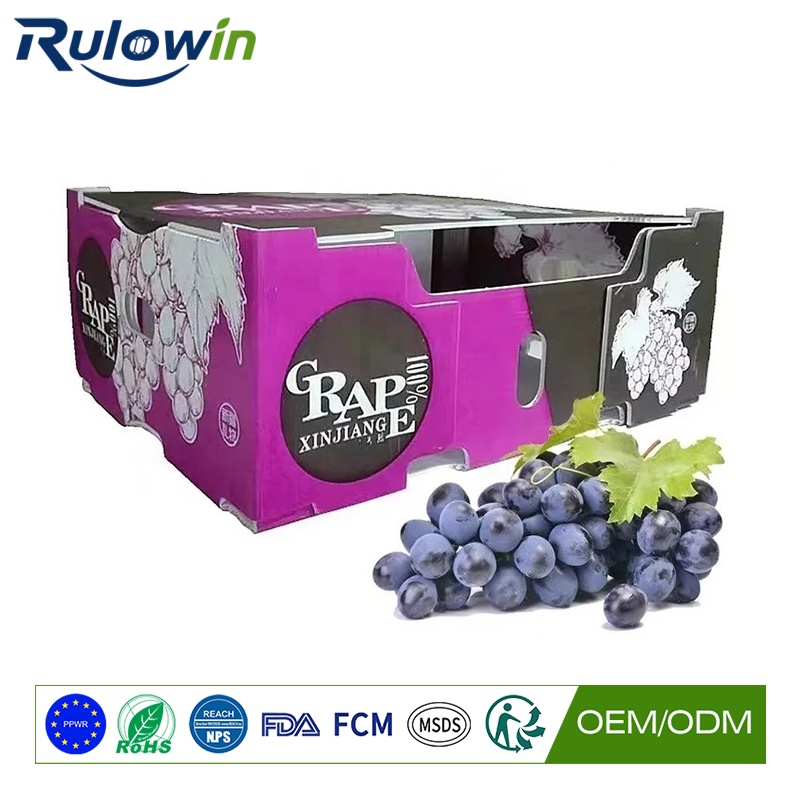
The comparison between reusable PP produce boxes and single-use corrugated cartons is usually presented by someone selling one of them. Here it is from a position where the answer depends more on your distribution than on the material.
Where cartons genuinely win
One-way, long-distance export. If the box is not coming back, a reusable box is just an expensive carton. This is the clearest case and it is not close.
Cushioning. Paperboard absorbs impact better than a rigid PP wall. For delicate fruit that bruises, a carton with a tray or a pad can protect better than a hard box.
Moisture buffering. Fibreboard takes up condensation and releases it. A plastic box does not, so water sits on the surface and can pool at the bottom.
Print and branding. High-quality print on paperboard is cheaper and better than printing on PP.
No return logistics. Nothing to track, collect, wash or store empty.
Where reusable boxes win
Cost per trip once the loop works. This is the whole argument and it is real, but it only applies if the boxes come back.
Wet strength. A carton that gets wet loses most of its stacking strength. A PP box does not care. For washed, iced or hydro-cooled produce this is decisive.
Consistent dimensions. Reusable boxes are the same every time, which matters for automated handling and for pallet efficiency.
Ventilation and drainage that survive the whole journey.
Waste handling cost, which is increasingly a line item rather than a free service.
The part that decides it
Return rate. Everything else is secondary. If you get ninety percent of your boxes back, the economics work comfortably. At fifty percent they get marginal. Below about a third, you are buying an expensive carton and paying to ship the empties home.
Which means the real question is not “reusable or not” but “can I build a return loop”. Short supply chains, direct to retail distribution centres, and any operation with its own transport backhaul usually can. Long export routes usually cannot.
Hybrid answers
A lot of operations end up with both: reusable boxes for the domestic or regional route where they come back, cartons for export. That is not a failure of commitment, it is the correct answer to two different problems.
What the buyer at the other end wants
Retail customers have opinions about packaging, and they are not always the ones you would expect. Some specify reusable packaging as a sustainability requirement. Others refuse it because their back-of-store handling is built around disposable cartons that get flattened and baled.
The second case is more common than the first, and it is the one that quietly kills reusable programmes. If the receiving end has no process for empties, no space to stack them and no vehicle to return them on, the boxes will be treated as waste regardless of what the contract says.
Before committing, ask the receiving site what happens to empties. It is a five-minute conversation and it usually determines whether a reusable programme is viable at all.
What we would ask you
How far does the box travel? Does your transport come back empty or loaded? Who pays for the empty leg? Do you have somewhere to store empties? Those four answers tell you more than any product datasheet. If they look favourable, we can build reusable produce boxes that will outlast a good number of cartons – and if they do not, we will say so.