
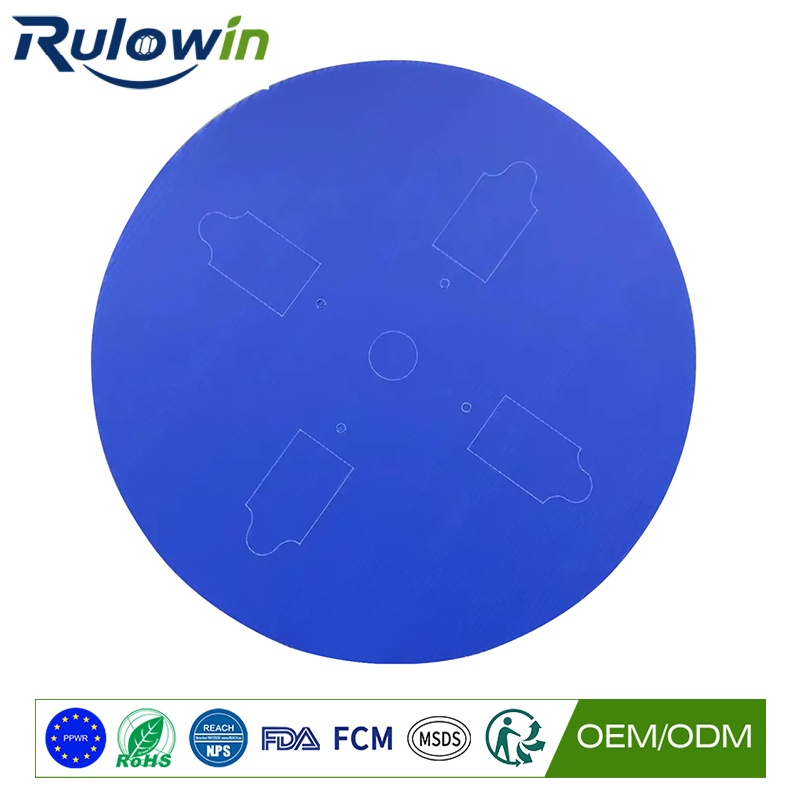
Holes to let water out and air in are common on returnable packaging, and usually regarded as unalloyed good. Mostly they are. But they interact with everything else about the flange in ways worth thinking through before specifying them, because unlike most design choices they are often added late and without much thought.
What they genuinely solve
Standing water. A spool stored outdoors on its flange can hold water. Water sitting in the spool adds weight, encourages biological growth, and transfers onto product. A drain path is a simple fix.
Washing. If spools get washed — and we have written separately about what cleaning actually works — water has to get back out. Without drainage, spools go into service wet, and moisture goes onto the product.
Collection during storage. Condensation in a shipping container is a real thing. Anything that lets moisture escape rather than pool helps.
Ventilation during drying. Air movement through the flange shortens drying considerably compared to a closed construction.
What they cost
Everything discussed about cut-outs generally — they remove material and create stress concentrations. Covered in our article on lightening holes and cut-outs. The specific issue for drain holes is that they usually need to be at the low point, and the low point of a flange when a spool rests on it is the rim or thereabouts.
That is mostly fine. It becomes a problem when:
- They intersect ribs or other reinforcement
- They are positioned near the hub, where stress is highest
- They let water into somewhere it should not go rather than out — a drain that admits water into the core is worse than no drain at all
- They are numerous enough that the cumulative effect is significant
The question nobody asks: which way is up?
A drain hole only drains if it is at the bottom. A spool stored on its flange has an obvious low point. A spool lying flat does not — and a spool rotated during handling changes its own low point several times.
In practice this means drainage works well for predictable storage orientation and poorly for everything else. If your spools are stored consistently, drain holes work. If they are tossed about, they help some of the time and you should think of them as one contribution rather than a solution.
What tends to work better
In rough service, we would generally recommend:
- Cover the spool rather than draining it. Keeping water off is more reliable than letting it out.
- Store under cover. The obvious answer that the outdoor yard economics usually rule out, but worth stating.
- Drain at the core rather than through the flange face, where any water that gets in has somewhere to go.
- Accept wet and dry before use. Sometimes the process answer is simpler than the design one.
When they definitely earn their place
- Spools that are washed routinely, where drying time is the bottleneck
- Outdoor storage with consistent orientation
- Clean applications where standing water is a contamination problem
- Applications where product is moisture sensitive and the spool is stored in humid conditions
What we suggest
Say what you are trying to achieve rather than specifying holes. “Spools need to dry within a few hours after washing” is a requirement we can design to; “put six 20 mm holes in each flange” is a guess at the answer, and it may or may not achieve anything.
On our hollow board spools, drainage is one of the options we set during design rather than after. And if your real problem is that spools are stored outdoors getting rained on, we will probably say so rather than adding holes and calling it solved.