
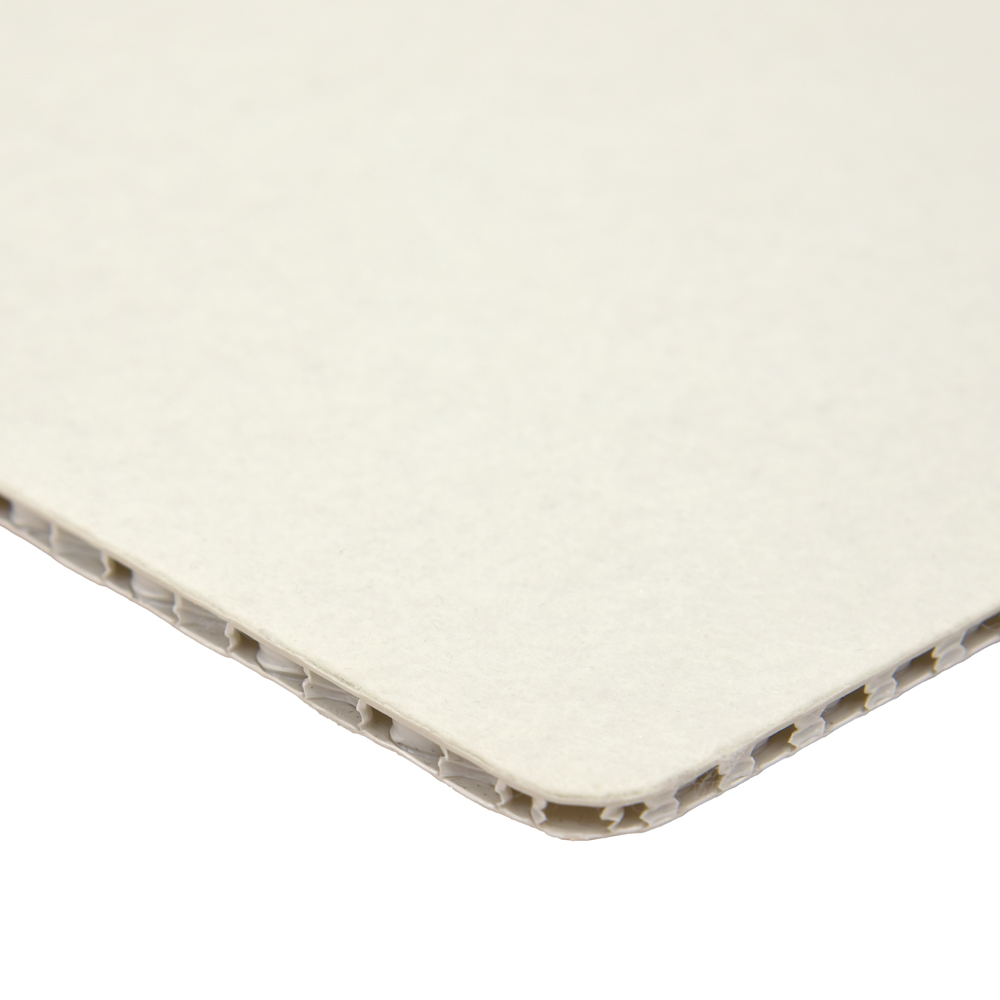
Choosing a honeycomb thickness for a layer pad is usually done by going one step up from whatever failed last time. That works, in the sense that it stops the failure, and it usually overshoots – because the two load cases that justify thickness are specific and easy to identify.
When thin is enough
A continuous deck – a pallet with full boards, or a solid surface – with a load spread across the pad. In that case the pad is not bending; it is just separating and spreading. A thin panel does this perfectly well, and it is lighter, cheaper and easier to handle.
Most layer pads in a warehouse fall into this category. The thickness that gets specified is frequently two steps more than the job requires, and the extra cost buys nothing measurable.
When you need thicker
Two cases. Spanning: the pad bridges a gap, between pallet boards or over a hollow in the load below. Deflection rises very steeply with span, so a small gap needs a disproportionately thicker pad.
Point loads: the thing on top rests on feet, or on a small footprint. The pad has to resist being locally crushed as well as bending, and thin panels crush.
Both are identifiable by looking at the pallet and the product. Neither requires a calculation to spot – the calculation is only for sizing once you know you have one of them.
The middle case, which is the common one
A partly supported pad – a load that is mostly spread but has some concentrated elements, on a deck with a couple of gaps. This is most real applications, and it is where the honest answer is “one step up from the thinnest, and test it”.
Testing is cheap. Load a pad to your working load, leave it for a week in the conditions it will see, and look at it. If it has not crushed or deflected visibly, the thickness is right.
Weight and handling, which argue for thin
Pads get handled by whoever builds the pallet. A thinner pad is lighter, easier to place, and less likely to be dropped. On a line where hundreds of pads are handled a day, that is worth something and it is rarely in the specification.
There is also freight. Thicker panels mean fewer per container, which raises landed cost per pad – the effect we described in how many honeycomb panels fit in a container. Going up a thickness step can cost more in freight than in material.
And the case for going thicker than calculated
Where failure is expensive. If a pad failure means a pallet of product is damaged, the cost of one failure dwarfs the saving on a thousand pads. In that situation, over-specify and stop thinking about it.
Work the number – cost of one claim against the price difference across the pads on a pallet. On most export work it is not close.
A note on mixing thicknesses
Two thicknesses in one operation cause confusion if they look the same. Panels of different thickness that are visually identical will end up in the wrong place, and a thin pad where a thick one was needed fails.
Either colour-code them or keep them in clearly separate storage. It is a small administrative detail and it is the difference between a two-thickness system working and causing a failure that looks random.
If your operation will not reliably separate them, use one thickness and accept the over-specification. Consistency beats optimisation here.
What we can do
We supply PP honeycomb panels across the range and will tell you which thickness your case needs rather than the next one up. Tell us the deck, the load and what happens if the pad fails – and we will say plainly when the thin one is fine.