
A box footprint tuned for one leg of a journey is tuned for one set of constraints. The moment the load changes vehicle – road to container, container to rail, truck to a smaller regional van – the arithmetic changes and the box no longer divides the space it is in. Because the loss is empty air rather than a charge, it rarely appears anywhere a finance team would look for it.
Why one leg hides the problem
Optimising for a single trailer can produce an unusual footprint that fills that trailer extremely well. It is a real gain on that leg. The trouble is that the same footprint on a container, a rail wagon or a smaller delivery vehicle leaves a band of unusable space, and the load then ships with a lower average utilisation across the whole route than a more ordinary size would have given.
The three envelopes worth designing against
Most European multimodal lanes touch three envelopes: the road trailer, the ISO container and the final-mile vehicle. Drawing all three and testing candidates against each takes an hour and prevents most of the problem. The realistic outcome is a compromise footprint that is second-best everywhere and best overall, which is the correct answer for a fleet.
Where the loss actually lands
Lost cube becomes extra trips. Extra trips become extra freight, extra handling, extra emissions and extra administrative work, and they are all recorded under their own headings. The packaging decision that caused them is recorded nowhere. That is why the cost of a non-standard size is consistently underestimated: it has no line item of its own.
When a custom size is still right
Two cases. A closed loop between fixed points with one vehicle type throughout, where there is genuinely only one envelope to satisfy. And a part so large or so awkward that a standard footprint wastes more than the custom one costs. Outside those, a near-standard footprint usually wins on total cost even where it loses on the primary leg.
What standard actually costs you
Choosing a standard module usually means a box slightly larger than the part requires, which costs a little cube on every trip. It also means no tooling, shorter lead times, easier replacement and a second source. Against the background of a fleet that will run for years, the first cost is small and recurring and the second is large and one-off.
Writing it into the enquiry
Ask for outer dimensions in the quotation, ask for the tolerance that applies to them, and ask for a load plan at the vehicle formats the lane uses. Three requests, all reasonable, and between them they move the pallet question from an assumption to a number.
The container is the harshest test
A road trailer is forgiving: its internal width suits almost any footprint and its height gives more headroom than most loads need. An ISO container is narrower and its internal dimensions are fixed, which means a footprint tuned for a trailer can leave a band of unusable space down one side. That band is typically 100 to 150 mm, and it runs the full height and length of the container.
Designing for the container first and checking the trailer second is usually the safer order, because the container is the tighter constraint. Where the volume justifies it, the two can be satisfied together by choosing a footprint that divides both – which is largely why 1200 x 800 and 1200 x 1000 persist as the working modules.
What we can do
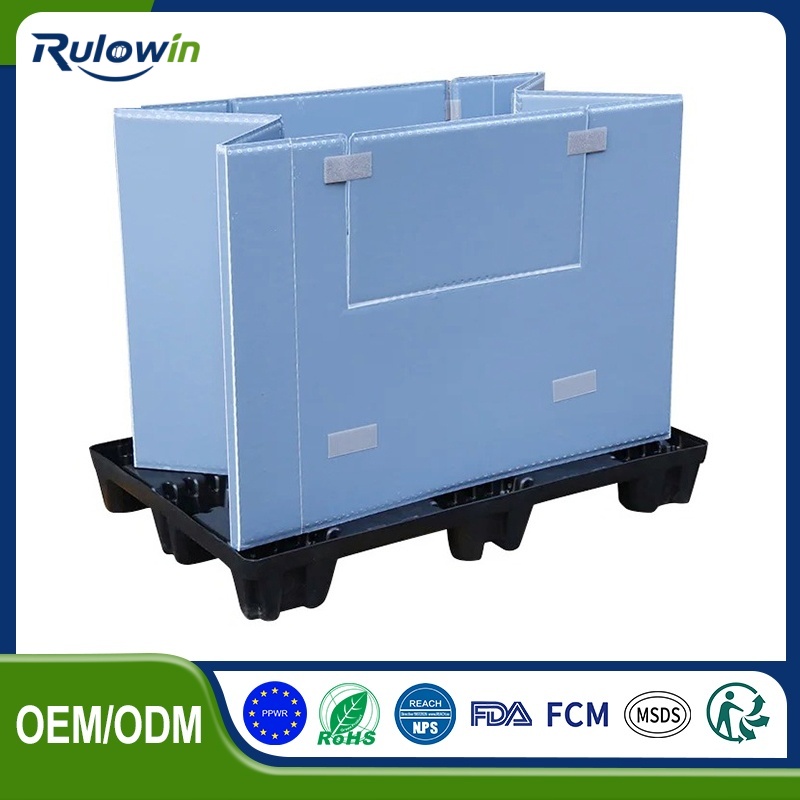
We build PP corrugated turnover boxes to a module wherever the part allows it, and we will say so when it does not. Send us the part, the volume and the legs the box has to survive, and we will propose a footprint with the reasoning attached. Choosing a module to design against is covered in how the two standard footprints shape a box.