
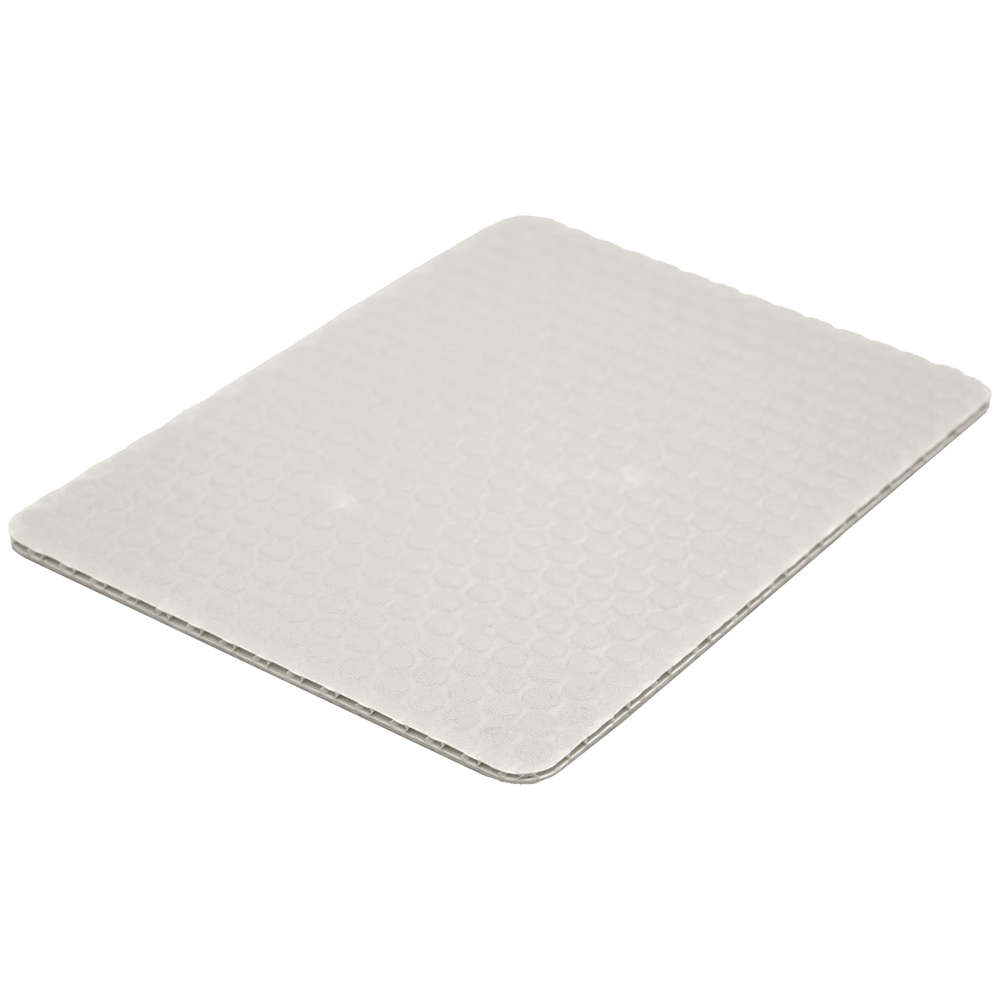
Worn steps are the awkward case. The stair is already damaged, it still has to be used, and it is uneven in a way that makes ordinary protection behave badly. Covering it is often the right answer, but the cover has to do something different from what it does on a new stair.
Why flexible sheet fails on worn treads
A worn tread is dished: the middle of the walking line is lower than the edges, sometimes by several millimetres. A flexible sheet laid over it follows the dish, so the cover is thinner over the hollow and thicker at the edges – exactly the inconsistency that causes trips. It also moves, because a sheet sitting in a dish is not flat on anything.
A rigid cover bridges instead
A stiff panel spans the hollow and bearing on the two high edges, which gives a consistent walking surface across the tread regardless of what is underneath. That is the whole argument for a rigid cover on a worn stair and it is the reason a honeycomb panel outperforms a thicker flexible sheet here. The stiffness does the work, not the thickness.
Levelling the dish
Where a tread is deeply worn, a rigid cover on its own bridges the hollow but is unsupported in the middle, and a point load in the middle will eventually crack it. A levelling layer – a thin pack under the cover at the low point – restores the support and costs very little. On badly worn stairs this is worth doing for the bottom few treads, which are always the worst.
Do not hide a safety problem
If a step is worn to the point where it is a trip hazard, or the nosing is broken away, covering it during the works is fine and covering it permanently is not. A temporary cover that makes a dangerous stair usable for six months can end up staying for six years. Say clearly what the cover is for, and make sure the stair is in the scope for repair.
Where replacement is cheaper
A flight of badly worn treads is often cheaper to replace than to cover properly, particularly in a standard block where treads are a stock item. Covering makes sense when the stair is going to be refurbished later in a later phase, or when it cannot be taken out of use. Ask what the stair scope is before ordering covers for it.
Checking what is under the cover
A worn stair is often worn for a reason – movement, a structural issue, or a nosing that has failed. Lift a cover periodically and look at whether the wear is getting worse, because a cover hides progression as well as damage. If the stair is actively deteriorating, the cover is buying time and that time needs to be spent on a repair.
When a worn step is a defect, not wear
A worn tread is one thing; a tread with a broken nosing or a loose edge is a safety defect and it should be reported rather than covered. Covering it hides the evidence and transfers the risk. If a stair is in that condition, say so in writing and let whoever owns the building decide – do not quietly make it look fine.
The property that does the work is stiffness, not thickness, which is the same argument as panels that lie flat instead of curling at the edges.
What we can do
We supply rigid honeycomb tread covers that bridge worn treads, and levelling packs for the worst ones. Tell us how worn the flight is and what the plan for it is, and we will say whether covering it is the right interim measure – including when replacing the treads is the cheaper call.