
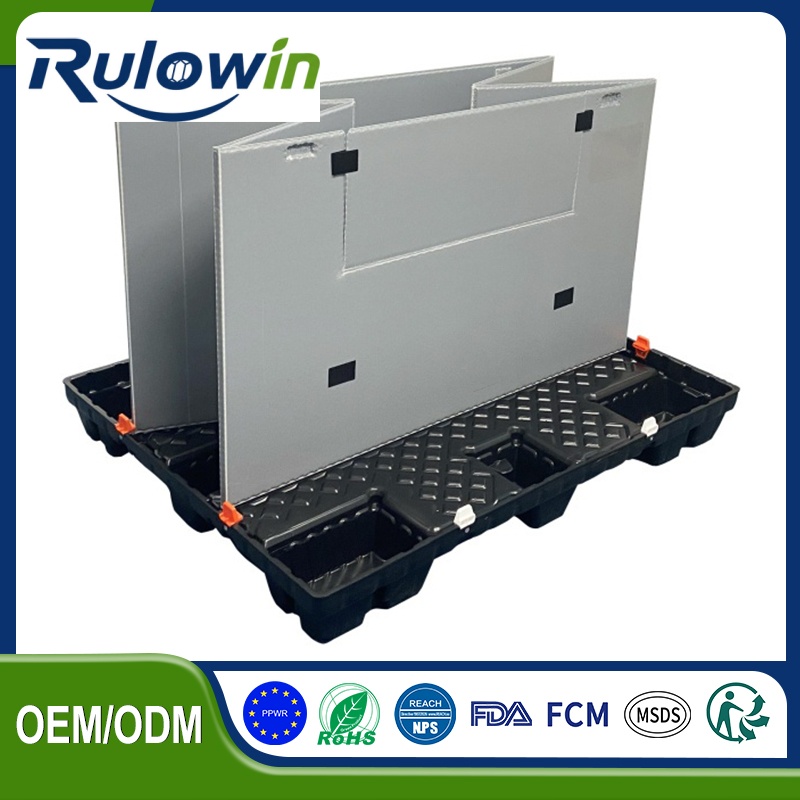
Empty boxes stack differently from loaded ones. They are light, they have no contents to brace the walls, and they get stacked by whoever is tidying up, to whatever height the space allows. That is how a well-designed box acquires a permanent set in its first month.
Why empty stacks fail
A loaded box carries its load through the walls and the base. An empty box carries only the weight of the boxes above, which is trivial, so it ought to be safe. The failures come from three other causes: wind or a nudge on a tall light stack, creep where a box sits under a small load for months in a warm store, and the top box being dropped on rather than placed. Only the third is really impact.
Rated height versus practical height
A box rated to stack five loaded is not necessarily safe to stack ten empty. The empty stack has a worse stability margin and a worse aspect ratio, and the visual cue that usually limits a loaded stack is missing because the boxes are all the same. Set an empty stack height explicitly and mark the bay, rather than leaving it to judgement.
Creep and permanent set
Leave an empty box under load in a warm store and the panels will slowly deform. It is not a failure, it is a change of shape, and after six months the box no longer stacks squarely. Where empties are stored long-term, either stack low or store them unloaded. This is the same slow deformation that shows up in loaded stacks, at a much lower load and a much longer time.
Indoor, outdoor and the middle ground
Under a canopy is the worst case for many materials: sun on one face, damp on another, and no airflow. Ultraviolet light degrades the outer surface over years, and standing water at the base is worse than either. If empties have to live outdoors, stack them where water cannot collect, keep them off the ground on a pallet or rail, and accept a shorter service life for the bottom boxes.
Dunnage inside empties
Empties are usually stacked with their dunnage either in place or removed. In place is faster and holds the walls apart. Removed stacks flatter but the dunnage then has to be stored, counted and reunited. Almost always, leaving the dunnage in and accepting the extra height is the cheaper decision over a year.
Lifting and placing, not dropping
The top box in an empty stack is usually placed by hand at height, with one person and a stretch. Setting a box down square matters, because a box landed on a corner damages the one below and starts the cycle of corner damage described in corner reinforcement. Wheeled stands or short bay heights solve it more cheaply than any box upgrade.
The temptation to stack higher in a quiet period
Empty stacks grow during shutdowns and quiet weeks, when space is being cleared and nobody is watching the height. Those are the stacks that take a permanent set, and the boxes at the bottom of them are usually the ones that get scrapped first the following year. Marking the bay and keeping the store sized for the peak rather than the average is what prevents it.
Rotation helps too. Where a stack sits for months, turning the outer boxes into the middle and the bottom ones onto the top spreads the load and the exposure, and it costs an hour twice a year. A fleet that is stored outdoors or in a warm store needs that rotation more than one that lives in a shaded, ventilated area.
What we can do
We build PP honeycomb board boxes with locating lids and reinforced corners so an empty stack stays square, and we will give you a recommended empty stack height rather than leaving it to the yard. Tell us where the empties live and for how long.