
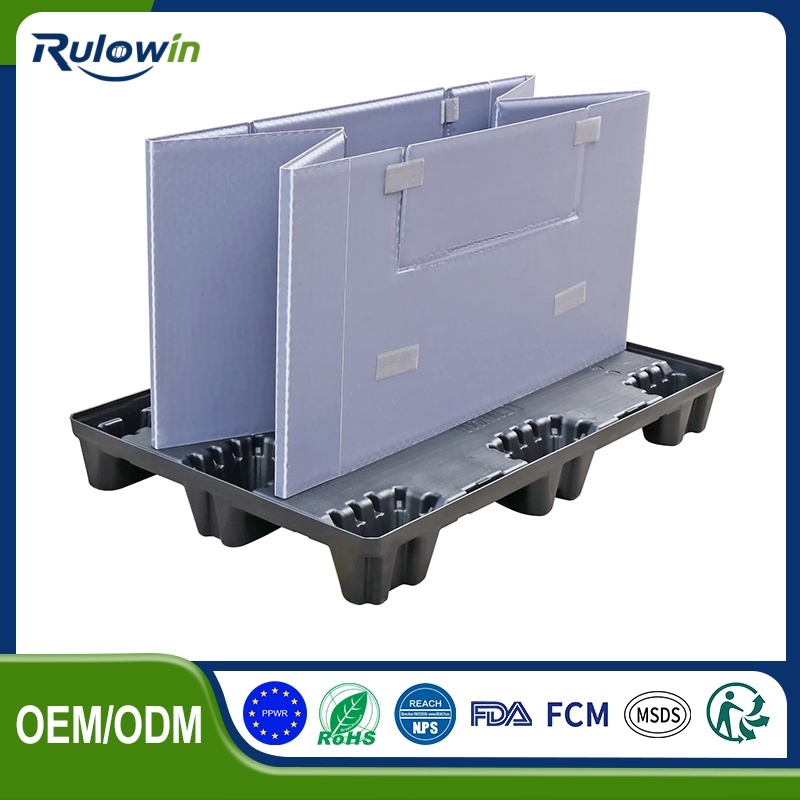
If you cut open a failed returnable box, the crack usually runs up from a bottom corner or across a lid corner. Corners concentrate stack load, absorb impact, and sit exactly where a forklift or a trolley wants to be. Making them good is cheap at design time and expensive afterwards.
Why corners concentrate load
A stack of boxes transfers its weight down through four vertical lines. Everything above rests on those four points, so a corner post on the bottom box is carrying the whole stack in a small area. Add an impact from the side and the same corner has to resist a bending moment it was never sized for. This is why the base corner and the top corner are the two places to spend material.
The three ways to reinforce a corner
A thicker section of board, a separate post or extrusion that runs the full height, and an insert that ties the three panels together. The thicker section is cheapest and helps least. The separate post is the strongest and adds an assembly step. The tying insert is what actually stops the corner opening up under a racking load, and it is the one most often left out when a box is costed against a competitor.
Internal or external posts
An external post is sacrificial: it takes the impact and can be replaced. An internal post keeps the outside face clean, which matters for a box that is wrapped, labelled or stacked flush, and it takes up internal volume. For a box in a busy plant, external is usually right; for a box in a customer-facing or automated handling setting, internal is usually right.
Bottom corners take the worst of it
The bottom corner has to do three jobs at once: carry the stack, accept the fork entry and survive being set down on a hard floor. If any single point in the box is over-designed, it should be this one. A replaceable corner block at the base is one of the cheapest durability features available and it turns a scrapped box into a five-minute job.
Top corners and lids
Lids are where boxes get lifted by one hand and twisted. A lid that locates positively onto the stack below removes that twist, because the box is being lifted as part of a stack rather than as a loose object. If the lid is separate, it will be put down, driven over and lost, so a tether or a captive design is worth considering.
How corners fail over time
Rarely in one event. A small impact closes a cell, the panel loses local stiffness, the next impact closes more, and a year later the corner is soft enough that the box does not stack squarely. That is the mechanism behind most cosmetic retirement, and it is why the inspection rule in retiring a box fleet focuses on squareness rather than on visible splits.
Reinforcing without adding weight everywhere
The discipline is to put material in the load path and take it out everywhere else. A box with heavy walls and thin corners is worse than a box with light walls and honest corners, for the same weight. That trade is the single most useful conversation to have with a supplier, and it is the reason two boxes of the same weight can have very different service lives.
Looking at corners on a used box
Open a box that has done a few hundred trips and look at the bottom corners from the inside. Cells that have closed up, a panel that has gone soft, a slight bulge outwards at the base. Each tells you where the impact is landing and whether the reinforcement is in the right place. It takes a minute and it is the most direct design feedback available.
Compare a box from a busy aisle with one from a quiet corner of the same plant. The difference in corner condition is the cost of traffic, and it is usually large enough to justify a sacrificial outer rail on the boxes that live in the busiest bays.
What we can do
We build PP honeycomb board boxes with replaceable corner blocks and post reinforcement where the stack and the traffic demand it. Send us the stack height and a photograph of where your current boxes are failing, and we will design the corner for it.