
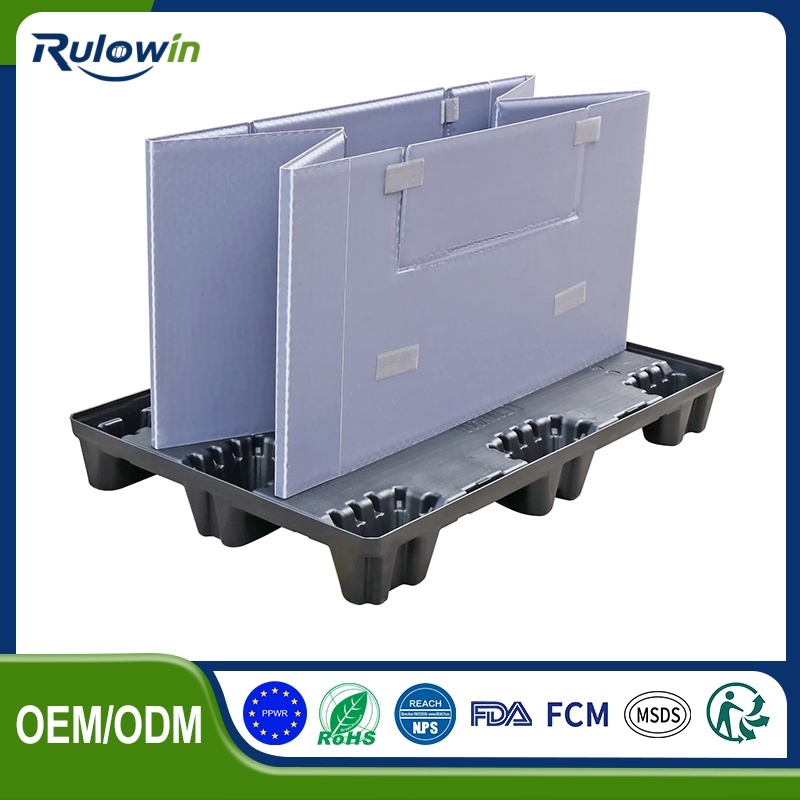
Retirement is the least designed part of any returnable packaging programme. Boxes go out of service when someone decides they look tired, which means cosmetic boxes get scrapped early and structurally compromised boxes stay in the bottom of stacks for another year.
What actually matters at retirement
Two things, and appearance is neither. Does it still carry the stack load, and does it still protect the part? Everything else is cosmetic. A box with a scuffed face and honest corners is a perfectly good box; a box that looks clean but has taken a permanent set in the base is a risk every time it goes into a stack.
The squareness check
The best single test. Put the box on a flat floor, stand on the opposite corner gently and look for rock, then measure the diagonals across the top opening. A box that has lost its square will not stack properly and is being held level by the boxes around it. It takes fifteen seconds and it catches the failure that matters most.
The base and corner check
Look at the base for deflection with a straight edge, and at the corners for cells that have closed up. Closed cells at a corner mean the box has lost local stiffness and will take more damage in the same place. When the cells at the bottom corners have closed over most of the post height, the box is done.
Cosmetic versus structural, written down
Write two lists. Cosmetic: scuffs, small dents, faded print, a stained panel, a taped repair. Structural: permanent set, closed corner cells, a soft base, a cracked panel, a failed hinge that cannot be replaced. Cosmetic stays in service; structural goes to repair or scrap. The value of writing it down is that the decision stops depending on who is on shift.
Where retired boxes go
A retired box should be physically marked and removed, not left in the yard. A marked box in a stack is worse than no box, because it will be used. Scrapped polypropylene is recyclable, and a documented scrap route helps both the sustainability claims and the housekeeping. The end-of-life options are worth stating explicitly to a customer, as covered in end-of-life for a box fleet.
Retiring a whole fleet at once
Sometimes a fleet reaches retirement together, because it was bought together. When that happens, decide whether to replace with the same design or with one that addresses the failure mode that dominated. The failure data is available and it is usually ignored, which is how plants end up buying the same box three times.
The last trip
Where possible, use the final trips on internal lanes rather than customer routes. A tired box that fails internally is an inconvenience; the same box failing at a customer’s dock is a quality incident. Organising the last year of a fleet’s life deliberately is a small piece of planning with a disproportionate effect on complaints.
Who makes the decision
Retirement decisions get made by whoever is holding the box, which is why appearance drives them. Nominating one person or one role to make the call, with a written rule and a quarantine point to send boxes to, removes the guesswork. It also gives the fleet a consistent size, because the same standard is being applied across every site.
Keeping a record of retirements by reason is what makes the next specification better. Five minutes a month of tallying the categories turns a series of individual judgement calls into data about which failure mode is actually shortening the fleet’s life, and that data is the only sound basis for changing the design.
What we can do
We build PP honeycomb board boxes with the load path in the corners and the base so retirement happens for structural reasons at a predictable point rather than for appearance. We will also review a retiring fleet and tell you which design change would have extended it.