
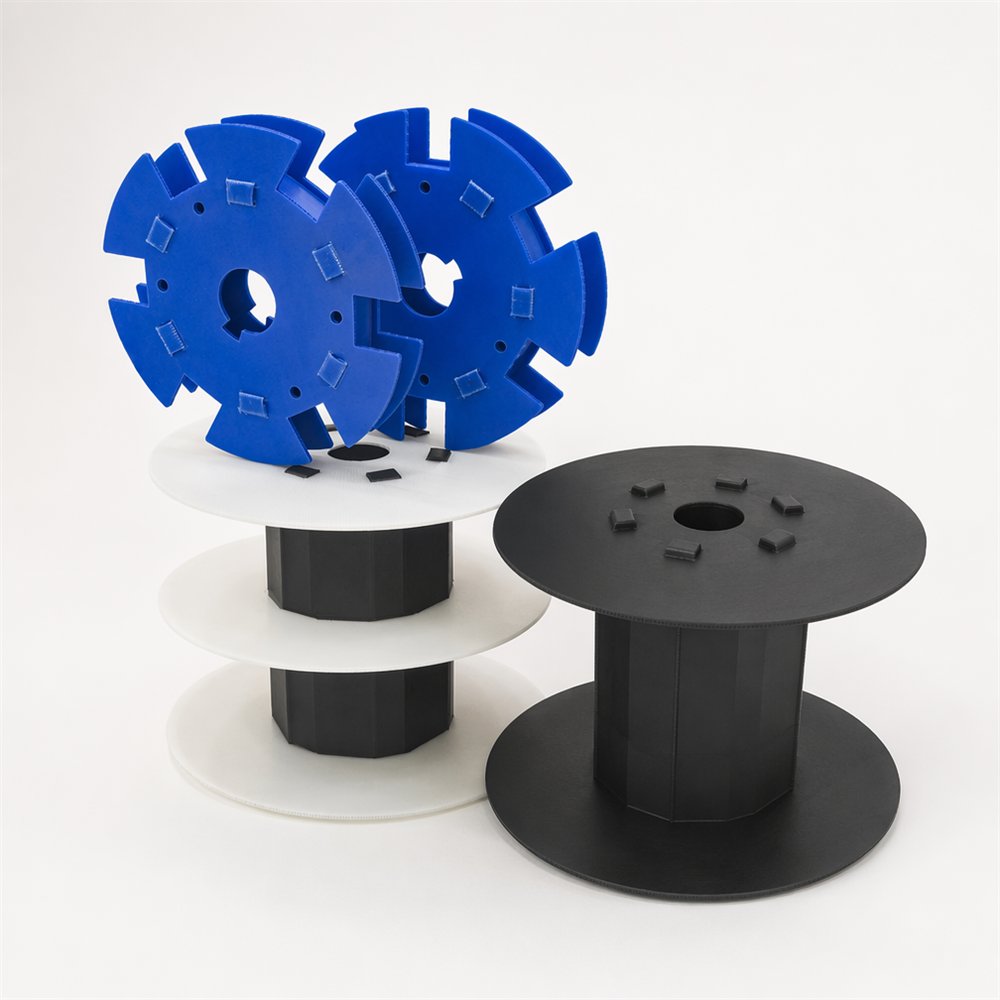
The economics of reusable spools are straightforward until you have to decide whether a specific returned spool is fit for another run. That decision is currently being made, at most operations, by whoever is standing nearest the return area — which is why reuse programmes drift: good spools get scrapped, bad ones get reused, and nobody can say what the rule was.
A one-page inspection standard fixes this. It does not need to be complicated; it needs to be written down and applied by everyone.
What to check, in order
Flanges: true and undamaged
Spin the spool and watch the flange rim against a fixed reference. Any wobble means the flange is bent, and a bent flange produces tension variation for the whole next run. A slight set can sometimes be corrected; a cracked or chipped flange cannot. Check the flange face for nicks — a nick abrades product on every revolution.
The core and the joint
For take-apart spools, check that flanges still seat positively on the core. Loose joints develop eccentricity, which is the failure that hurts fine product. Cycle the assembly a few times by hand: it should snap together with the same force as a new one and show no free play.
Check for a step or burr at the flange-to-core joint. Fine product catches on steps, and a burr grows with handling rather than healing.
Bore and shaft interface
Worn bores make spools rattle on the shaft and walk under load. If the bore is visibly oversize or the spool wobbles on a known-good shaft, retire it. This is a cheap check that prevents an expensive jam.
Surface condition
Look for cracks, deep gouges and stress whitening — pale lines at high-stress points that indicate the material has been worked. Stress whitening at a corner is an early warning; a crack is a retirement. Also look for melted or smeared areas, which come from contact with hot surfaces and indicate the material has changed locally.
Cleanliness
Contamination is a product-quality risk, not just an appearance issue. Grease, swarf, grit, tape residue — anything on a surface that touches product has to go. Set a cleaning method and make it part of the same inspection step.
Grade them, do not just pass or fail
Two grades are enough for most operations:
- Grade A — any product. Full inspection pass, no findings.
- Grade B — limited use. Cosmetic wear only: scuffs, faded colour, light surface marks with no cracks, no dimensional findings. Fine for robust product, or as the outer spool in a multi-spool pack.
Grading stops the two classic wastes: scrapping a spool that is perfectly good for a robust product, and quietly running a marginal one on fibre.
Retirement criteria
- Any crack in a flange or the core
- Bore out of tolerance, or spool that will not seat on the shaft
- Flange runout beyond the limit after a correction attempt
- Stress whitening progressing at a load-bearing corner across consecutive inspections
- Assembly joints that no longer seat positively
Mark retired spools permanently — drilled, cut, or stamped — so they cannot re-enter the loop. A retired spool that looks serviceable will find its way back into service within a month unless it is obviously dead.
Track the numbers
Count returns by grade. The useful figure is the proportion of returns that fail inspection and how it trends: a rising failure rate points at a handling problem upstream, a packaging problem in transit, or a material grade that is not up to the duty. Either way, the inspection data tells you where to spend money before losses get expensive.
If you are setting up a reuse programme and want a draft inspection standard or an opinion on what a realistic cycle life looks like for your product, send the spool type and the winding duty.