
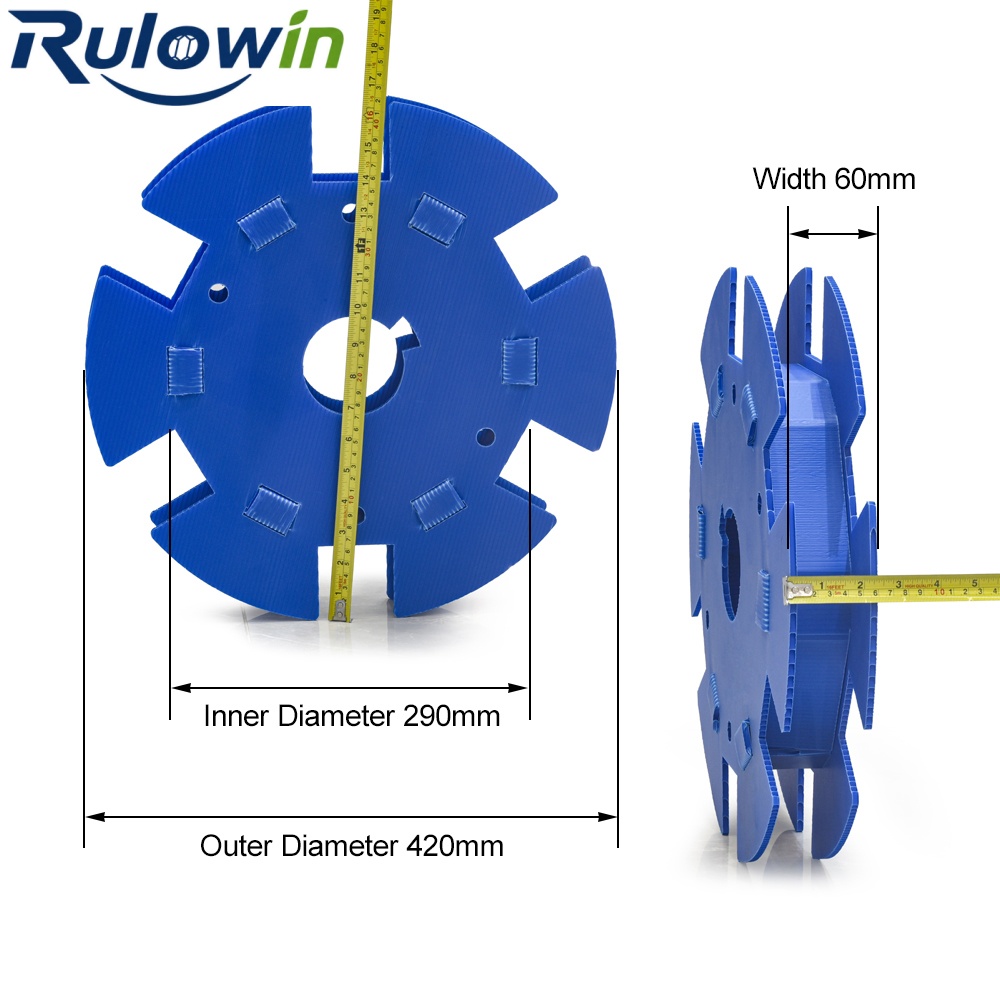
The question arrives as “what drum do I need for 3,000 metres?” and the honest answer starts with another question: what is the cable diameter, and how fast do you want to wind it? Drum sizing is geometry with a few corrections, and getting it right saves both freight and scrap.
The basic calculation
Cable winds in concentric layers. For each layer, the number of turns is the traverse width divided by the cable diameter. The circumference at that layer’s radius, times the turns, gives the length per layer. Sum the layers until you reach the target length or run out of flange height.
In words: cable diameter sets everything. Halve the diameter and you roughly quadruple the capacity on the same drum, because you fit more turns per layer and more layers under the flange.
The corrections that matter
Winding pitch
Real winding is not perfectly tight. Cross-lay and random wind patterns leave gaps, and the effective pitch is larger than the cable diameter. Typical practice adds 5–15% depending on the winder and the product stiffness. Stiff cable that resists bending packs looser than soft cable of the same diameter.
Effective diameter
Use the actual overall diameter including any jacket ribs, armour or serving. A cable whose nominal diameter is 12 mm but whose armour bumps it to 13.5 mm has visibly less capacity on the same drum, and the error compounds through every layer.
Fill height below the flange
Never wind to the flange top. You need freeboard for handling, for protecting the product, and because the outer layers are the ones that get damaged in transit. A common margin is one to two cable diameters below the flange; more for product that is sensitive to pressure.
Weight before length
Geometry may say a drum holds the length; the shaft and the handling equipment may not hold the weight. Check the loaded weight against the drum’s rating and against your payoff stand. Also check the weight distribution — a heavy, narrow pack loads the drum differently from a lighter, wide one.
The variables worth optimising
Once the calculation is done, two parameters usually have room in them:
- Core diameter. A larger core reduces the ratio between full and empty radius, which flattens the tension curve on payoff and is gentler on the product. The cost is capacity. For sensitive or high-value cable, spend the capacity.
- Traverse width. A wider traverse means more turns per layer and fewer layers for the same length — a flatter, more stable pack that pays off more evenly. The limit is handling width and shipping volume.
Between them, these two choices let you tune the same capacity toward either tighter shipping cube or gentler payoff behaviour. It is worth deciding which you are optimising for before ordering, because they pull in opposite directions.
Common sizing mistakes
- Using nominal diameter instead of actual overall diameter — the most common error by a wide margin
- Forgetting that the first layer sits on the core, not at the core radius plus zero
- Sizing exactly to capacity with no freeboard, then losing the outer layers to transit damage
- Ignoring the empty drum’s return volume on lanes where the drum comes back
Practical advice
Run the calculation for two or three candidate drums and compare not just capacity but loaded weight, payoff tension behaviour and shipping cube. The largest drum that your handling equipment likes is rarely the best answer; the one that fits the product’s tension behaviour usually is.
If you send us the cable type, overall diameter, length and winding speed, we will run the numbers, suggest a drum, and tell you what the payoff behaviour will look like at the end of the run.