
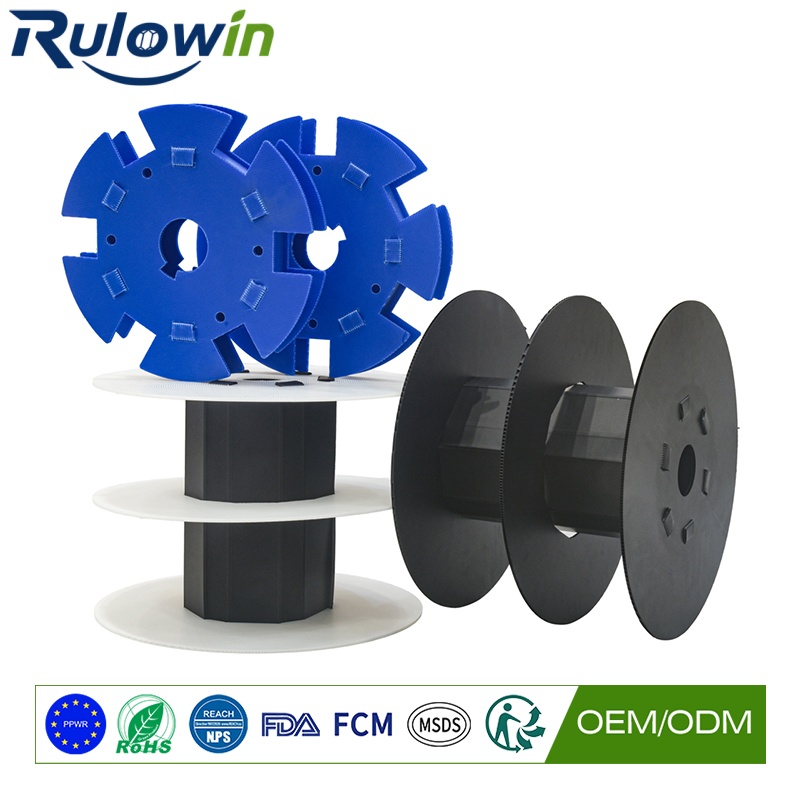
Spools get wound and then sit. A production run is made ahead of demand, an order is delayed, a customer’s project slips six months. The spool stays fully wound the whole time, holding the full hoop load of the product against its flanges.
Every material responds to sustained load to some extent. The question is whether it matters over a realistic storage period, and where the risk actually sits.
Creep, briefly
Under constant load, polymers deform slowly over time. This is creep, and it is real for polypropylene. What it means in practice for a wound spool is that the flanges take a permanent outward set — very slightly, over a long period — and the core takes a compressive load continuously.
The good news: at normal ambient temperatures and normal service loads, the amount is small. Spools are designed with the flange stiffness to keep it that way. The risk rises with temperature and with load, and both are worth knowing about.
What it looks like when it has happened
- Flanges that are very slightly dished or spread, identifiable by measuring across the rim and comparing to a new spool
- A pack that has settled, so the product is no longer tight on the core
- On take-apart designs, joints that have taken a permanent set
None of this is dramatic, and in most cases a spool that has been stored for a year is perfectly usable. The failure mode is cumulative rather than sudden — it is the fifth year of continuous loading, in a hot warehouse, on a spool that was marginally specified, where this becomes a real problem.
The product usually suffers more than the spool
This is the part worth more attention. Whatever is wound on the spool has its own long-term behaviour under tension and bend:
- Cable and wire may take a permanent set from being held at the core diameter, which shows up as a curl at payoff
- Soft compounds can cold-flow where layers press against each other
- Adhesive products, tapes, and some coated materials can block — layers sticking together — especially in warmth
- Elastomers and some polymers age differently in a wound state than relaxed
If a long-stored spool unwinds badly, the product is the first suspect, not the spool. The product manufacturer is the right person to ask about maximum storage time at a given temperature — that is their specification, not ours.
Heat is the accelerator
Everything above gets faster with temperature. A warehouse that reaches 40 °C in summer is a different proposition from one held at 20 °C. Direct sunlight through rooflights onto a stack of black spools is worse again — the surface temperature can be far above ambient, and UV is a separate degradation mechanism on top.
If you must store wound spools, a cool, shaded, indoor space is worth a great deal more than it seems.
How to store wound spools sensibly
- Store on the flange, not on the rim of the wound pack — do not let the product carry the stack load
- Keep them off the ground and out of standing water
- Out of direct sunlight, which matters for both the spool and the product
- Rotate stock — first wound, first shipped, so nothing sits indefinitely by accident
- Record the wind date somewhere on the spool so you know what you are looking at in two years
- If it will be years rather than months, consider whether it should be stored wound at all
If you have spools that have been sitting
Before winding them out at speed: check the flanges for distortion, check that the pack is still tight on the core, and run the first spool slowly. A pack that has settled can shift at payoff, and slow running reveals that without the consequences that full speed would bring.
Our PP hollow board spools are specified with flange stiffness in mind for exactly this reason, and if you tell us you have a long-storage application we will specify for it. What we will not do is give you a blanket maximum storage duration — that depends on the product, the temperature, and the load, and a number without those qualifications would not be worth much.