
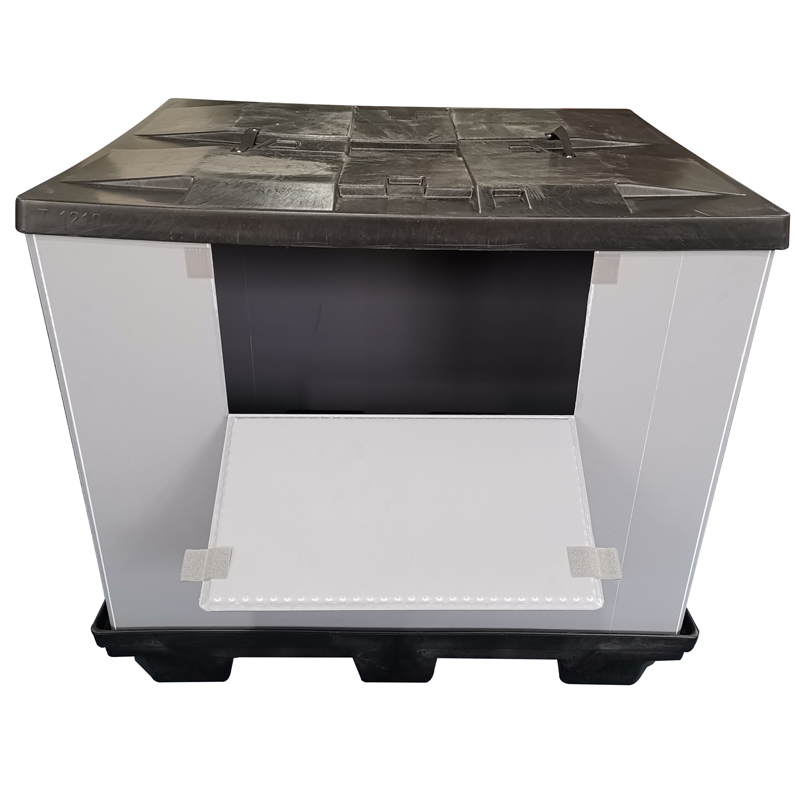
A distribution network moving parts between its own sites is close to the ideal application for pallet sleeve boxes. The return leg already exists because vehicles run both ways, the loads are repeatable, and the same people own the boxes at both ends.
The complication is specific: parts are dense, and dense loads are the hardest case for a sleeve box.
Density, and what it does
A sleeve box is designed for distributed vertical load. A box full of castings or machined parts puts a high load on a small area of the base, and the load is concentrated rather than spread. That is the load case the base is least good at.
Two answers. Either specify a heavier base – which is the part that wears anyway and is worth over-specifying – or spread the load with a dunnage layer at the bottom of the box. Both work; the dunnage layer is usually cheaper and also stops parts marking each other.
Weight limits, honestly
A sleeve box is not a crate. There is a load above which the sleeve walls start to bulge and the lid starts to dish, and it is lower than most people expect. If your parts are very heavy, either reduce the fill height or use a different container for them.
Worth stating plainly: sleeve boxes suit medium-density parts in volume. Very dense loads in small quantities are better in something else, and no specification change fixes that.
Standardising across sites
The advantage of one footprint and one height across the network is large – boxes can go anywhere and nobody has to think. The cost is that the height is wrong for some loads.
Two heights usually covers a parts network: one for small fast-moving items and one for bulky ones. Three is rarely justified. Worth analysing the actual distribution of your load heights before deciding, because the assumption that one height will do is usually wrong.
Tracking, or boxes leave
In a multi-site network boxes migrate. One site accumulates them, another runs short, and nobody knows where the fleet is. A simple count at goods-in and goods-out per site – a tally, not a system – is enough to see it and to have the conversation.
This is the failure mode that most networks hit in year two, and it is a counting problem rather than a packaging one.
Two operational details worth fixing early
Lid management. Lids are the part that goes astray in a multi-site network, because they are the part that gets taken off. A lid in a different colour from the sleeve is much easier to account for, and an attached lid removes the problem at a small cost per box.
Where empties wait. Each site needs a designated place for collapsed sleeves, or they end up wherever there was space that day and the collection becomes a hunt. A marked floor area is enough. It sounds trivial and it is the difference between a return rate of most of the fleet and a return rate of half.
What we can do
We supply pallet sleeve boxes for warehouse and supply loops with bases specified for dense loads. Tell us the part weight, the footprint and how many sites, and we will specify – including whether one or two heights suits your load profile.