
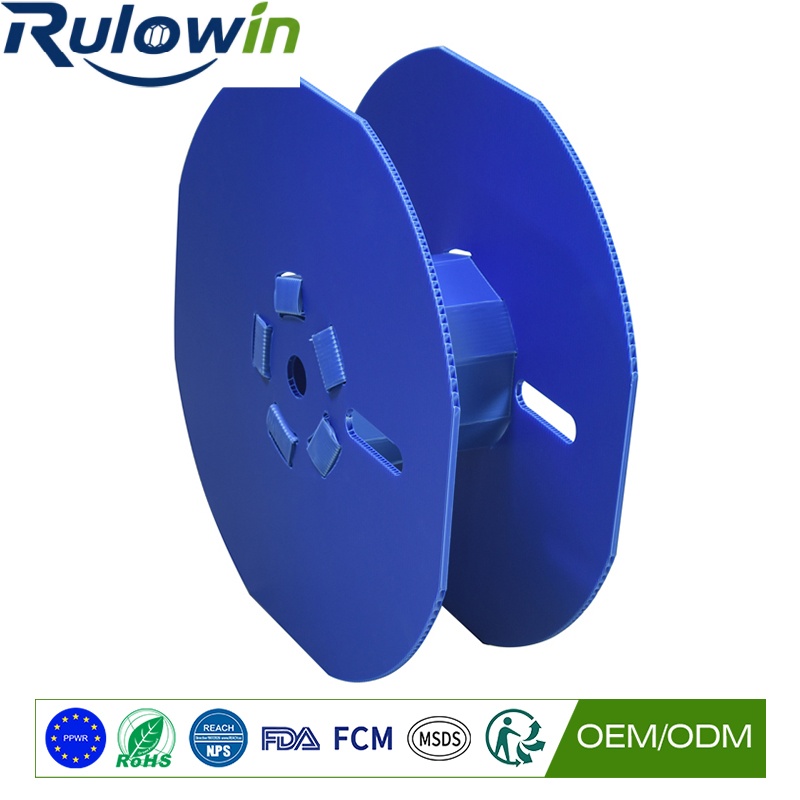
An assembled spool is mostly air. Ship a truck full of them and you are paying to move the hole in the middle. This is the argument for take-apart designs, and it is a good one — but the saving is on one side of the ledger and the cost is on the other, and the cost is easy to forget.
What nesting actually saves
Flanges from a take-apart spool stack or nest compactly; cores nest inside each other. Depending on the design, the collapsed volume is a small fraction of the assembled one, and the freight difference on a long lane is correspondingly large.
Where it bites hardest is exactly where it matters most: empty returns. A one-piece reel comes back at full volume no matter what you do, and if you are paying for that volume, the take-apart design pays for itself in return freight alone — before you count the material saving on the flanges.
What it costs
- Assembly labour. Somebody puts them together. It is seconds per spool, and seconds per spool at volume is a person.
- A joint. Every joint is a tolerance, and every tolerance is a potential source of eccentricity. An assembly that does not seat concentrically runs out of balance.
- A wear point. The joint has to survive however many assembly cycles the trip target implies. A joint rated for ten cycles on a spool that will do a hundred is a problem waiting to happen.
- Administration. Flanges and cores are separate items to track. In a fleet with mixed sizes, that is a real inventory job.
When it is clearly right
Long return legs on paid freight, high trip counts, standardised product ranges where the same spool is used repeatedly, and export lanes where the inbound freight is a genuine line item. In those cases the arithmetic is usually decisive.
When it is not
Short domestic loops where empties come back on your own vehicles at marginal cost. Low trip counts, where the assembly joint never gets amortised. Very high payoff speeds, where any joint eccentricity is unacceptable. And operations where the assembly labour is expensive relative to the freight saved — worth actually calculating rather than assuming.
The hybrid
Some operations run both: assembled one-piece spools for short domestic lanes, take-apart for export. It complicates the fleet slightly and it optimises each lane properly. If your lane mix is bimodal — some very short, some very long — this is usually the right answer.
Specifying a take-apart spool
Four things on the drawing:
- Joint type — snap, screw, or heat-stake — and the cycle life it must survive
- Concentricity of the core seat to the flange bore, with a number
- Whether the joint presents a step at the product contact surface, which it must not
- Assembly and disassembly time, if you are paying for it — ask, and check
That last one is the most commonly skipped and the easiest to verify. Time somebody assembling ten of them, and put the number in the model.
If you send us the lane, the volumes and the freight rate, we will run the comparison and tell you where the break-even falls — including when the answer is that one-piece spools are the better buy.
The middle option: part-nested
It is not always all-or-nothing. Some take-apart designs can ship with the core loose alongside nested flanges, which recovers most of the volume saving without requiring assembly at the far end — the recipient fits the core when they wind.
That works well where the destination has the capability and poor where it does not. It is worth asking about specifically, because it is not always offered as an option and it suits a lot of situations better than either extreme.