
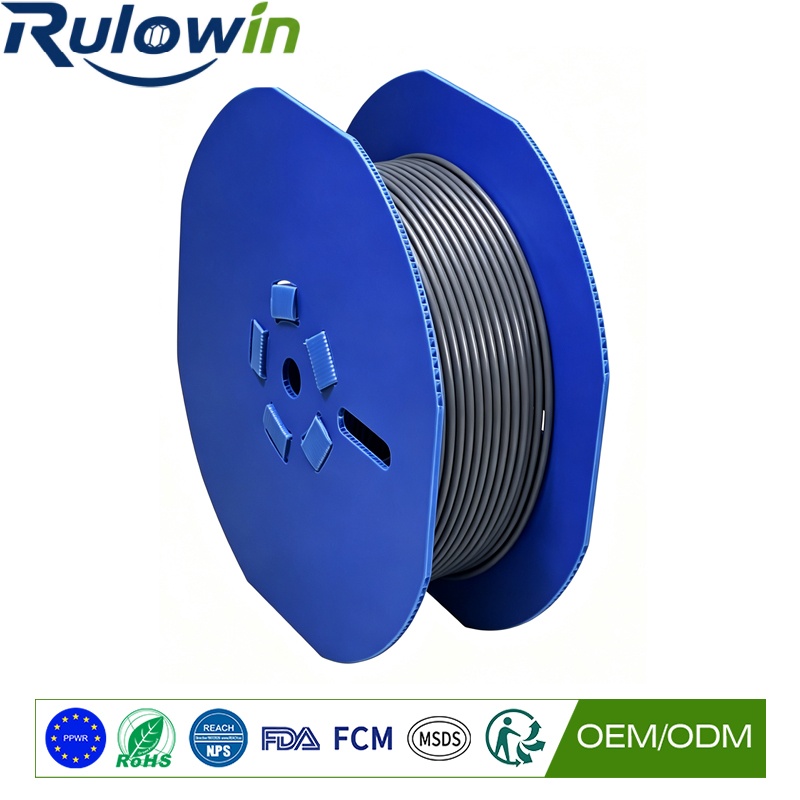
Fibre optic cable looks like cable and is handled like cable, which is how it gets damaged. It has no plasticity to absorb a mistake: a bend beyond its minimum radius either exceeds the limit or it does not, and a tension spike either causes attenuation or it does not. The spool decisions that are cosmetic for copper are functional here.
Bend radius governs the geometry
Every fibre product has a specified minimum bend radius, and the tightest bend in a spooling operation is usually at the flange face on the penultimate layer. Two spool variables set that angle: core diameter and how close to the flange the pack is wound.
A larger core and a pack kept away from the flange both open the angle up. Both cost capacity. On fibre, pay it — the length you gain by filling the spool is worth nothing if the last fifty metres fail attenuation testing.
Tension consistency
Fibre is sensitive to both peak tension and tension variation. Peak tension risks immediate damage; variation at high speed is what causes the subtle problems that show up at commissioning.
Two spool properties drive variation. Runout — an eccentric spool produces a once-per-revolution pulse — and the full-to-empty tension ratio, set by the core-to-flange diameter ratio. A spool that is true and has a large core gives the payoff system a flat curve and room to work in.
Specify both with numbers. Runout at the winding diameter, not at the hub, and the ratio you need for your tension window.
Surface finish
Any surface the fibre touches has to be smooth and free of steps. That means the core, the flange inner faces, and — on a take-apart spool — the joint between them. A step at the joint catches fine product, and a burr grows with handling rather than wearing away.
Specify the product-contact surfaces as critical surfaces on the drawing. It costs nothing to say and it prevents the most annoying class of problem, which is damage you cannot see.
Static and dust
Fine product moving at speed generates static, and static attracts dust. On fibre, dust at the connection is a real problem. Whether you need a dissipative material depends on the environment — dry air and high speed tend to push yes — and if you do, specify a compounded rather than a topical treatment, because a reusable spool will be washed.
What to tell a supplier
- Product type and overall diameter, including any stiffening or armour
- Minimum bend radius from the product datasheet
- Maximum winding tension and payoff speed
- Core and flange diameters you can live with, and your pallet or container constraints
- Whether the spool is washed between trips
With those, a decent supplier can tell you whether your current geometry is safe and what to change if it is not. Without them, you are buying a spool and hoping.
The honest caveat: on short, low-speed runs with generous margins, a standard spool is fine. The specification above matters when you are pushing length, speed, or both — which is where most fibre operations are.
Test before you commit
Because the failure modes here are subtle and product-specific, we would always suggest a short trial rather than a specification exercise. Wind a few lengths on sample spools, leave them for a couple of weeks, then unwind on your own equipment and test.
It costs a little time and it catches the problems that no amount of drawing review will find. If attenuation shift or coating marking matters to your product, that trial is the only way to know.