
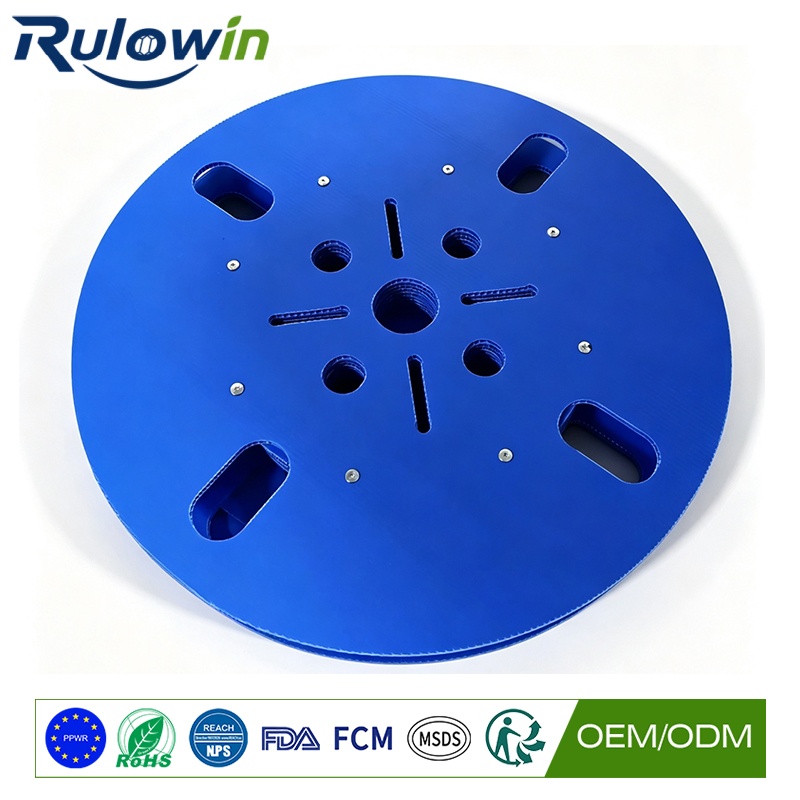
Sample spools arrive, they look well made, they fit the shaft, and the order goes in. Three months later the fleet starts failing in a way nobody predicted, and the post-mortem finds that nothing about the sample was ever actually tested.
Six tests, none of them expensive, predict most of what matters. They do not need a laboratory.
1. Wind it, then run it
The only test that really matters. Wind a spool to your normal fill height at your normal tension, store it for the normal interval, and pay it off on your equipment. Everything else is a proxy for this.
If you can only do one test, do this one — and do it with the product you actually run, not a convenient substitute.
2. Drop test at the real height
Loaded spool, dropped from the height it will actually be dropped from: the loading dock, the forklift forks, the back of a truck. Not a standard test height — your height.
Drop it on the rim, because that is how it will land. Inspect the rim and the flange root for cracks rather than dents; a dent is cosmetic, a crack is a retirement.
3. Flange deflection under load
Wind to full tension and measure how much the flange moves. A dial indicator against the flange face works; so does a straightedge and a feeler gauge if that is what is available.
Do it at your maximum service temperature if you can, because polymer stiffness falls as it warms and the deflection that matters is the worst-case one.
4. Bore fit on your shaft
Not a measurement — a fit test. Mount it on the actual shaft, spin it, and see whether it seats without force and runs without play. Do this on several samples, because a single sample tells you nothing about variation.
A bore that is nominally correct and practically loose will wallow out in service, and the resulting runout will be blamed on the machine.
5. Runout
Mount the spool and watch the rim against a fixed reference as it turns. Anything you can see is too much for high-speed work. It will not catch subtle cases, but it catches the ones that cause problems, and it takes ten seconds per spool.
6. The cleaning or wash cycle
If spools will be washed, run samples through the actual wash process five or ten times and re-test. Look for dimensional change, joint loosening on take-apart designs, and any degradation of the surface.
This is the test most often skipped and the one that most often reveals a problem, because washing is harder on spools than winding is.
What to record
For each test: the sample ID, the conditions, and the result — including the ones that passed. Three months later, when the fleet is behaving unexpectedly, that record is what tells you whether the spools changed or your process did.
How many samples
Enough to see variation: five at minimum, ten if the decision is expensive. A single sample proves the supplier can make one good spool, which is not the question.
What to do with the results
Turn the passing configuration into a specification — dimensions, material, tolerances, and the winding and handling conditions it was tested under. Then hold the supplier to it, and re-test if anything changes.
Send us the product and the duty and we will tell you which of these tests we think will be decisive for your case, and what we would expect a spool to do in each.