
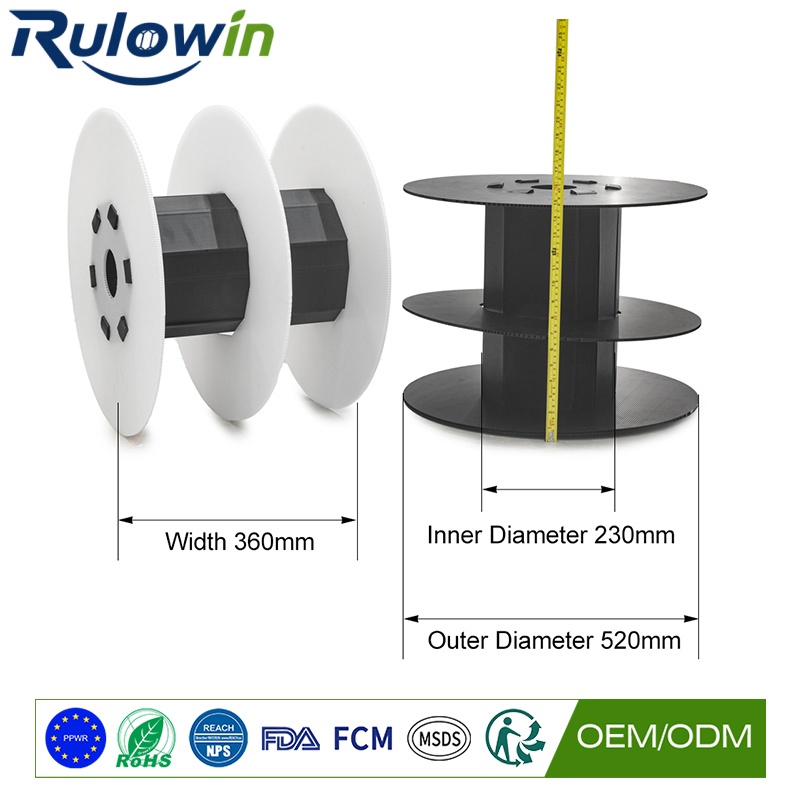
Everyone rolls spools. It is faster than carrying, it needs no equipment, and on a good smooth floor it is entirely reasonable. It is also responsible for a steady trickle of rim damage that nobody attributes to it.
When it is fine
- Smooth, clean, level floor. The dominant condition.
- Short distance — across a bay rather than across a site.
- Empty or lightly loaded spools. Weight concentrates the contact and makes every irregularity worse.
- Rim in good condition. A spool with a damaged rim will degrade quickly if rolled.
- Someone controlling it rather than giving it a push and walking away.
When it is destructive
- Rough ground. Gravel, expansion joints, damaged concrete. Every irregularity is an impact concentrated on the rim.
- Debris on the floor. Rolling over offcuts, fasteners or swarf embeds material in the rim and abrades it.
- Loaded spools on hard floors. Weight plus irregularity plus a narrow contact line.
- Across thresholds, grates or cable runs. Each one is an impact.
- Down slopes or ramps where control is lost.
- Cold conditions, where polypropylene is less impact tolerant — the mechanism in our cold weather article.
What it damages
Almost all of it at the rim:
- Abrasion wearing the rim flat or rough
- Chipping and cracking from impacts
- Delamination starting at an open edge and propagating — the failure described in our rim reinforcement article
- Debris embedding in the rim, which then transfers to product or to the next surface
The rim is also what the spool lands on when it is set down, so a worn rim compounds with everything else that happens to it.
Why it is rarely identified as the cause
Rolling damage accumulates over many events and does not look like an incident. A spool that has been rolled across a rough yard twenty times arrives at inspection with a worn rim and no story attached to it. It gets recorded as wear, and the yard floor never comes up.
The diagnostic is distribution: if rim damage is consistent around the whole circumference rather than at a point, it is abrasion from rolling rather than a single impact.
Alternatives that are not much slower
- A spool trolley or cart. Cheap, and removes the problem entirely for the common short moves.
- Palletise and move with a pallet truck. Works where spools are already palletised.
- Designated smooth routes. If rolling is going to happen anyway, make one path good rather than tolerating it everywhere.
- Keep floors swept. Uninteresting and effective.
Setting a rule
Most sites are better off permitting rolling under stated conditions than banning it, because a ban that is ignored is worse than a rule that is followed. Something like: rolling permitted on the warehouse floor, not outside; empties only; and not over debris.
The rule needs to be one people can follow without thinking about it, which means the conditions have to be simple.
A note on direction
Rolling a wound spool in the direction it unwinds is generally preferable to against it, because against it can encourage the outer turns to loosen. This is minor compared with the floor condition, but it is free to do correctly.
What we can say
Our hollow board spools have a rim that survives reasonable rolling, and we can supply sealed-edge construction where rolling is part of normal handling — worth specifying if it is, because an open edge is the thing that fails first under abrasion.