
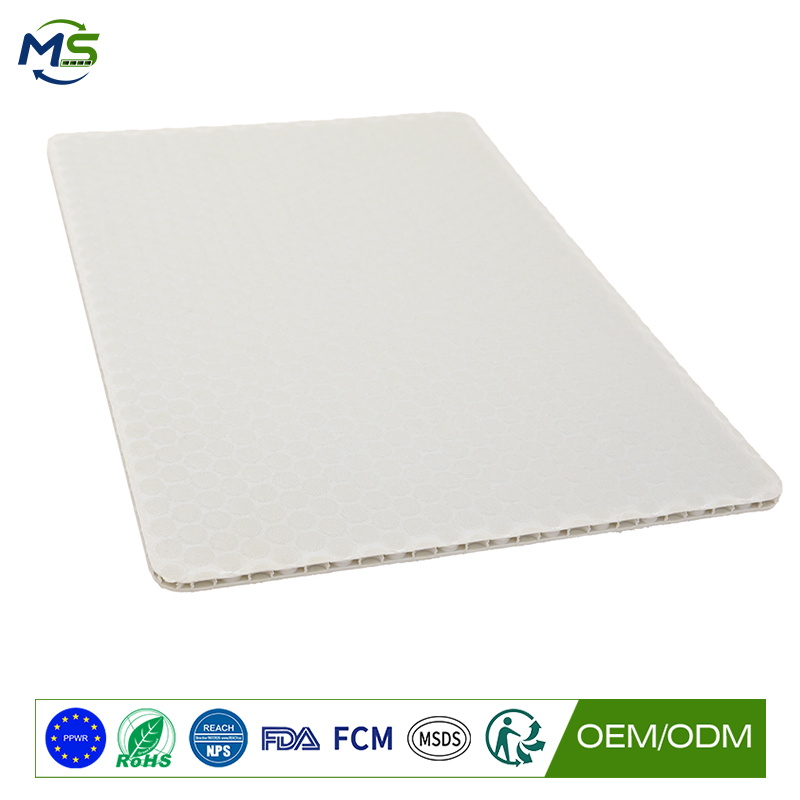
Why Sites Skip Floor Protection at Their Peril
Most floor damage during construction is avoidable. The real cost shows up later, when owners discover scratches under the furniture and ask who pays to make it right.
Why Crews Choose Protective PP Honeycomb
Think of it as a rigid doormat for the whole room. The honeycomb core flexes under impact while the protective face won’t scratch the finish beneath.
- Shields Finish & Substrate — It forms a shock layer between the floor, stair, or wall and the work happening above, protecting both the visible finish and the structure beneath.
- Load Bearing — The honeycomb core supports carts, scaffolding, and staged materials, so protection does not mean closing off the workspace.
- Absorbs Impacts — Drops, ladders, and tool carts are the usual culprits behind chipped tiles and dented timber. The honeycomb structure spreads the load so the surface below stays intact.
- Non-Slip Protective Backing — The protective layer grips the substrate and stays put under foot traffic, so crews are not constantly re-laying shifted sheets.
- Fire-Retardant Variants — Sites with strict fire codes can specify retarded boards without giving up the reusable honeycomb advantage.
- Lightweight Yet Rigid — Crews can carry and lay full sheets quickly without special equipment, then lift them just as easily at the end of the day.
Best Uses for Protective PP Honeycomb Floor Board
On real sites, the board proves its value wherever finished surfaces meet ongoing work:
- Kitchen and bath upgrades
- Tenant move-in and move-out
- Commercial office fit-outs
- Residential renovations and remodels
- Painting and decorating projects
Choosing Thickness, Size and Backing
Match thickness to traffic. Light foot traffic is fine with 3-5 mm; cart and scaffolding zones need 8-10 mm. Choose protective backing where grip matters, and size sheets to cover the run with a small overlap. For sites that need it, ask about our reusable variant.
FAQ
Can crews walk on it straight away?
Yes. The board is laid and immediately walkable, with the protective backing keeping it stable on tile, timber, or concrete.
Will it slip on polished tile?
The protective backing is designed to grip the substrate, so it stays in place under normal foot traffic without extra taping.
Work With Rulowin
Talk to our team for samples and a layout plan. We help contractors standardise on one circular, recyclable protection system across every project.