
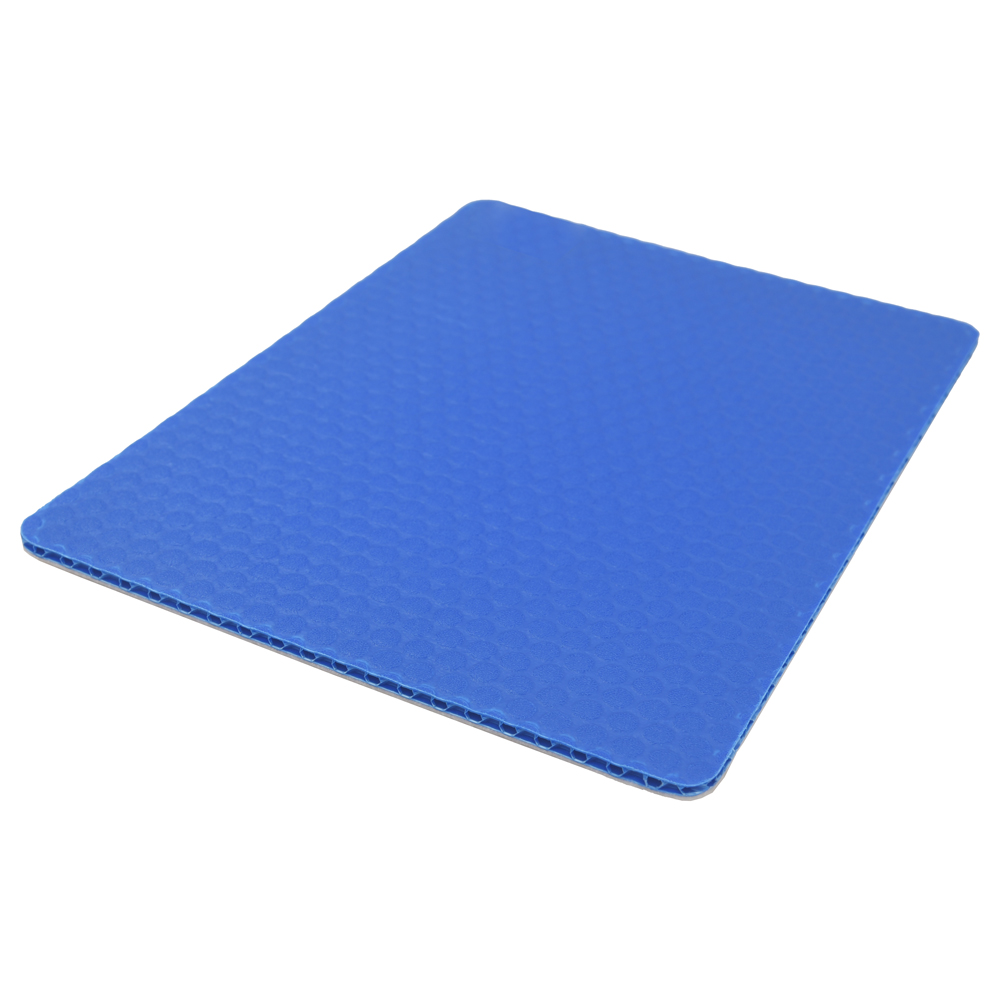
The economics of reusable protection depends entirely on what happens at the end of a phase. Panels that go into a skip were an expensive single-use product. Panels that get cleaned, graded and put back were a genuinely reusable one – and the difference is a decision somebody has to own.
Three grades, not two
Pass or fail is the wrong model. In practice panels come back in three conditions: clean and undamaged, serviceable but worn, and finished. The middle grade is the one that gets thrown away unnecessarily – a panel with a worn felt face is no longer right for a client-facing corridor but is perfectly good on a rough surface or in a working area.
What makes a panel finished
A split skin, because water then gets into the core. A crushed or delaminated edge that has run more than a short distance. Severe curling that does not recover after a day flat. Those three are terminal. Almost everything else is a grading question rather than a disposal one.
Who does the grading
Somebody named, at a named point in the programme. If it is nobody’s job it does not happen, and the panels go in the skip because that is the path of least resistance at the end of a phase. An hour allocated at each phase boundary is the entire requirement.
Counting what comes back
Worth doing, because it is the number that tells you whether the reusable programme is working. A recovery rate below about 70 per cent on the first phase usually means the panels are being lost rather than damaged, and the fix is usually storage and handling rather than a better product.
What to do with the ones that fail
Polypropylene is recyclable where there is a stream for it, and it is clean if it has been washed. Ask the supplier whether they take it back. Where there is no stream, it is general waste – which is another argument for not over-ordering in the first place.
What a realistic recovery rate looks like
Seventy to eighty per cent on the first phase of a well-run programme, lower where the traffic is rough or the site is tight, and higher once the crews are used to handling the panels. A number well below that usually means panels are being lost rather than damaged, and the fix is storage and a named collection rather than a better board.
A grading system that takes two minutes a panel
Grading used board is only worth doing if it is fast. Three grades: A goes straight back into stock, B is reusable with a sealed edge or after cleaning, C is skipped or recycled. Anything more detailed than that gets ignored by the people doing the sorting at the end of a long day.
The checks that matter are whether the panel still lies flat, whether the edges are intact, and whether the facing has separated from the core. Surface dirt is almost never the reason to reject a panel – it washes off. Curling and delamination are, because a curled panel is a trip hazard and a delaminated one lets water in. Sort on a flat surface, stack by grade, and keep grades physically apart so A does not get contaminated once the C pile builds up. What to do with the C pile is covered in taking protection panels back for reuse or recycling.
What we can do
We supply PP honeycomb protection board built for repeated use, and will give an honest estimate of recovery rates for a given programme. Tell us how many phases and how rough the traffic is, and we will help plan the grading. Recovery expectations are discussed in recovery rates on reusable floor protection.