
Recycled content requests arrive with increasing frequency and usually without much specificity. The gap between what is asked for and what can be delivered — and verified — is one of the larger areas of quiet overclaiming in packaging.
What kinds of recycled content exist
Post-industrial regrind. Material from the same process — offcuts, rejects, trimmings. Clean, well-characterised, same polymer, known history. This is the easiest to use and the least problematic.
Post-consumer recycled. Sourced from collected waste streams. Genuinely diverting waste, which is what most people mean when they ask. Higher variability in properties and composition, availability varies by region, and traceability is harder.
Both are legitimate. They are not equivalent, either environmentally or technically, and conflating them is the most common source of misleading claims.
What it does to properties
Being honest about this matters more than being encouraging:
- Mechanical properties generally reduce with recycled content. Impact strength and elongation are typically the most affected.
- Consistency reduces. Batch-to-batch variation widens, which matters for the dimensional consistency discussed throughout our tolerance article.
- Colour consistency suffers, particularly with post-consumer content.
- Long-term behaviour is less predictable — relevant to the UV and creep discussions in this series.
None of this rules recycled content out. It means the spool has to be designed knowing it is there, rather than substituted in later.
For a reusable item
There is a specific tension in this application. A reusable spool’s environmental case rests on surviving many trips. If recycled content shortens service life meaningfully, you have traded trips for material content — and depending on the numbers, that trade can go either way.
This is the same arithmetic as our cost per trip article, applied to carbon rather than money. Trips are in the denominator of both.
Getting thirty trips from virgin material and twenty from recycled may favour either, depending on how much recycled content and how bad the degradation. Anyone quoting a general answer without knowing those numbers is guessing.
What you can actually get
It depends on:
- Local availability of suitable recycled PP streams, which is genuinely variable by region
- Quantity — a consistent supply sufficient for your production
- Whether you can accept colour variation
- Whether you can relax any property requirements
A supplier’s ability to deliver depends heavily on the first two, and transparency about them is a better signal than any headline percentage.
Claims and verification
If you make a recycled content claim:
- State which kind — post-industrial or post-consumer
- State the percentage and how it was calculated
- Be prepared to substantiate it, which means your supplier must be too
- Reconcile it with any substance declarations you make — see the note on this in our REACH and RoHS article
An unspecified “contains recycled material” claim is close to meaningless and increasingly likely to be challenged.
What we will do
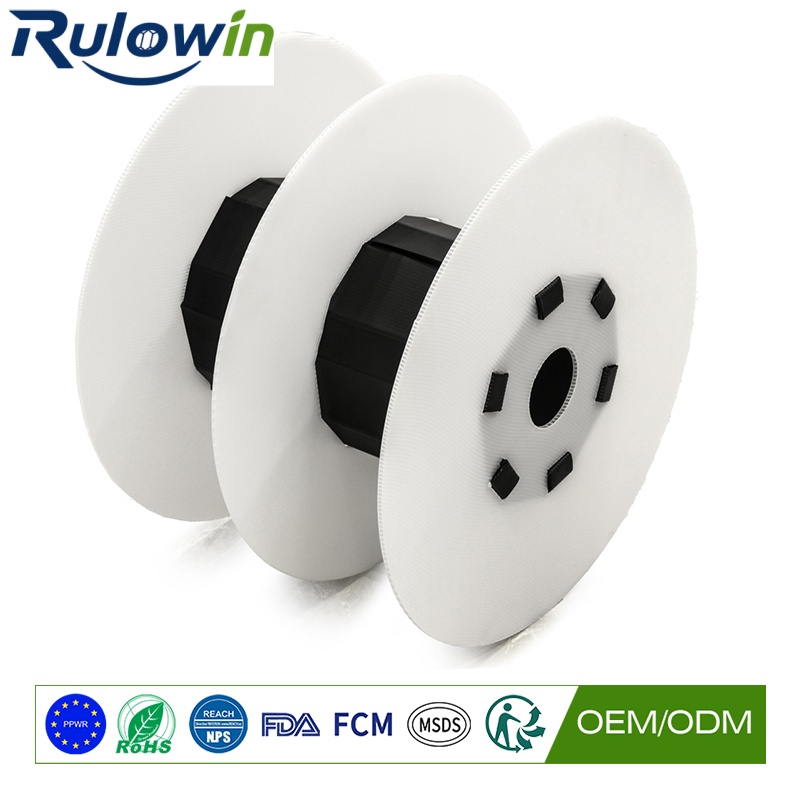
For our hollow board spools, we can produce them with recycled content and we will tell you honestly: what percentage, what type, what it does to properties, and what we can substantiate.
What we will not do is quote a number we cannot back up or imply there is no trade-off. If your application is near the edge of what the material handles, we will probably recommend against using recycled content in the load-bearing components and suggest it elsewhere — which is a real option worth discussing.