
An accessible route has a different requirement from every other protected floor: it has to remain usable, safely, by people who cannot step over anything and cannot recover from a slip. That rules out several things that are fine elsewhere, and it makes fixing and continuity more important than softness.
Firm, not soft
A wheelchair needs a firm surface. A thick soft cover that compresses under the small front castors makes propulsion harder and, on a slope, can create a rolling resistance that matters a great deal to someone with limited strength. Cover on an accessible route should be rigid and thin rather than cushioned – the opposite instinct to protecting a finish.
Continuous, with no lips
A small front castor drops into any gap. A cover joint that a boot would step over will stop a wheelchair, and a 5 mm lip at a doorway can be a genuine barrier. Joints on an accessible route have to be butted tightly or chamfered, and they have to stay that way – which means fixing rather than laying loose.
Gradient and slip resistance when wet
A ramp that is fine dry can be marginal wet, and a wheelchair user braking on a slope is in a worse position than a pedestrian. The wearing surface wants a tested wet slip value, and it wants cleaning – a textured face packed with mud is smooth. On an external accessible route in bad weather this becomes a daily check rather than a weekly one.
Where the alternative route has to be provided
If the accessible route genuinely cannot be kept safe during the works, the answer is not to accept the risk – it is to provide a signed alternative route that is at least as good, agreed with the building manager in advance. Doing that late, after someone has been unable to get in, is far worse than doing it at the start.
What does not matter
Scratch protection. A wheelchair route is about safety and usability, and the finish underneath is secondary – if there is a conflict, the safety requirement wins. That is worth stating explicitly, because a protection spec written for floor finish protection alone will get this wrong.
Doors, and the force needed to open them
A ramp at a doorway changes the threshold condition on a door that may have a closer and a force limit. A wheelchair user has to get through it, hold it, and get over the ramp – three things at once. Where a powered door is available, use it; where it is not, the ramp needs to be outside the door swing rather than inside it.
Width, and what a cover costs you
Anything fixed along an accessible route reduces its effective width, and there are minimum widths that have to be maintained. A ramp with side upstands, or a cover fixed with a batten down one edge, can take a route below its required width without anyone noticing. Measure the clear width after the cover is down rather than before.
Who to ask
The building’s accessibility requirements, and whoever is responsible for them, are the source – not the general arrangement drawing. On a building with existing accessible provision, there is usually a named person or an access statement, and a five-minute conversation prevents a specification error that would be expensive to discover later.
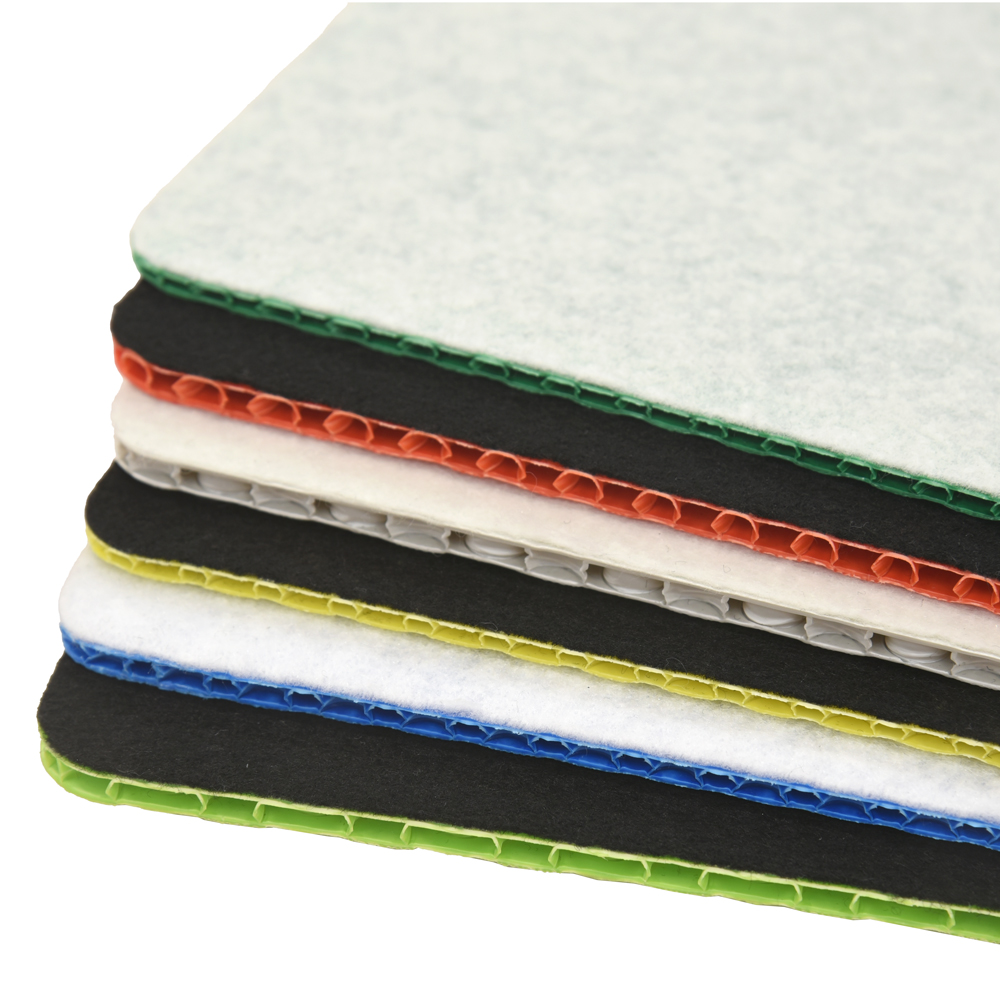
A rigid PP honeycomb panel gives the firm surface a wheelchair needs; corrugated PP sheet is too flexible and too thin to hold a consistent going over a threshold.
What we can do
We supply rigid honeycomb panels with a tested wet slip face for accessible routes, cut with chamfered joints. Tell us the gradient, the width and whether the route is external, and we will specify – including where an alternative route is the better answer. Slip behaviour is explained in slip resistance testing on protection panels.