
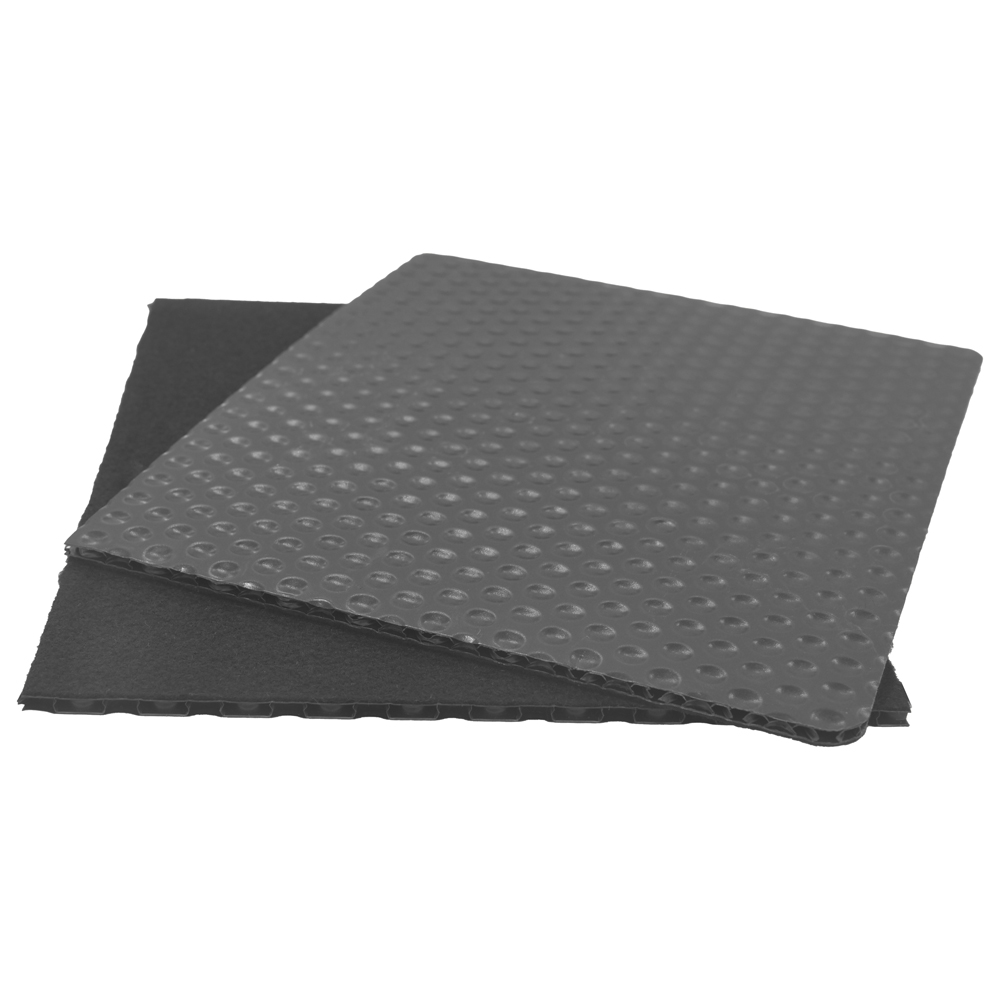
On a wet week, everything wrong with a floor happens in the first few metres inside the entrance. That is where the water comes off boots and wheels, where it meets the grit that came in with it, and where it gets carried onwards into the finished areas. It is also, routinely, where the protection is thinnest, because the entrance is treated as a working zone rather than a finished one.
Why the entrance does the damage
Water alone is not the problem on most floors – a spill that is wiped up does nothing. Water plus abrasive is, because the water turns grit into a slurry that gets dragged and worked into a finish, and it suspends fine particles so they reach places dry grit never would. The entrance zone is where both arrive together and get carried on soles and wheels for the next twenty metres.
The panel has to drain, not just resist water
A panel that does not absorb water is necessary and not sufficient. Polypropylene absorbs effectively nothing, which means the panel itself will not swell, warp or rot – the failure modes of the cardboard and MDF products this replaced. But water sitting on the top surface is still a slip hazard and still gets carried onwards. An embossed face with channels between the studs moves water sideways to the panel edges instead of holding it in a film, and that is what makes the difference underfoot rather than in the material spec.
Where the water goes after that
Off the panel edge, and then it has to go somewhere. A run of protection that ends at a doorway with no absorbent mat beyond it just relocates the puddle. The arrangement that works is scraper mat outside, embossed panel across the wet zone, absorbent mat immediately inside the finished area, and a cleaning frequency that matches the weather. Miss the last one and the other three stop working by the second day.
Slips, and what is actually measured
Pendulum or ramp testing on a wet panel gives a number, and a wet embossed face typically holds a usefully higher value than a wet smooth one. But the number assumes a clean surface. A panel carrying a film of clay slurry will be slippery whatever its pattern, which is why cleaning frequency matters more than the pattern once the site gets genuinely muddy. Testing method and its limits are set out in slip resistance testing on protection panels.
Winter, and the grit that comes with it
Rain brings mud; frost brings salt and grit, which is worse because the particles are harder and because de-icing salt is corrosive to some finishes and to metal door furniture. A site entrance in February needs a different cleaning regime from the same entrance in June. Sites that run one specification year-round discover this at handover on a floor that was protected every day of the programme.
Where the mat goes
A scraper mat inside the finished area is in the wrong place – it collects grit after it has already been walked across the floor. It goes outside or in the transitional zone, before the finish starts. The absorbent mat goes inside, after the scraper, to take the water off soles. Two mats, in that order, and the panel between them does most of the work.
What we can do
We supply embossed-face honeycomb panels for wet entrance zones, cut to size with a tapered leading edge so trolleys do not catch. Tell us what the entrance is made of, what the weather does there and how often it can be cleaned, and we will size the run and tell you where it needs to stop.