
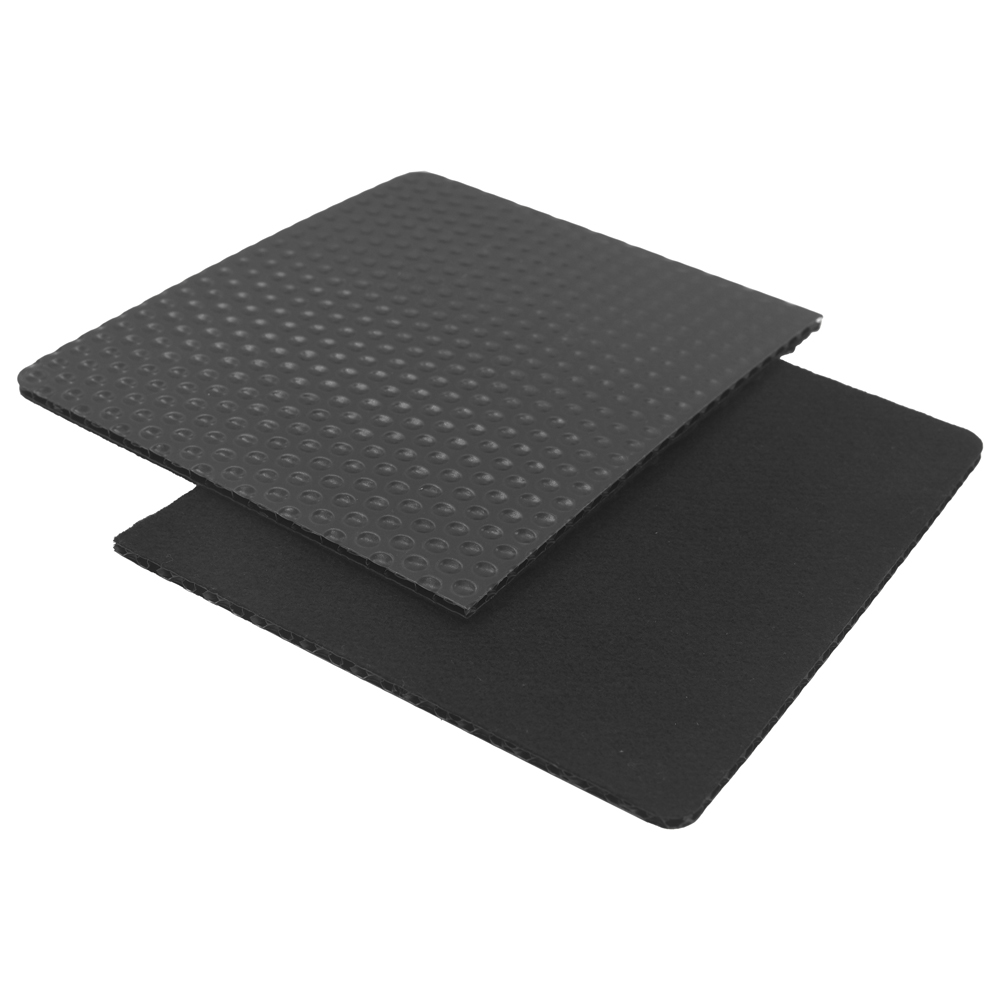
Most floor protection fails from the top surface down, not from the floor up. Wheels are the reason. A loaded pallet truck puts perhaps a tonne through four small wheels, and each wheel contacts the panel over an area smaller than a ten pence piece. Nothing in the panel specification matters as much as what that top surface does under a rolling, turning load.
Why wheels are harder on panels than feet
A boot spreads load over a sole, and the load is transient. A wheel concentrates load into a line contact and stays there as it travels. Worse, the wheel is usually harder and stiffer than the panel skin, so it is the panel that deforms. Anything soft on the top surface – a felt face laid studs-down by mistake, for instance – will bunch ahead of the wheel and tear within a few metres.
Turning is the destructive part
Rolling straight is relatively benign. Turning on the spot is what kills panels, because the wheel is now scrubbing laterally across the surface while carrying the same vertical load. That shear is what lifts embossing, scuffs skins and drags the top layer sideways. The practical consequence is that protection gets destroyed at doorways, corners and lift lobbies rather than along straight runs – the places where vehicles turn.
What the raised face does here
An embossed top face helps for two reasons that are not about grip. The studs give the wheel something to sit on that is not continuous skin, so deformation is localised to the stud tips instead of dishing a whole area. And the valleys between studs give the torn material somewhere to go rather than propagating a crack across the panel. The grip benefit is what people buy it for; the abrasion behaviour is what actually saves the panel.
Where it still gets shredded
At joints. A wheel crossing from one panel to the next meets a step, however small, and that step is where edges chip and skins lift. Butting panels tightly, and avoiding joint lines across known wheel routes by rotating the laying pattern, is worth more than upgrading the panel. On routes that carry pallet trucks daily, a dedicated run of thicker panel along the wheel line costs little and stops the whole floor being re-laid. The route planning side is covered in moving materials over protected floors.
Thresholds and transitions
Door thresholds and changes of level are where panels crack, because the panel is being bent over an edge while carrying a wheel load. A chamfered transition strip or a tapered panel at those points removes most of the failures. It is also the detail most often missing from a protection layout, because it is nobody’s explicit responsibility.
Wheel width is worth asking about
A narrow wheel concentrates load and cuts; a wide wheel spreads it and rolls. Two trolleys of identical weight can do very different things to the same panel depending on wheel width and material, and where the fleet is known it is worth asking. A site running narrow steel wheels needs a thicker panel than one running wide polyurethane ones, at the same load.
What we can do
We supply honeycomb panels with an embossed wearing face for routes that carry wheels, and we will ask about vehicle types before quoting rather than after. Tell us what runs over the protection and how often it turns, and we will specify the face and thickness to suit – including saying when a plain panel will do because the route is foot traffic only.