
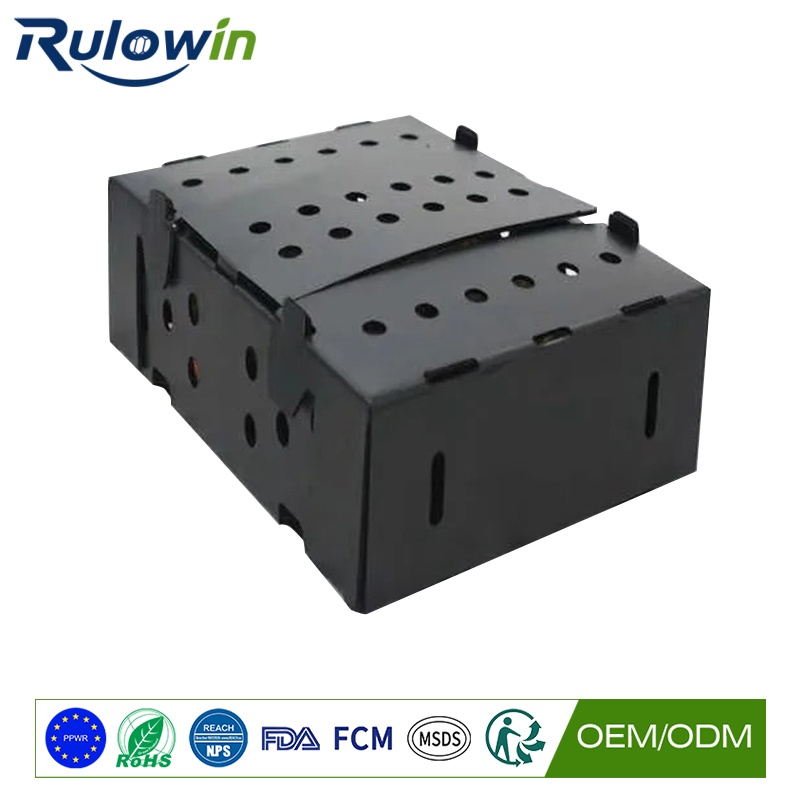
Hand packing forgives variation. An automated line does not. Moving from manual to automated handling is where a crate specification that was perfectly adequate becomes a source of downtime, and the causes are rarely about strength.
What the line needs from a box
Consistent external dimensions. A robot or a gripper is taught a position. If boxes vary between mouldings or between deliveries, the line drifts out of alignment and someone spends their day adjusting it. This is the single most common cause of trouble, and it is invisible until the line runs fast.
A predictable base. Conveyors, roller beds and transfer points all need a flat, consistent surface. A base that rocks, or that has features at varying heights, catches on gaps and transfers.
Known friction. Boxes have to grip enough to be carried and release when they should. PP on steel has its own coefficient, and it changes with wear, dust and moisture. If the line has inclines or diverters, friction is a design parameter rather than an accident.
Square, stable stacking. Automatic palletisers build stacks fast and cannot correct a box that sits crooked. Boxes that nest inconsistently or that have poor stack registration cause more palletising problems than any strength issue.
Where reusable boxes differ from cartons
A carton is damaged slightly on every trip, so the line sees a fresh box each time within a narrow band. A reusable crate is the same box for years, which is generally better for consistency – until it is damaged.
The consequence is that the line has to tolerate a crate that has a slightly knocked corner or a scuffed base. Where that is not tolerable, the retirement rule has to be tighter than it would be for manual operations, because a marginal crate that a person would work around will stop an automated line.
Practical points
- Standardise on one footprint if the line handles several products. Fewer changeovers, fewer errors.
- Check the base for features that could catch – lips, ribs, drainage that protrudes.
- Consider a wearing surface on the base if it runs on rollers, since abrasion changes friction over time.
- Allow for nesting during infeed – de-nesting reliably is a mechanical problem that a poorly designed rim makes worse.
- Test with worn boxes as well as new ones. A line validated with new crates can fail in month three.
What to validate and how
Run a full shift with production crates at both ends of the age range – a new one and one approaching retirement. Watch the transfer points, the diverters and the palletiser. Problems show up within an hour and are obvious once seen, and they cannot be predicted from a drawing.
It is worth doing this before committing to a fleet rather than after. A change of base design is trivial at specification stage and disruptive once a thousand crates exist.
Where automation changes the specification
Automated handling usually pushes toward more consistent dimensions, a flatter base and tighter tolerances – all of which favour a moulded or more rigidly formed crate over a lightly fabricated one. It also pushes toward better stack registration, which often means a specific rim profile rather than a generic one.
The trade is cost and, sometimes, nesting efficiency. It is worth being clear about which of those you are willing to give up before the line is installed, because retrofitting consistency into a fleet is not possible.
What we can do
We supply produce boxes and will ask about your handling equipment before recommending a construction. If you are moving to automated packing, tell us the conveyor type, the transfer points and the palletiser, and we will tell you what the box needs – and where the honest answer is that a moulded crate would serve you better than what we would otherwise build.