
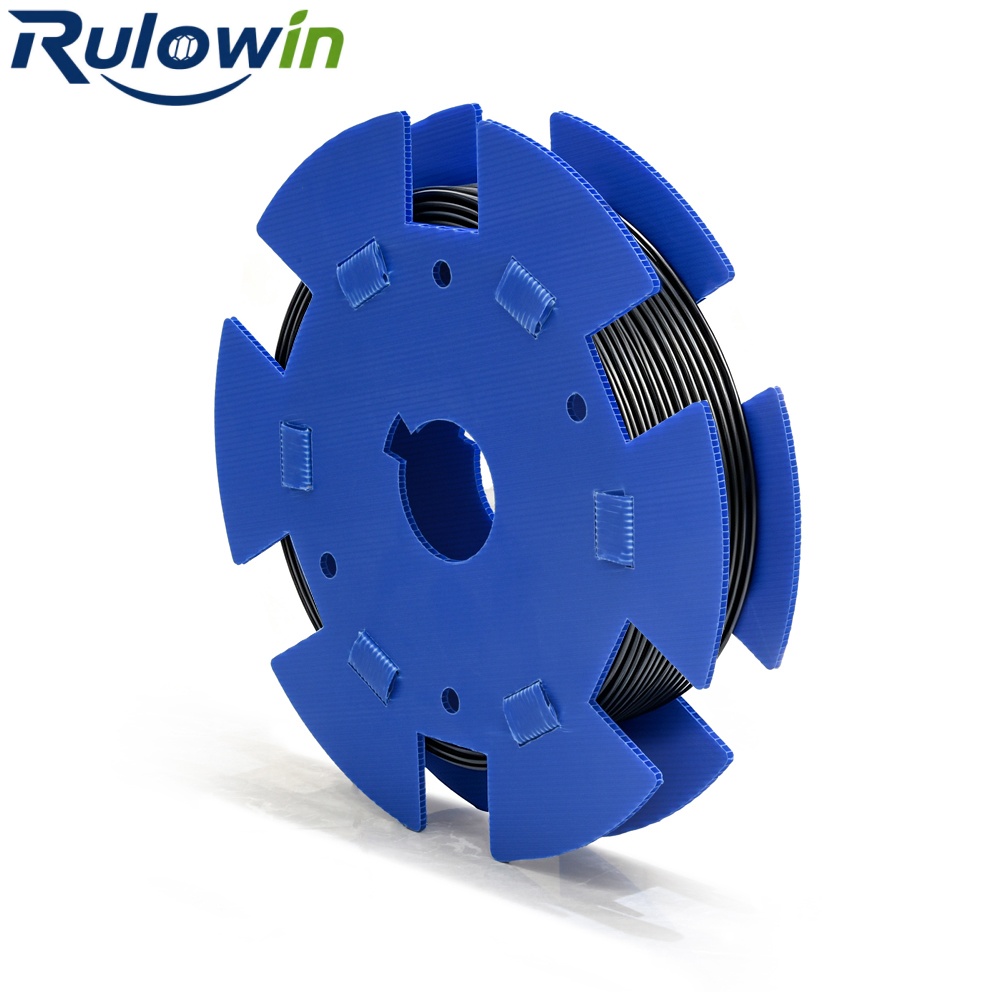
A returnable spool that cannot be identified is a returnable spool that will not come back. Marking matters more than it looks like it should, and it is usually specified last, which is why so much of it has disappeared by the time anyone needs it.
Why you mark a spool
- Ownership. “Property of X, return to Y” only works if it is legible in a yard at the far end of a supply chain.
- Traceability. A serial number lets you track cycles, identify a batch, and find out where the damage is happening.
- Safety and handling. Weight, stack limits, “do not drop”.
- Product identification. Which product line, what spec.
- Branding. Genuinely matters in some sectors, irrelevant in others.
The methods, and what happens to them
Paper or film labels. Cheapest, highest fidelity, and the first to go. They peel in the wet, tear when dragged, fade in UV, and come off entirely if the spool is washed. Fine for one-trip packaging or indoor storage. Poor choice for anything reusable outdoors.
Printed directly onto the flange. Screen or pad printing onto PP. Better than a label because there is nothing to peel, but PP is a low-surface-energy material and ink adhesion depends on surface preparation. Done properly it lasts reasonably; done poorly it wears off in patches within a season. Ask what surface treatment is used.
Hot stamping / heat transfer. Good adhesion and decent durability. Limited colour range and it is a contact process, so the surface has to be flat.
Embossed or moulded markings. Where the flange is formed rather than cut, the marking can be raised from the surface. Effectively permanent, survives washing and abrasion, readable even when dirty. Costs tooling and limits what you can say — changing a phone number is not trivial.
Engraved or etched. Permanent, low fidelity, slow to apply. Useful for serial numbers where you want permanence and the marking is small.
RFID. Excellent for tracking, and genuinely useful where cycle counting is part of the programme. Adds cost per spool, needs to be placed where it will not be crushed, and needs readers at the points that matter. Discussed in the context of automation in our article on automated handling.
Where to put it
This is where most markings fail. General rules:
- Flat surfaces take marking well; curved rim or ribbed areas do not.
- Outboard on the flange face survives better than anywhere near the hub, where handling contact concentrates.
- Protected positions — recessed, or where another stacked spool will not abrade it.
- Visible when stacked. A marking on the inside face of a flange cannot be read on a stack of nested spools, which defeats the purpose entirely.
- Where a label will not interfere with the product. Raised markings inside the winding space are a marking risk.
The interaction with cleaning and UV
These are the two that kill markings most often. Washing removes labels and abrades print; UV fades pigments unevenly so that part of a marking disappears first. Both are covered in more detail in the relevant pieces on cleaning and UV exposure.
If your spools get both, print may not be viable at all and permanent marking is the answer.
Colour coding, briefly
Colour identification survives better than print because it is the material rather than something applied to it. We covered this in our article on colour coding spools by product type, and it remains the most durable low-cost identification available.
What we recommend in practice
For a reusable programme: permanent or integral marking for ownership and serial number, and something changeable for product-specific information. Trying to do both jobs with one method usually ends with neither working.
Ask about marking when you order rather than after — on our hollow board spools, some methods need to be set up during production and cannot be added later at reasonable cost.