
An airport terminal refit is floor protection at its most constrained: tens of thousands of passengers a day crossing the work area, security and airside rules governing what can be brought in and left down, and a floor that is usually stone or terrazzo where a repair is visible and expensive. The product matters less than the constraints around it.
What the floor is, and why it matters
Terminal floors are typically terrazzo or a hard stone, chosen for a service life measured in decades. They resist wear well and they are essentially impossible to patch invisibly: a chipped terrazzo nosing or an etched stone panel is a replacement, not a repair. That makes edge protection and chemical protection the priorities rather than general coverage.
Passengers, not workers
The traffic crossing the protection is not site traffic. It is passengers with wheeled luggage, in a hurry, often in a group, and not looking at the floor. Wheeled suitcases are hard, narrow and destructive at joints, and they travel in exactly the areas that have to look acceptable. Joints have to be tight and edges tapered, and the run has to be inspected daily rather than weekly.
Airside constraints
Anything used airside has to be agreed with the airport operator in advance – fire performance, how it is fixed, whether it can be left overnight, and how it is brought through security. That process takes longer than the product lead time, so it is the first thing to start and the most common cause of a protection plan failing on day one.
Night working and re-laying
Most terminal work happens at night. The protection goes down after the last flight and comes up before the first, which means it is laid and lifted hundreds of times over a programme. It has to be quick to handle, obvious to put back correctly, and durable enough to survive that cycle – which is an argument for a reusable board over anything disposable.
Procurement on this kind of job
Terminal frameworks run for years and the specification is set once. Quantities are called off against the works programme, deliveries are timed to night shifts, and the supplier has to be able to hold stock for the duration. Price matters less than reliability: a late delivery on a night shift is a failed shift.
Where not to bother
In back-of-house areas with a service floor, and in any area being fully stripped and re-floored. Terminal floor protection budgets get wasted on areas nobody sees while the passenger route is under-specified.
What the operator will ask for
Expect four things: a fire test report for the construction supplied, a wet slip test result, a method statement for laying and removal, and confirmation of how the board is fixed – which at an airport usually means not fixed at all. Getting those four together takes longer than the product lead time, so they are the first task on the programme rather than the last before delivery.
Twenty-four-hour buildings with no slack
An airport terminal has no shutdown window. Work happens behind hoarding while passengers walk past, and the protection has to cope with a rolling load that never stops – wheeled suitcases, trolleys, cleaning machines and catering barrows, all on a hard polished floor that is also the building’s public face.
Two properties dominate. The first is edge safety: a raised panel edge in a public concourse is a trip claim, so joints have to be tight and panels have to stay flat. The second is residue. Cleaning machines run across the floor every night, and any adhesive left by tape will be spread rather than removed. Panels should be held at the perimeter with low-tack tape and weighted at field joints, never taped across the surface. Where the work is behind hoarding, the panel also protects the hoarding base from trolley impact, which is where hoarding usually fails first. Public-area phasing is described in phasing protection across a live building.
What we can do
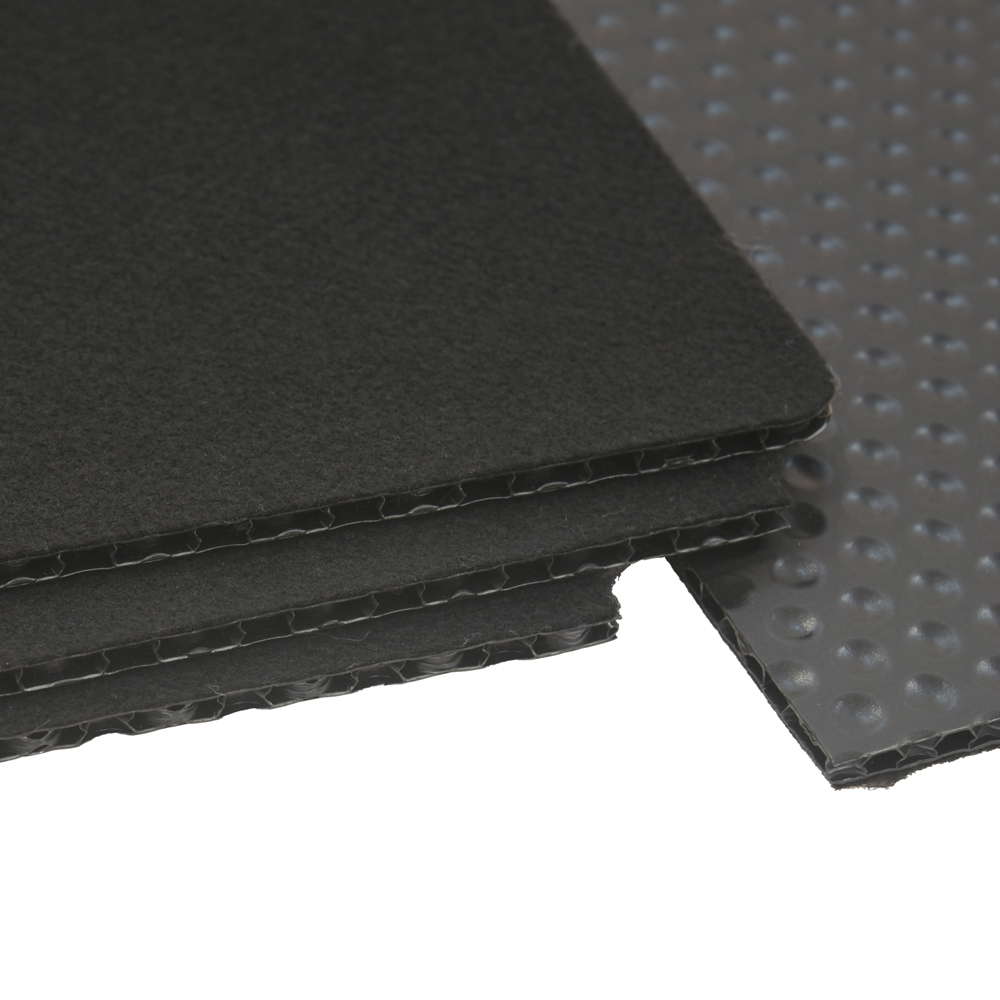
We supply PP honeycomb protection board with fire performance data for airport submissions, cut to size with tapered edges for passenger routes. Tell us the floor type, whether the area is airside and what the operator requires, and we will provide the documentation first. Edge risk on stone is covered in protecting stone and terrazzo from chipped edges.