
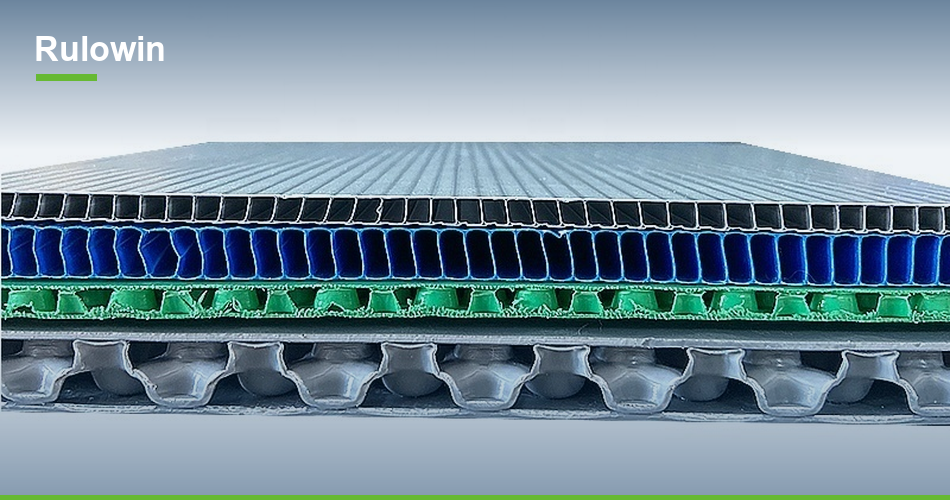
When procurement teams look for one material that can quietly solve a dozen packaging problems at once, polypropylene (PP) corrugated sheet — sometimes called PP hollow board or fluted board — is the answer. At Rulowin we manufacture this lightweight, rigid, waterproof and fully recyclable substrate for industrial customers who are tired of cardboard that sags, delaminates and ends up in the bin after a single trip. This article explains what PP corrugated sheet is, why it outperforms fibreboard in demanding environments, and the concrete ways global manufacturers deploy it on the line.
What Exactly Is PP Corrugated Sheet?
PP corrugated sheet is an extruded twin-wall polypropylene panel. Two flat outer skins are welded to a fluted inner core, producing a board that is stiff in bending yet light in weight — typically 300–2,000 g/m2 depending on thickness (2–10 mm). Because it is a thermoplastic rather than a cellulose fibre, it does not absorb water, does not harbour mould, and resists most acids, alkalis and solvents found on a factory floor. It is also 100% recyclable and can be reground into new sheet at end of life, which matters for any company tracking its circular-economy metrics.
Why It Beats Cardboard in Industrial Use
Corrugated fibreboard is cheap per unit but fragile under real industrial stress. PP corrugated sheet changes the economics by surviving the journey instead of being consumed by it. The differences are concrete:
- Water and chemical resistance: it will not soften in wash-down, cold-chain or oily environments where cardboard fails within hours.
- Reusability: a typical PP corrugated divider or tote lasts 20–50 trips versus one trip for fibreboard.
- Weight: comparable rigidity at a lower areal weight than laminated board, trimming freight.
- Cleanliness: fibre-free and splinter-free, so it is safe around electronics and food.
- Printability: smooth surfaces take screen print, labels and barcodes without bleed.
Core Use Cases on the Factory Floor
The versatility of the material shows up in the number of jobs it can absorb. Four applications dominate:
Dividers and Part Separators
Custom-cut PP dividers keep components from knocking together inside totes and cartons. Because the sheet is easy to die-cut and crease, Rulowin supplies compartmentalised inserts for automotive and electronics kits where each cavity is shaped to a specific part.
Reusable Totes and Boxes
Folded and ultrasonically welded, the sheet becomes rigid returnable boxes that survive assembly-line circulation far longer than taped cardboard.
Layer Pads
Flat PP layer pads separate stacked goods on a pallet, distribute load and protect surfaces — reusable hundreds of times and easy to wipe clean between batches.
Lightweight Boxes and Covers
For in-plant transport, PP sheet boxes replace disposable cartons, eliminating the daily cardboard spend and the associated waste-handling cost.
A Quick Comparison
| Criterion | PP Corrugated Sheet | Corrugated Cardboard |
|---|---|---|
| Trips per unit | 20–50+ | 1 |
| Water resistance | Excellent | Poor |
| Chemical resistance | High | Low |
| Recyclability | 100% (closed loop) | Downcycled |
| Fibre / dust | None | Present |
Specifying the Right Sheet
Choosing the correct grade is straightforward: match thickness and density to the load and trip count you need, decide on anti-static or food-grade additive, and let the converter handle die-cutting and welding. Rulowin stocks standard sheets and also produces made-to-measure inserts and boxes, so the same material can serve a divider today and a returnable tote next quarter.
PP corrugated sheet is the quiet foundation of a reusable packaging program — cheap enough to standardise on, tough enough to forget about. Talk to Rulowin’s engineers to spec the right reusable packaging for your line.