
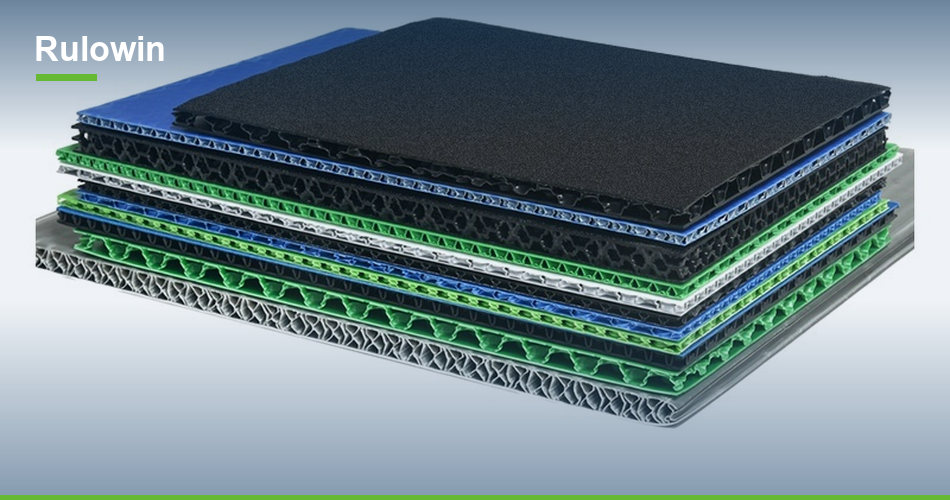
For decades, heavy returnable packaging meant plywood crates and steel framing. They worked, but they were heavy, prone to corrosion and rot, and expensive to ship back empty. PP honeycomb panel is the modern alternative that Rulowin supplies to automotive and industrial customers who want the structural performance of wood or metal with a fraction of the weight. This article shows how the honeycomb structure achieves its strength-to-weight advantage and where it pays off most.
The Strength-to-Weight Principle
A PP honeycomb panel is a sandwich: two solid PP face sheets bonded to a honeycomb core extruded from the same polymer. The geometry is the same one bees use — a cellular structure carries shear and bending loads efficiently because the material is placed where stress occurs, not in the middle where it does little. The result is a panel that can rival plywood for rigidity at roughly 60–70% lower weight, and that does not degrade the way wood does.
Replacing Plywood
Plywood in returnable packaging suffers three failure modes: moisture absorption and warping, splintering and fibre contamination, and gradual delamination. PP honeycomb avoids all three:
- No water uptake: the panel stays dimensionally stable in wash-down and outdoor storage.
- No rot or mould: polypropylene is biologically inert.
- Fibre-free: safe for cleanroom and food-adjacent lines.
- Edge-sealed: Rulowin edge-seals panels so the core cannot ingress liquid or debris.
Replacing Metal
Steel dunnage is strong but heavy and rusts. Where load requirements allow, PP honeycomb cuts return tare weight dramatically, which directly lowers reverse-logistics fuel cost. It is also non-conductive and non-sparking, useful around sensitive electronics and flammable goods.
Automotive Dunnage and Beyond
The clearest win is automotive dunnage — the custom racks that carry doors, bumpers, instrument panels and sub-assemblies between tier suppliers and OEM lines. A PP honeycomb dunnage rack can be:
- Designed to the exact part contour with CNC-cut cavities.
- Cleaned and reused across hundreds of cycles.
- Food-grade or cleanroom-capable for painted or sterile components.
- Up to ISPM 15 exempt because it contains no wood.
Performance at a Glance
| Property | PP Honeycomb Panel | Plywood | Steel |
|---|---|---|---|
| Relative weight | Low | Medium | High |
| Corrosion / rot | None | Yes (rot) | Yes (rust) |
| Fibre contamination | None | Yes | None |
| Reusable lifecycle | 100s of trips | Limited | High |
| ISPM 15 | Exempt | Requires treatment | Exempt |
Designing for Load
Specifying honeycomb is an engineering exercise: face-sheet thickness, core cell size and panel gauge are matched to the distributed load and the stacking height. Rulowin supports customers from prototype cavity design through to volume production of edge-sealed, food-grade-capable panels, so the swap from wood or metal is a drop-in improvement rather than a redesign project.
If your returnable racks are heavy, rusting or shedding fibres, PP honeycomb is worth a serious look. Talk to Rulowin’s engineers to spec the right reusable packaging for your line.