
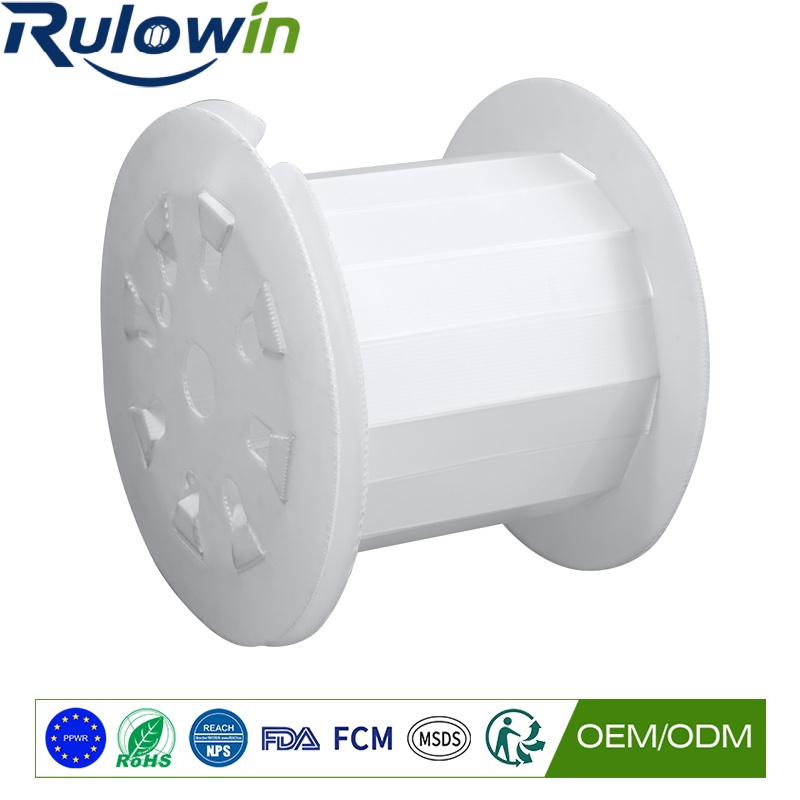
Pallets get chosen by availability and the choice rarely gets revisited. For spools specifically, three characteristics matter more than for most loads, and getting them wrong causes damage that looks like something else.
Overhang
A spool that extends beyond the pallet edge is unsupported at that edge, and the overhanging section carries load it was not resting on. Consequences:
- Flange deformation where an unsupported rim takes stack or strap load
- Damage in transit when an overhanging spool contacts a container wall or a neighbouring pallet — contact happens at the extremity first
- Instability where the load’s centre of gravity falls outside the pallet footprint
- Problems with automated handling, which is unforgiving about footprint in a way human operators are not — see our automation article
The practical rule: keep spools inside the pallet footprint. If the spool diameter makes that impossible, the pallet is the wrong size rather than the overhang being acceptable.
Footprint match
Ideally the spool diameter and the pallet dimensions relate cleanly, so spools sit with support across their base and without wasted space.
Where they do not, you get either overhang or poor utilisation — and poor utilisation on a bulky lightweight item is expensive, because you are shipping air either way. This compounds with the freight arithmetic in our article on spool weight and freight.
Worth doing once: work out how many of your spools fit per pallet without overhang, and compare against what you currently ship. The difference is sometimes surprising in both directions.
Deck board gaps
A spool resting on a pallet contacts the deck boards, not a continuous surface. Wide gaps between boards mean:
- Point loading on the flange where it bridges a gap
- A tendency to rock if the spool is not centred on a board
- Damage in transit as the load shifts slightly and re-seats
Where spools are heavy relative to the flange, a deck with close board spacing or a solid deck is meaningfully better. Cheap pallets with widely spaced boards are a false economy for this load type.
Pallet condition and type
- Broken deck boards create a gap where a spool can drop or tilt — worth rejecting at loading, not after
- Wood moisture matters for export, which is why our article on ISPM 15 exists; the pallet is often the item that needs treatment, not the spool
- Plastic pallets avoid treatment questions and are dimensionally consistent, at higher unit cost and with their own repair considerations
- Pallet weight adds to the freight bill on both legs of a return loop
Stacking on pallets
How spools are arranged on the pallet matters as much as the pallet:
- Flange-to-flange stacking concentrates load at the rim; face-to-face across the flange distributes it
- Interleaving board between layers spreads load and prevents rim-on-face contact damage
- Height affects stability more than people allow, particularly on a pallet that will be moved several times
What to specify
If you are setting this up rather than inheriting it:
- Pallet size that accommodates your spool diameter without overhang
- Deck with close board spacing or solid top for heavy spools
- A stated rejection criterion for damaged pallets
- Whether pallets are returnable, exchanged, or consumed — which is a cost question and an ownership question, similar to the issues in our ownership article
What we can tell you
Give us your spool diameter and weight and we can tell you what our hollow board spools need in terms of support and what fits a standard pallet without overhang. It is a five-minute question and it prevents a recurring category of avoidable damage.