
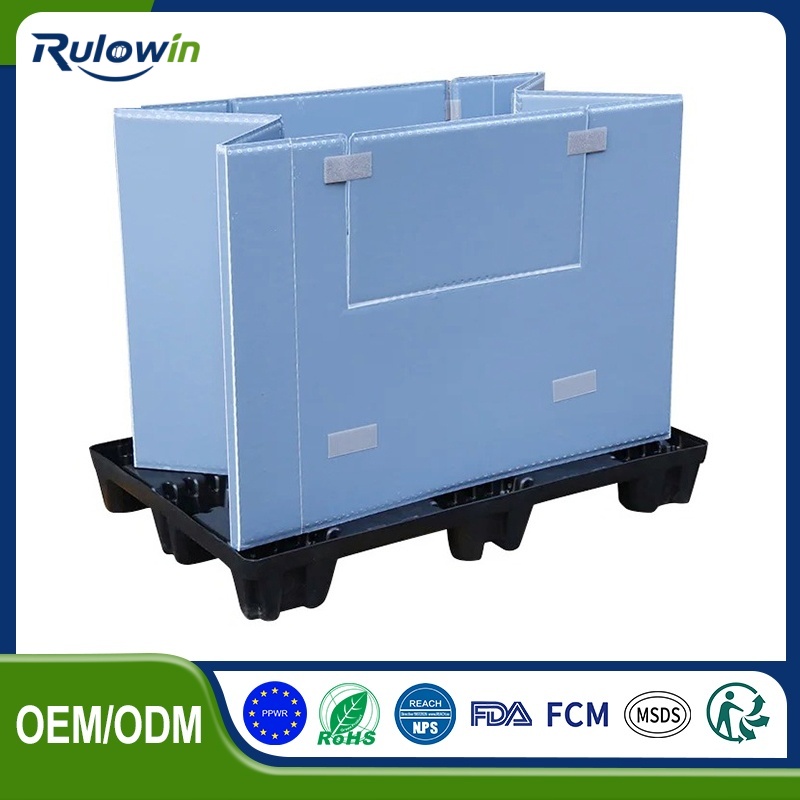
A mixed-case palletiser builds stable pallets from boxes of different sizes arriving in an unpredictable order. The software can plan the pattern; what it cannot do is compensate for boxes that are not the size the plan assumed. Where mixed-case palletising runs below expectation, the cause is usually dimensional variation in the container rather than a limitation in the planning algorithm.
The plan assumes the box
Pattern planning works from a list of box dimensions. If every box is exactly that size, the plan builds a pallet that matches the simulation. If boxes vary, each placement carries an error, and the errors accumulate across a layer – a millimetre per box becomes a centimetre across ten. The result is a pallet that is either unstable or does not fit the footprint, and the usual response is to add gaps to the plan, which costs density.
Where the variation comes from
Between sizes it is intended. Within a size it is not, and it comes from tooling, from material thickness, from how the box folds or seats, and from service deformation. A fleet that has been in use for a year has a wider distribution than a new one, and a fleet that has been repaired has a wider distribution still. Measuring the fleet is the only way to know, and it is a morning’s work that prevents a long commissioning argument.
Gaps are the cost of tolerance
A planner deals with uncertainty by leaving gaps. The gaps are the price of the tolerance: a fleet held to two millimetres gets a tighter pallet than one held to five, and the difference in pallet density is real and repeatable on every pallet. Where density matters, buying tolerance on the container is often cheaper than buying a better planner. The trade-off is the same one discussed in palletising patterns and cycle time.
Weight distribution in a mixed pallet
A mixed pallet is only stable if heavy boxes go low. Where the arrival order is unpredictable, the planner cannot always achieve that, and the fallback is a rule about which sizes may be placed on which. Those rules depend on knowing which sizes are heavy, which means the container specification has to include the loaded weight – and it frequently does not, because the weight depends on the contents rather than the box.
Interlocking and why mixed sizes break it
Some box families interlock when stacked, which greatly improves stability. Interlocking only works between boxes of the same footprint, and a mixed pallet is by definition not that. Where a fleet is intended for mixed palletising, interlocking features are of limited value and the stability has to come from the pattern and the wrap instead. Designing interlocking features into a fleet that will be mixed is wasted effort.
What actually improves a mixed cell
Reduce the number of sizes. Standardise footprints so sizes differ mainly in height. Hold a tight tolerance on the footprint and allow more on the height, because the planner cares about footprint far more. And measure the fleet periodically so the plan’s dimensions stay true. Four changes, none of which involve the robot, and together they usually recover most of a mixed cell’s shortfall.
What to give the integrator
Every size with its tolerance, every loaded weight, and the arrival mix. Where the mix is unknown, the worst realistic mix rather than the average one. A planner given the average will build pallets that fail when the mix runs heavy, and a planner given the worst case will build pallets that hold. Send us the sizes and we will quote a family that shares a footprint.