
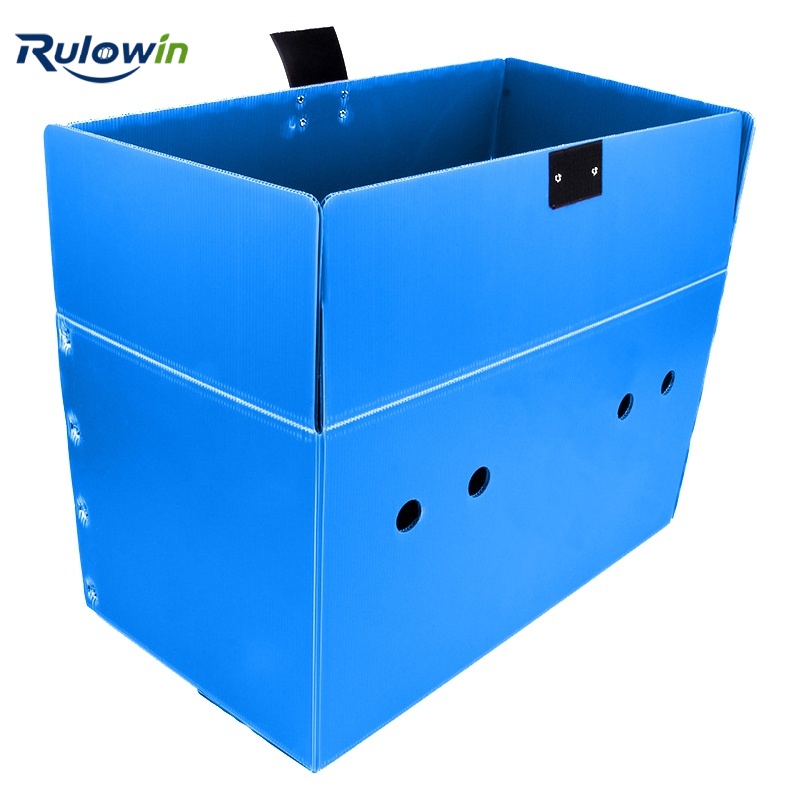
A vision-guided system needs something to look at, and the options range from finding the box‘s own edges to reading a dedicated mark. The dedicated mark is usually more reliable and always more fragile, because it is a small feature in exactly the place where the box gets handled. Choosing the right kind means deciding what the service life has to be, and that decision should be made before the tooling is cut.
Geometric features first
The longest-lived locating feature is part of the box: a corner, a rim, a boss, a recess. It cannot wear off because it is the material, and it cannot be misapplied because it is always in the same place. Where a box’s natural geometry provides a clean corner and a consistent edge, no added mark is needed at all, and this should be the default starting point. The requirement is that the feature is consistent across the fleet, which is a tooling question.
Moulded or embossed marks
Where the geometry is not enough, a feature moulded into the surface is the next best option. It survives washing, abrasion and most chemicals, and it is detected by shape or by shadow rather than by colour, which makes it far less sensitive to lighting changes. It costs a little more at the tooling stage and nothing per unit. Where containers are washed or handled hard, this is usually the right answer.
Printed marks and where they fail
A printed mark costs almost nothing and can be applied to an existing fleet, which is why it is the default. It fails by abrasion, by chemical attack and by UV, and it fails first at exactly the points where handling contact occurs. A printed mark in a protected recess lasts years; the same mark on a flat panel in a grip area lasts weeks. Position is more important than print method. See also label wear and scan read rates.
Colour and contrast stability
A mark detected by colour depends on both the mark and the box keeping their colour. PP containers are often coloured with a masterbatch that fades under UV, and the mark-background contrast that was strong when new can become marginal after a summer outdoors. Where colour detection is used, either the container material has to be UV-stabilised, or the detection should be by shape or by luminance rather than by hue.
Placement rules
Put the mark where the box is not touched: not in a grip area, not on a face that runs against a guide, not on the base, not where a stacked box covers it. Put it where the camera can see it from its actual mounting position, which is often lower and more oblique than people expect. And put it on enough faces that the box can arrive in more than one orientation. Three rules, and following all three costs nothing at the tooling stage.
Redundancy
Two marks are much better than one, because the failure mode of a single mark is total and the failure mode of two is degraded. Where a box can be handled from either end, or arrives in two orientations, redundancy is the difference between a system that slows down and one that stops. The marginal cost is small and the reliability gain is disproportionate.
What to decide
Whether the box geometry is sufficient, then whether the environment destroys printed marks, then how many orientations have to be supported. Three questions in order. Answering the first one well often removes the need for the other two, and answering it after the tooling is cut means living with whatever the box happens to present.