
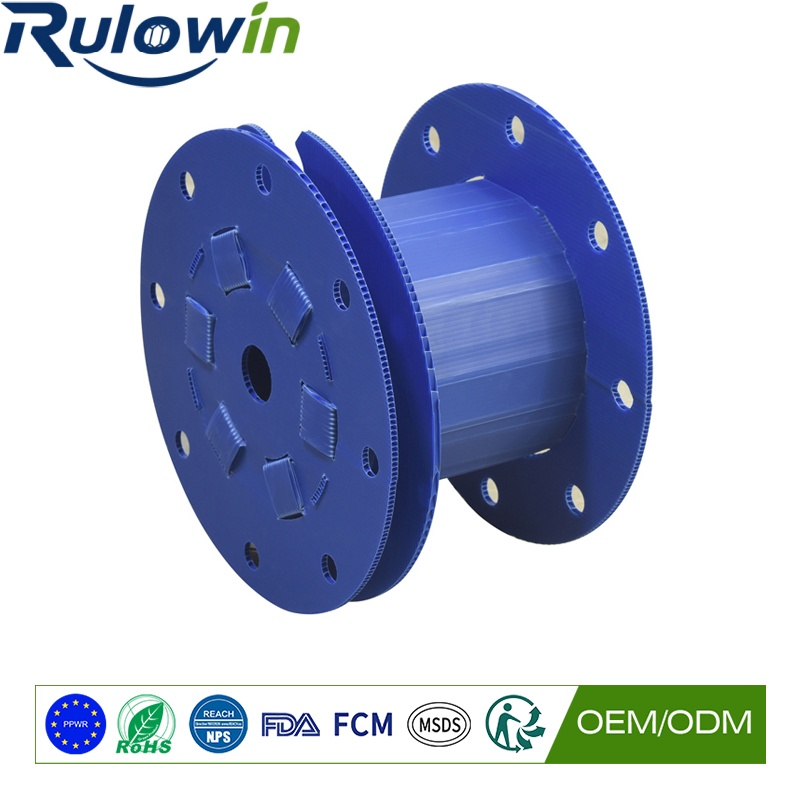
Once a spool is too heavy or too high for manual handling, it gets lifted. The lift is where serious damage and serious injury both happen, and the causes are usually about the attachment point rather than the equipment’s capacity.
Where the load should be taken
The spool is designed to carry load radially — outward from the core. It is not designed to be picked up by the flange rim and swung.
In order of preference:
- Through the bore with a proper lifting device — a shaft, a pin, or an expanding mandrel. The load path goes through the strongest region and the spool hangs in the orientation it is designed for.
- Under the flanges with a cradle or purpose-built frame that supports from beneath. Good where the spool needs to be horizontal.
- Around the pack, only where the product tolerates it and the sling is protected. Usually acceptable for hard-wearing product, unacceptable for anything soft or finished.
What should not be used: a hook through the bore, a sling around the flange rim, or anything that grips a single point on the flange edge.
Why hooking through the bore is a problem
It is common because it is convenient, and it is a bad practice for several reasons:
- The bore edge carries the whole load on a small contact area. Polypropylene will deform there, and repeated lifting damages the bore — the same region discussed in our bore wear article, for a different reason.
- The spool hangs at an angle and swings unpredictably.
- It can slip. A hook in a round hole has no positive retention.
A lifting pin or shaft that fills the bore changes all three.
Slings around the pack
Sometimes the only practical option. If so:
- Protect the product. Anything between the sling and the pack prevents marking and cutting.
- Use a sling wide enough to spread the load rather than a wire or narrow strap that concentrates it.
- Check the angle. A sling at a wide included angle puts considerably more tension in each leg than people assume.
- Lift vertically. Dragging a suspended load sideways multiplies the tension.
Dynamic loads
A static lift is one thing. What damages spools and injures people is:
- Snatch loading — taking up slack quickly. Peak loads several times the static weight.
- Swinging. A swinging spool has momentum that the attachment has to resist.
- Setting down on one edge, which puts the whole load on a small area of flange.
- Dragging a suspended spool sideways, which is how slings fail.
Slow, vertical, deliberate movement costs seconds and removes nearly all of this.
Equipment condition
Obvious and frequently skipped:
- Slings inspected and within their inspection period
- No damaged or deformed hooks
- Shackles and pins correct and secured
- Lifting devices rated for the load, with the rating visible
Exclusion
People stand under suspended loads. It is the single most reliable way for a spool handling incident to become serious, and it happens because the lift is routine and quick.
A stated exclusion zone, even an informal one, is worth insisting on for any lift above head height.
Where spools get lifted most
In our experience the risk concentrates at three points: loading and unloading vehicles, moving spools on and off machines at height, and recovering them from stacks. All three are worth a specific method rather than leaving it to whoever is available.
What we can tell you
Weights and centre of gravity for our hollow board spools, and what the bore will and will not take. We can also supply lifting pins sized to the bore if that is what your process needs — worth asking, because it is a cheap addition that removes the most common bad practice.