
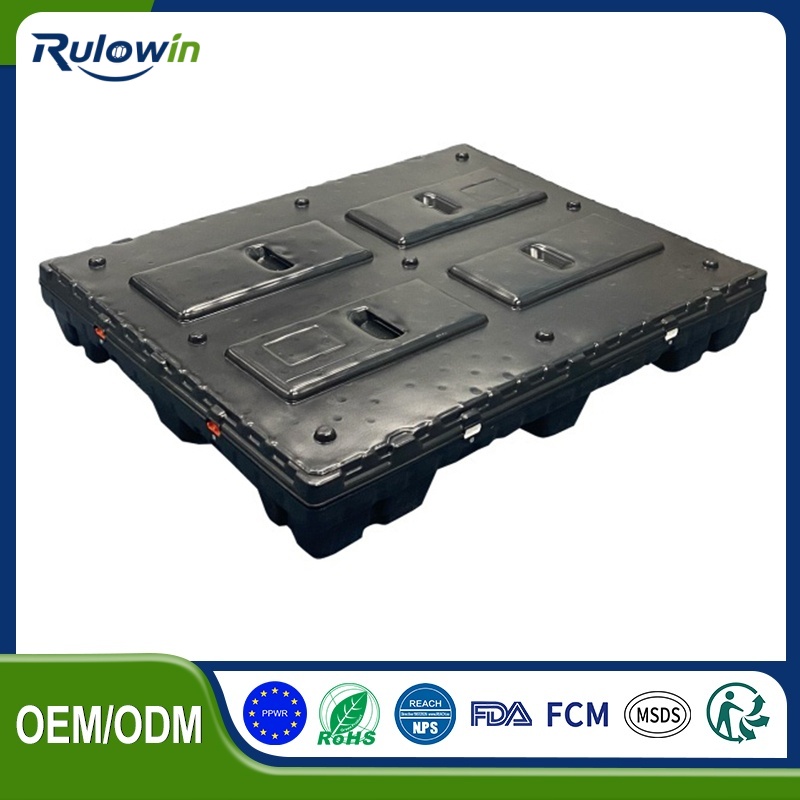
Layer pads arrived with cartons and are usually carried across to reusable boxes without much thought. They do something useful, but in a returnable loop every extra component is something to count, wash, store and lose. The question is not whether a pad helps the load, it is whether the box can be designed so it does not need one.
What a pad is doing
Two jobs. Spreading the load from the feet or lid of the box above across the full area of the box below, and stopping the two surfaces from abrading each other in transit. The first matters where the load arrives at a point; the second matters on long, rough legs.
When the box makes the pad unnecessary
If the lid and the base of a box are designed to register against each other, the load path is defined by the box and a pad adds little. That is the cheaper answer over a fleet life, because it removes a component rather than adding one. It does tie the box design to the stack, which is a constraint worth taking where the fleet is large.
When a pad earns its place
Three cases. Where the load above arrives at a point rather than a face. Where the boxes in a load are of different sizes and something has to bridge. And where the part inside is heavy enough that the box below is already near its rating. In all three, a sheet cut to the footprint is the cheapest form of the fix.
Reusable pads and the loop problem
A reusable pad is another tracked item. It has to be counted at both ends, it occupies space on the return, and it will be used as a floor liner by somebody. Where a pad is genuinely needed, a sheet that can be bought in bulk and written off is often easier to run than one that has to be managed. That runs against the grain of a reuse programme, and it is still usually right.
What to specify
Thickness, footprint, and whether the pad is part of the pack or part of the box. If it is part of the pack it has to appear on the packing instruction and on the bill of materials. If it is part of the box it has to survive the loop, which for a sheet means it has to be thick enough not to crease and cheap enough not to matter.
Testing whether the pad is doing anything
Build two pallets to the same pattern, one with pads and one without, and send them on the same route. Inspect on arrival and compare damage. Two pallets is enough to see a real difference, and the answer is usually obvious.
Where the difference is small, drop the pads. They are a component to buy, count, store and eventually throw away, and a component that does not change the outcome is pure overhead. Where the difference is large, keep them and specify them in writing so they do not get quietly dropped later.
What we can do
We supply PP corrugated sheet cut to a pallet footprint, and we build PP corrugated turnover boxes with lids and bases that register. Tell us the load and the leg, and we will say which of the two you need. The pattern the pads sit in is discussed in which pallet pattern suits a returnable box.