
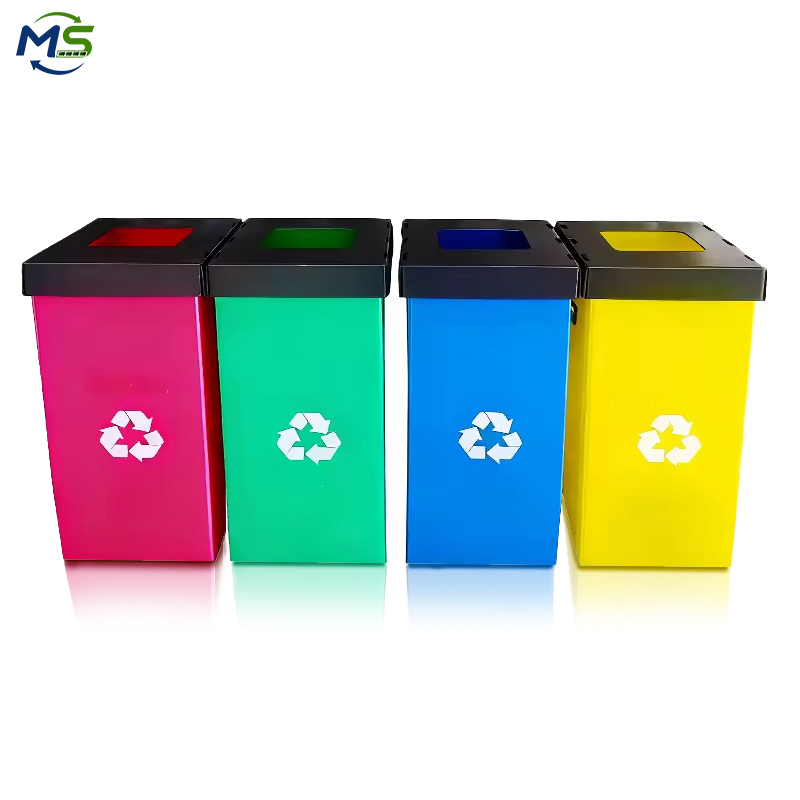
Once three phases of protection are on site, nobody can tell which panels belong where. Colour coding by phase or zone solves several problems at once – it makes stray panels obvious, it stops one trade stripping another’s protection, and it turns strip-out into a visual exercise rather than a deduction.
Decide what the colour means
Colour can encode phase, zone, ownership or “do not remove”. Pick one scheme and mark a legend somewhere visible. The most common mistake is two overlapping schemes – colours by zone and stickers by trade – which leaves everybody unsure which mark takes priority.
Where marking goes
Mark on the top face and on at least one edge, because panels get stacked and only the edge is visible. Large marks survive traffic far better than small ones, and anything relying on a printed label stuck to the surface will be gone within a fortnight on a working corridor.
Durable marking on polypropylene
Polypropylene has low surface energy, so ordinary inks and stickers do not last: they scuff or lift. Options that work include treated surfaces before printing, hot-foil marking, engraved or routed marks, and coloured material through the thickness rather than printed on it. We have written about print durability on this material in how long print lasts on reusable packaging.
Colour through versus coloured film
If the colour carries the meaning and panels will be re-used several times, specify the colour in the material rather than applied to it. Surface films wear off exactly where foot traffic concentrates, which is precisely where the mark needs to survive.
Combine with numbering for count control
A numbering convention printed on the corrugated PP sheet alongside the colour – zone letter plus sequence – gives you a count rather than an impression. At strip-out you know whether forty panels came out or thirty-two, which is the difference between managing losses and guessing at them.
Do not over-engineer it
A two-week job with one area does not need a coding scheme and a legend board; masking tape and a marker pen are plenty. Coding pays off from about the second phase or from the moment multiple trades share a floor. Matching the scheme to the complexity saves both money and eye-rolling.
Running the legend
A colour scheme fails when nobody can consult it. Put the legend where the work is decided – at the site entrance and on the protection drawing – rather than only in the welfare cabin. Keep it to four colours and two rules; anything more detailed stops being used within a fortnight.
Agree what happens at a boundary where two zones meet. A single rule decided in advance – whichever colour is nearer its own zone wins, for instance – prevents the boundary becoming the place where nothing is certain and everything gets stripped.
When coding outlives its usefulness
Colour schemes tend to survive into phases where they no longer mean anything, because nobody instructs anyone to stop. Review at each phase boundary and either reassign the colours deliberately or state that marking is no longer current. Ambiguous marking is worse than none: people either trust it wrongly or ignore all of it.
What we can do
We manufacture colour-coded PP protection items with the colour through the thickness so it survives traffic, and can add durable markings at the factory. Tell us how many phases you have and we will suggest a scheme simple enough for the site team to actually use.