
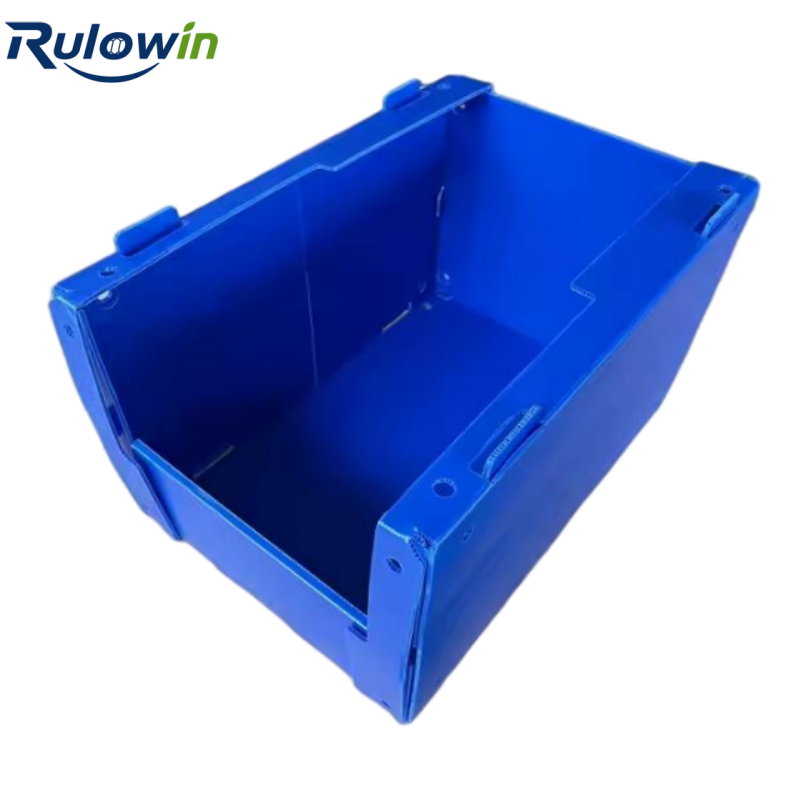
Kitting exists to move work off the line: someone else finds the ten parts, checks them, and presents them as one unit so the assembler does not break pace to hunt for a bracket. It works, and it fails in a specific way – the kit arrives as a heap in the bottom of a box and the assembler spends the saved time re-sorting it. The container decides which of those happens.
Separation is the design
A kit box is not a transport box with dividers dropped in. It is a set of fixed locations, one per part, sized so each part has a home and so a missing part is visible as an empty location rather than discovered at the end of the build. That means dividers fixed to the box rather than loose, because loose dividers migrate and, once they migrate, the visual check stops working. Fixed dividers in PP corrugated board are cheap and can be laid out to the actual kit list.
Sized to the kit, not the part
The temptation is to size each compartment to the part. Size it to the part plus a hand, because a compartment that is an exact fit is a compartment the operator cannot get a gloved hand into, and the kit then gets tipped out onto the bench. Twenty millimetres of clearance per compartment costs nothing and is the difference between a kit that is used as a kit and one that is used as a box.
Order of pick should be order of layout
If the assembler works left to right through the build, the kit should be laid out left to right in build order. This sounds like a detail and it is one of the larger ergonomic gains available at a station, because it removes the visual search entirely – the next part is the next compartment. It does require the kit list to be stable; if the bill of materials changes weekly, use numbered compartments and a card instead.
Count at a glance
Kitting’s other job is completeness. A kit of ten parts where the tenth is missing should be obvious before it reaches the line, and the cheapest way to achieve that is a fixed layout plus a fill line: if compartments are filled to a consistent depth, a short compartment stands out. Where the parts are too small for that, colour-code the compartment base and check by colour, which is faster than counting and works from a metre away.
What happens on the return
Kits are usually built in a store and consumed at a station, so the empty has to come back with dividers intact. That argues for dividers that fold flat or lift out in one piece for the return leg, and for a box that nests or stacks empties without the dividers being removed first. Design the return before the outbound; the loop is where kit schemes quietly break down, and a one-page SOP for a box loop is usually enough to hold it together.
Where kitting stops paying
Kitting is not free and it is not always right. It adds a handling step in a store, it needs a stable bill of materials, and it consumes floor area for the kitting bench. It pays when the alternative is an assembler breaking pace to search, and it does not pay when the build is simple enough that the parts can be presented at the station without pre-assembly. The test is whether search time at the station is actually significant – measure it before committing.
It also stops paying when the bill of materials is unstable. A kit laid out for a specific list is wrong the moment the list changes, and a wrong kit is worse than no kit because it looks right. If variants change daily, present the parts in standard compartmented boxes and let the assembler pick from them rather than pre-building a kit that may not match. The version-control problem that comes with unstable bills of materials is the same one that breaks fixed dunnage layouts, and the answer in both cases is a compartmented container rather than a shaped one.
What we can do
We build kit boxes in PP corrugated board with fixed dividers laid out to your kit list, plus a lid and an end label panel. Send us the list and the build order and we will lay out the compartments – and tell you where a compartment is too small to be usable.