
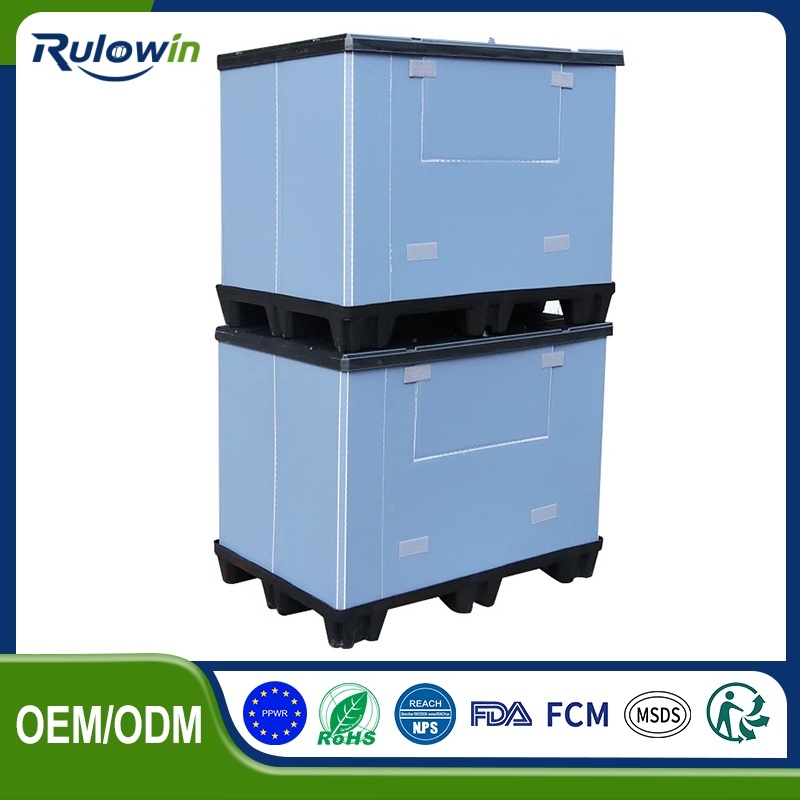
A kitting container carries the set of parts for one assembly operation, divided so each part has its place. The division is what makes the kit checkable – an empty compartment is a visible missing part – and it is also what makes the container inflexible. Deciding how many compartments, how large, and whether they can move is the whole design problem, and it should be answered from the kit rather than from the box.
Compartments as a checking device
The strongest argument for compartments is not organisation, it is inspection. A kitted container with a place for every part can be checked at a glance, and a missing part is visible without counting. That removes a verification step and it converts an error that would be found at the line into one found at the kitting bench. Where kits are complex, this is worth more than the capacity the dividers consume.
What dividers cost in capacity
Every divider takes material thickness out of the container, and every compartment takes a tolerance out of the usable space, because a part has to fit with clearance. Across eight compartments that is a noticeable fraction of the volume. Where the kit is dense and the container is small, dividers can cost a fifth of the capacity, which means a larger container for the same kit, which means more space at every station.
Fixed versus adjustable
A fixed compartment layout is built into the container and cannot change; it is tough, cheap per unit and locked to one kit. An adjustable layout uses movable dividers and suits several kits; it is flexible, slower to set up, and the dividers wear and get lost. Where a kit is stable for years, fixed wins. Where kits change with the product, adjustable wins despite the drawbacks, because the alternative is a container per kit.
Sizing compartments to the part, not to the drawing
A compartment has to accept the part as it arrives, which is not the same as the part as drawn – it may come in a bag, with a fitting, or in a quantity that varies. Sizing to the drawing produces compartments that are slightly too small in practice, and slightly too small means the part goes in the wrong one or on top. Where quantities vary, size for the maximum quantity rather than the nominal one.
Compartment height and the visual check
A compartment deep enough to hide its contents defeats the checking purpose. A shallow compartment shows what is in it, which is why kitting containers are often wider and shallower than a general-purpose box of the same volume. Where the check matters – and it is usually the reason compartments exist – depth should be limited deliberately rather than maximised for capacity.
Identification per compartment
A compartment needs to say what belongs in it, permanently, and in a way that survives the handling cycle. A moulded or printed mark inside the compartment lasts; an adhesive label in a compartment that parts are dropped into does not. Where kits are checked visually, the identification is part of the checking device and it should be as durable as the container. The marking options are covered in locating marks and durable marking. , and the wider kitting question in kitting parts into one box before they reach the line.
What happens at the end of the kit
When a kit changes, a fixed-compartment container becomes obsolete, and on a long product life that is a real cost. Where kits change regularly, either the container is adjustable or it is cheap enough to replace. That is the decision that should be made at the start, because it determines whether the container is a five-year asset or a consumable, and those are specified very differently.