
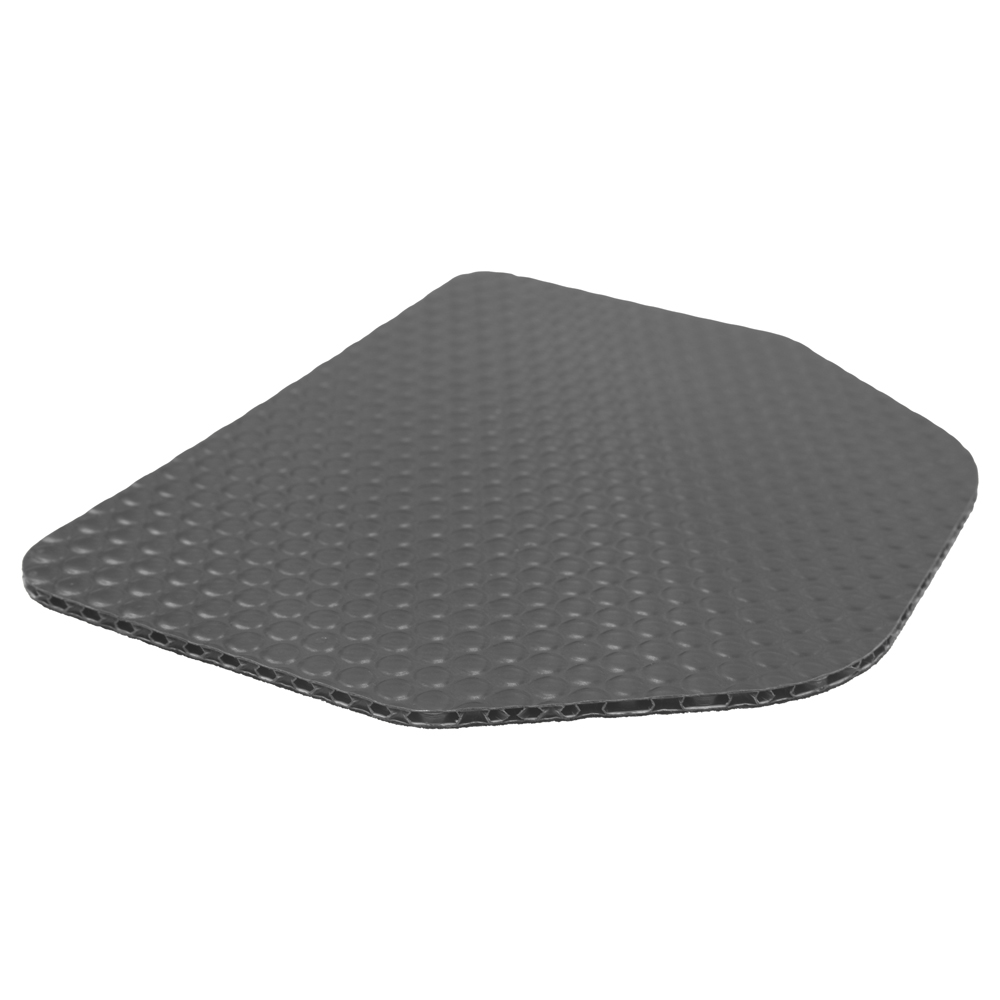
A loaded barrow pushed along a corridor needs friction to be steered and stopped. On smooth protection it has very little, so it runs on, turns wide and ends up against whatever is nearest – usually the thing the protection was installed to protect. This is a wheel-to-panel grip problem and it is solvable at specification.
What happens with a loaded wheel
A small hard wheel concentrates load onto a tiny contact patch. On a smooth panel there is nothing for the wheel to key into, so the available friction is low and the wheel slides wherever momentum takes it. The heavier the load, the more momentum there is to lose and the more likely the outcome is damage at the end of the slide.
Raised faces and wheel grip
A studded face gives the tyre something to deform into. Soft rubber and polyurethane tyres key into the pattern and hold direction much better than on a smooth face. Steel wheels benefit least because they do not deform, which is a separate argument for specifying wheel material rather than only panel surface.
Panels sliding rather than wheels
The other failure is the panel moving instead of the wheel: a loose panel pushed along a smooth floor by a turning trolley. Interlocking or lipped edges stop panels separating, and a heavier panel stays put better than a light one. Where trolleys turn repeatedly in one spot, a sacrificial panel at the turning point absorbs what would otherwise spread down the run.
Braking distances and corners
Where a route turns or ends at a wall, assume the load will slide further than the operator expects and leave room. It is cheaper to add a sacrificial panel at the end of a run than to repair what is behind it – the same thinking as moving materials over protected floors.
Checking the combination
Do not take it on trust: load the heaviest barrow that will use the route, push it along the intended line and try to stop it where it matters. Five minutes on a mock-up area tells you whether the combination works, and if it does not, changing wheel material is usually the cheaper fix.
The wheel material matters
Hard nylon and steel wheels grip poorly on a polymer panel and slide readily. Soft rubber grips well and marks some floors. Polyurethane sits between the two and is usually the best compromise. Where sliding is a persistent problem, changing the wheel is often cheaper and more effective than changing the panel – and it is a fix that travels with the trolley to the next job.
Load height and why high stacks slide
A barrow loaded high slides more easily than the same load carried low, because the centre of mass sits further from the contact patch and lateral force at the wheel rises with it. On a site pushing barrows across protection, a lower and wider load and a slower push does more than any panel specification. It is an instruction issue rather than a product issue, and it belongs in the induction.
What we can do
We supply honeycomb panels with a studded face for grip and interlocking edges so panels do not separate under turning loads. Tell us the wheel types and loads and we will size the panel – and tell you when the wheel needs changing instead.