
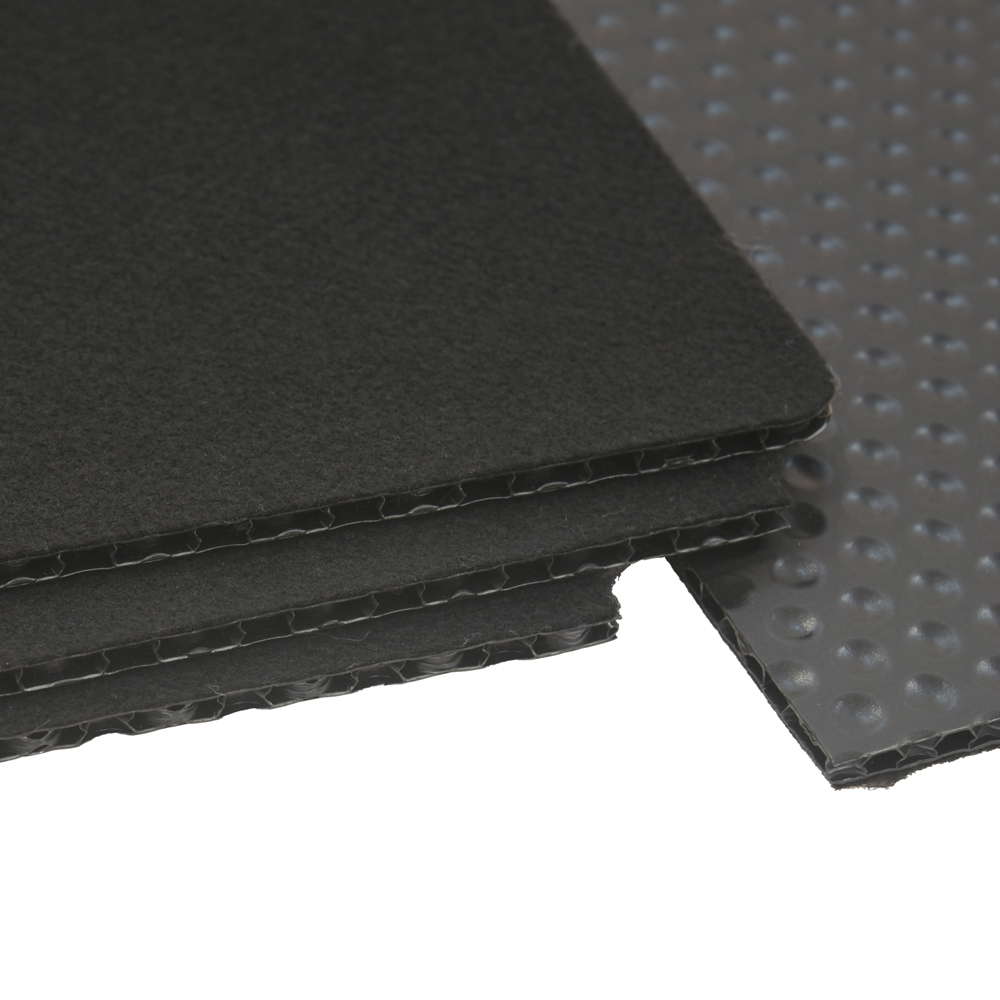
Threaded inserts turn a panel into something you can bolt to. On a honeycomb panel they are the difference between a joint that survives years of maintenance and one that spins loose on the second assembly. The difference is almost entirely in how the insert is supported.
Why a plain insert fails
An insert dropped into a drilled hole in a honeycomb panel is surrounded by air on three sides. Pull it, push it or load it sideways and the only material resisting is the thin skin it happens to be touching. The failure is usually the skin delaminating or the insert breaking through, and it happens under loads that seemed trivial.
What good practice looks like
The core around the insert has to be replaced with something solid. That means a filled cavity – potting compound, a machined plug of solid PP, or a plug of denser core material – sized so the insert is surrounded by material and the load spreads into the skins over a wide area.
The cavity should be formed during manufacture where possible. Drilling it afterwards from a finished panel removes the skin’s continuity and cannot put anything back.
Choose the insert type for the duty
- Blind threaded insert – no access needed to the far side, good for panel faces.
- Through insert with a flange – strongest, clamps both skins, needs access on both sides.
- Moulded-in insert – the most reliable where the panel is moulded rather than laminated.
- Press-in bush with a knurled body – good where the insert should not rotate, less good at taking pull-out load.
Design rules worth following
- Keep inserts away from edges. An insert within roughly a panel thickness of a cut edge has very little material around it. Move it inboard.
- Spread the load. Where the pull-out load is high, a larger flange or a backing plate over the skin is cheaper than a bigger insert.
- Match the thread to the use. A thread that will be assembled and disassembled repeatedly should be a metal insert, not a tapped hole in PP. Tapped PP threads wear quickly and strip.
- Consider the load direction. Inserts resist pull-out and shear differently. If the load is sideways, the insert needs material on the side facing the load.
- Allow for thermal movement. A long bolt through a panel into a metal frame has to tolerate the difference in expansion.
What goes wrong on site
The most common problems are an over-tightened bolt crushing the core around the insert, an insert that was set with too little potting material, and a joint assembled with no washer so the load concentrates on a small ring of skin.
None of these are design failures so much as assembly detail – which is why it is worth writing the assembly method down and giving it to whoever does the work.
Retrofitting into a finished panel
It can be done, and it is always a compromise. A blind insert with a spreader behind the far skin is the usual approach. It will take a lighter load than a properly potted insert and it should not be used for anything structural.
If you know the fixing points at design stage, tell us. Fitting inserts during manufacture costs a fraction of retrofitting them and performs considerably better.
For how inserts compare with the alternatives – through-bolts, self-tapping screws, rivets – see our article on mechanical fastening in PP honeycomb.
What we can do
We fit potted inserts and threaded bushings into PP honeycomb panels as part of the build, positioned to suit your load directions. Send us the assembly drawing and the loads and we will tell you the insert type, the cavity size and the spacing that will hold.