
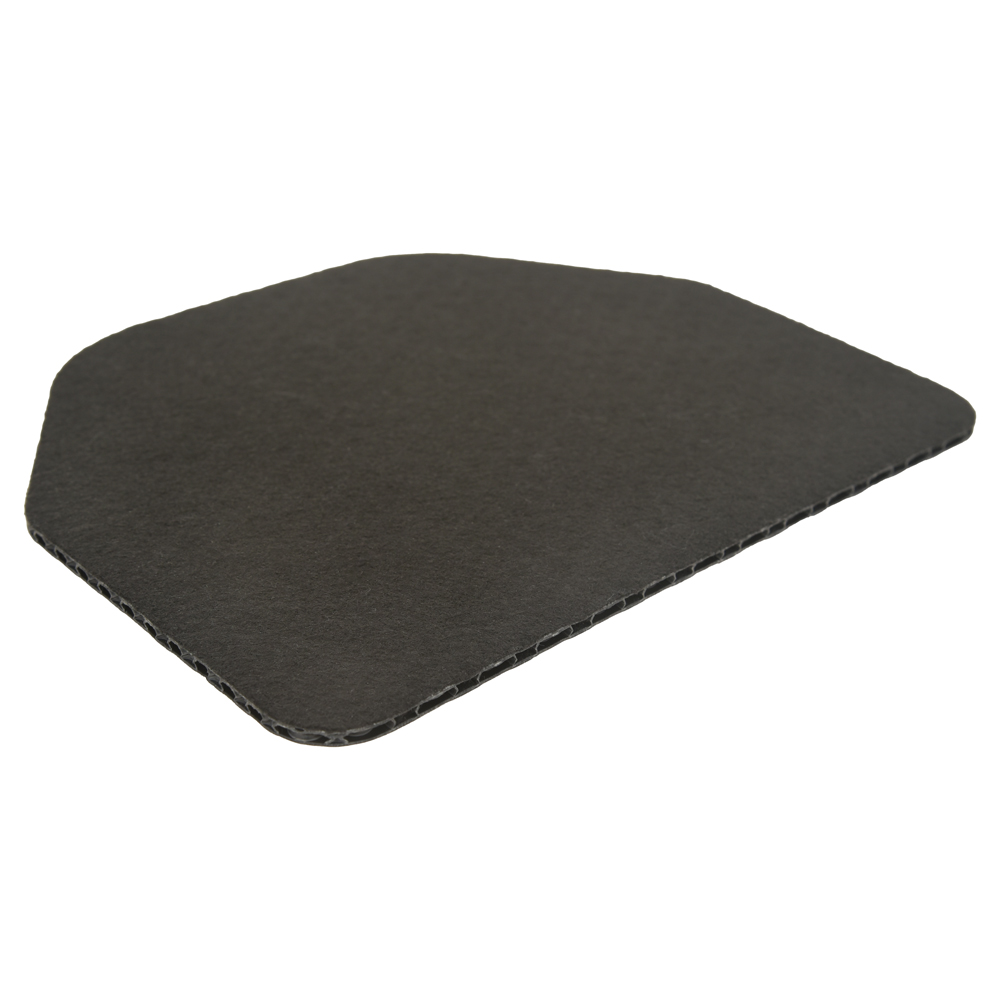
Screws are the default way to attach things to a panel, and on honeycomb they are usually the wrong one. The reason is simple: a screw needs material to thread into, and a honeycomb panel has a thin skin, an air gap, and a thin skin.
What a fastener can reach
Driving a screw into the face of a honeycomb panel engages the near skin. Depending on skin gauge that is somewhere between a marginal and a meaningless amount of material. It will hold the part in place on the bench and it will fail under vibration.
The reliable options all involve reaching through the panel to the far skin, or filling the core so there is something to grip.
The four approaches that work
Through-bolting. A bolt through both skins with load-spreading washers on both faces. Strong, inspectable, and requires access to both sides. This is the reference solution and everything else is a compromise against it.
Potted inserts. A cavity is formed in the core, filled with a potting compound, and a threaded bush is set into it. The insert then transfers load into both skins and the surrounding core. This is the standard answer for a fixing that has to be repeated, replaced or load-bearing, and it is what we recommend for anything structural or frequently disassembled.
Rivnuts and blind fasteners designed for sandwich panels. These spread behind the far skin. Better than a plain screw, though the load is concentrated in a small area of skin unless a washer is used.
Mechanical clamping with a frame. Where many fixings are needed along an edge, a frame or extrusion carrying the fixings is often cheaper and stronger than doing the same job panel by panel.
Which to choose
- Access to both sides, permanent joint? Through-bolt.
- Repeated assembly, or load-bearing? Potted insert.
- Blind fixing, light load? A sandwich-rated blind fastener with a spreader.
- Long run of fixings on one edge? A frame that carries them.
- Once, on site, light load? A screw may be acceptable, and it is still the weakest option.
What matters beyond the fixing
Spacing. Fixings too far apart let the panel flex between them and work the fasteners. Closer spacing reduces the load per fixing more than proportionally in most assemblies.
Edge distance. A fixing close to a cut edge sits in unsupported skin over open cells. Keep fixings back from the perimeter, or make the edge carry them.
Vibration. In any application with continuous vibration, use a locking feature and check the joint after the first period of service. Vibration loosens the marginal joints and leaves the good ones alone, which is a useful early indicator.
Dissimilar materials. Metal fasteners in a washed or outdoor panel will corrode. That does not make them unusable, but it makes them the life-limiting item.
Where a joint has to come apart repeatedly, the method matters as much as the fastener. That case is covered in our article on inserts and threaded bushings.
The failure modes, roughly in the order you meet them
Fastening failures in honeycomb are repetitive enough to be predictable, and worth listing because they point at different fixes.
- Preload loss. Polypropylene creeps under sustained load. A bolt torqued today is looser in three months, not because it turned but because the material under the head relaxed. If the joint depends on clamping force, plan a re-check or use a spring element that absorbs the movement.
- Pull-out in the skin. Common when a self-tapping screw goes into skin only. The fix is usually a design change: a thicker skin locally, a bonded pad, or a potted insert reaching the far skin.
- Stripped threads on reassembly. Thread-forming screws in thermoplastics have a limited number of re-uses, and it is fewer than people expect. On anything stripped down seasonally, use a metal insert at the joint or fit new screws every time. It is cheap insurance and it makes the assembly predictable.
- Vibration loosening. Where the panel sees continuous vibration, a plain screw in plastic will walk out eventually. A lock washer under the head helps less than people assume; a nyloc nut on a through-bolt, or an insert with a locking thread, is more reliable.
Notice that three of the four are cured at design stage. Kitchen-fitting fixes applied on the line tend to move the failure rather than remove it.
What we can do
We supply PP honeycomb panels with potted inserts fitted during manufacture, which is much cheaper than retrofitting them and gives a far more reliable result. Send us the fixing schedule and the load each one carries and we will tell you which method to use – and where a design change would remove the problem altogether.