
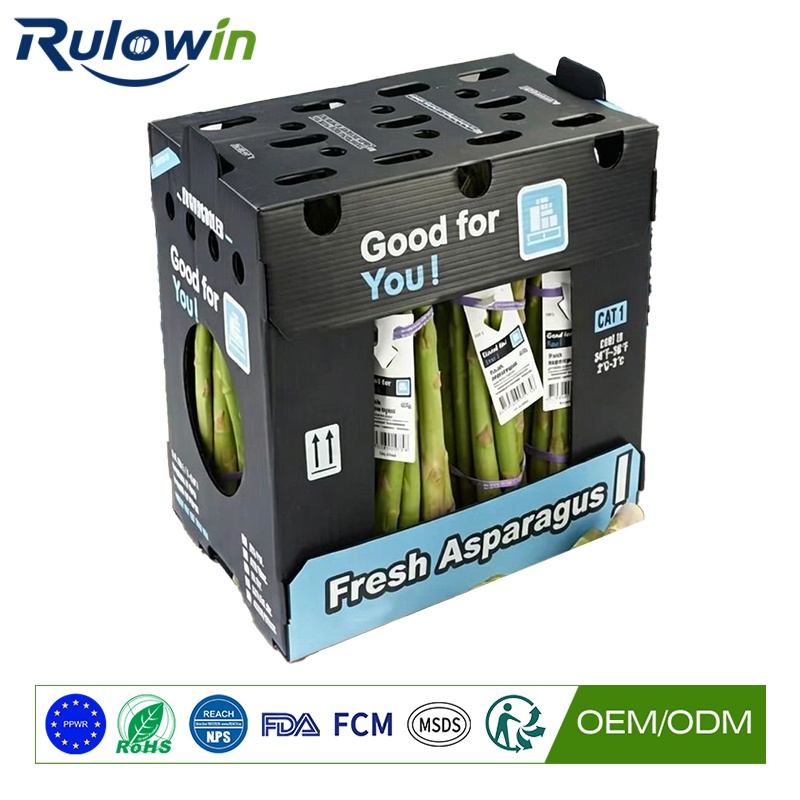
Berry growers and packhouses usually blame stack height when the bottom layer arrives bruised. Height is sometimes the cause, but the two things we see more often are alignment – where the vent holes and the ribs sit relative to the fruit – and a rim that passes the load sideways into the produce instead of carrying it down through the crate walls.
Load should travel through the walls, not the fruit
A crate with a proper stacking rim transfers the weight of the crate above it into its own side walls. That is the whole idea. If the rim is too shallow, or the crate above sits slightly inboard, the load goes down through whatever is inside – which is the fruit.
Practical check: stack two empty crates and press on the top one. If you can see the bottom crate’s walls flex outward, the load path is wrong. Then load the bottom crate and repeat. If the fruit visibly takes the deflection, no amount of careful handling will save it.
Where the vents sit
Ventilation and bruising pull in opposite directions. Larger holes cool faster and give the fruit a place to sag into. On soft fruit, the usual compromise is many small openings rather than a few large ones, and ribs or a raised floor pattern that lifts the fruit off the flat bottom so it is sitting on structure rather than on the opening.
If you are stacking crates directly on top of each other, check what is above each hole. A hole in the crate floor that lines up with a hole in the lid of the crate below creates a column of unsupported fruit through the whole stack. Staggering is free and it removes the problem.
Height, and the honest part of it
Every metre of stack adds load to the bottom crate, and the relationship is not linear with damage – it gets worse faster, because soft fruit under sustained load continues to deform. But the more common failure is a stack that has been standing for a day in a warm yard. Time under load matters as much as the load.
So the useful rule is not a maximum height. It is a maximum time at height. Get the stack off the field, cooled and moved within hours rather than leaving it standing overnight because the truck comes in the morning.
Small things that help more than they cost
Keep layers level. A crate rested on one corner of the crate below puts an edge load into a small area of fruit. Fill to a consistent depth so the rim engages evenly. And do not overfill – a heaped crate means the crate above rests on fruit rather than on the rim, which converts the entire stack load into a crushing force on the top layer of produce.
Everything above assumes the crate itself is stiff enough. If you want to understand why a crate loses stiffness over a season, we covered how many trips a PP crate actually survives in another piece.
What we can do
We make PP crates for fruit and vegetables with the vent pattern and floor ribbing set by what you are actually packing. Tell us the crop, the fill weight and how long a stack stands before it moves, and we will tell you what floor and rim design suits it – including when our standard crate is not the right answer.