
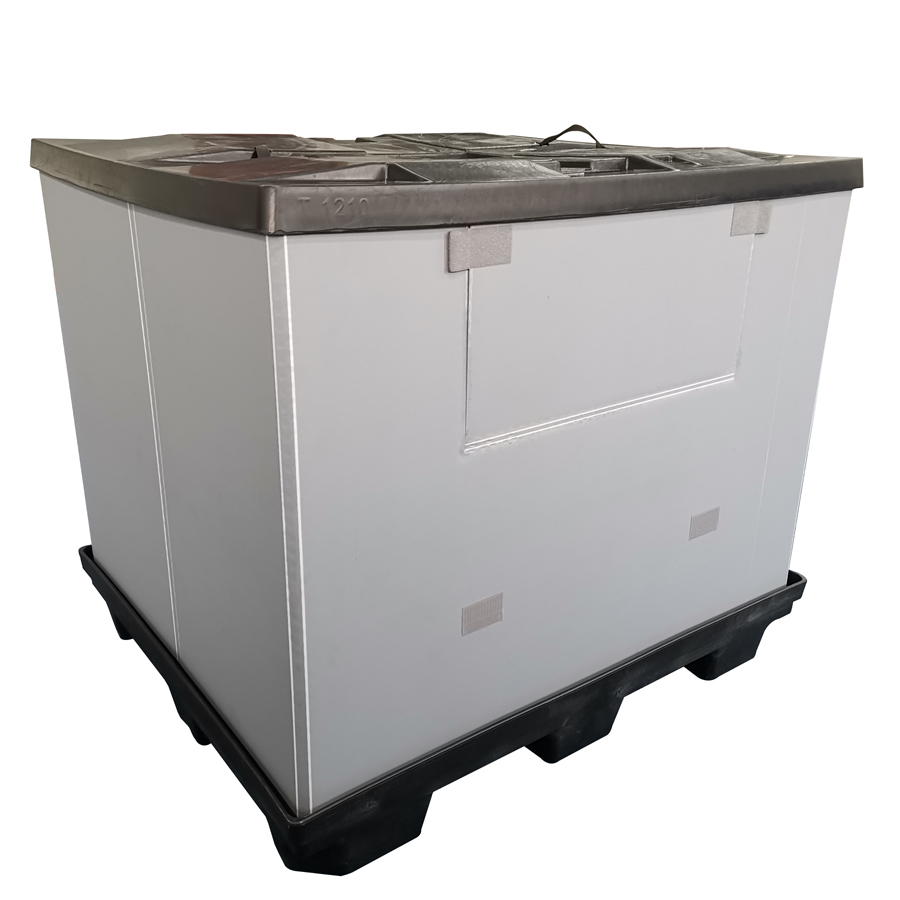
Ask what makes a pallet sleeve system pay for itself and the answer is this number. A sleeve collapses to roughly the thickness of its folded walls – a few centimetres – so a stack of fifty collapsed sleeves occupies about the space of two or three assembled boxes. That ratio is what turns a returnable container from an expense into a saving.
What sets the ratio
Two things: collapsed thickness and stackability. Collapsed thickness depends on wall thickness and how the corner creases fold – a heavier sleeve collapses thicker. Stackability depends on whether collapsed sleeves lie flat and stay flat; sleeves that spring open slightly do not stack tightly and you lose a lot of the advantage.
Bases and lids are the awkward part. They generally do not collapse. A return load of sleeves is light and compact; a return load of bases is bulky. Most operations return sleeves frequently and bases rarely, or nest the bases if the design allows it. Worth establishing before you assume the return leg is cheap.
Working it out for your lane
Take the vehicle’s usable load volume. Divide by the collapsed volume of one sleeve including the air between stacked sleeves – which for a springy sleeve is more than you think. That is your number of sleeves per return trip.
Then compare with how many assembled boxes went out on the same vehicle. The ratio between the two is your return efficiency, and it is the figure that decides how many trips a year you need to make the system pay.
A word of caution: do this with a real stack, not a calculation from thickness. Twenty collapsed sleeves pressed down by hand is not the same as twenty in a stack that has been strapped.
What usually goes wrong
The return leg is not scheduled. Sleeves accumulate at the far end because nobody has put the empties on a vehicle, and the operation ends up buying new sleeves while a yard full of them sits three hundred kilometres away. That is a logistics failure, not a product one, and it is the most common reason sleeve systems underperform.
The other common problem is damaged returns. Sleeves folded badly at the far end come back with creased walls and are scrap. Five minutes of instruction at the receiving site prevents most of it.
The economics against crates are set out in pallet sleeve box versus wooden crate, cost per trip.
What to do about the bases
Bases do not collapse, and they are the part of the calculation that ruins the neat ratio. A return load is usually sleeves, with bases coming back far less often because they are bulky relative to their value.
Two approaches. Either accept a lower base return rate and budget for base replacement, or nest the bases if the design allows – some do, some do not, and it is worth asking specifically rather than assuming.
The honest position is that the sleeve return ratio is the headline number and the base is the operating cost. Both need to be in the calculation, and only one of them usually is.
What we can do
We supply pallet sleeve boxes for warehouse and supply loops and will give you collapsed stack height measured on a real stack, not calculated. Tell us the sleeve size and the return vehicle and we will work out how many come back per trip – including what to do about the bases.