
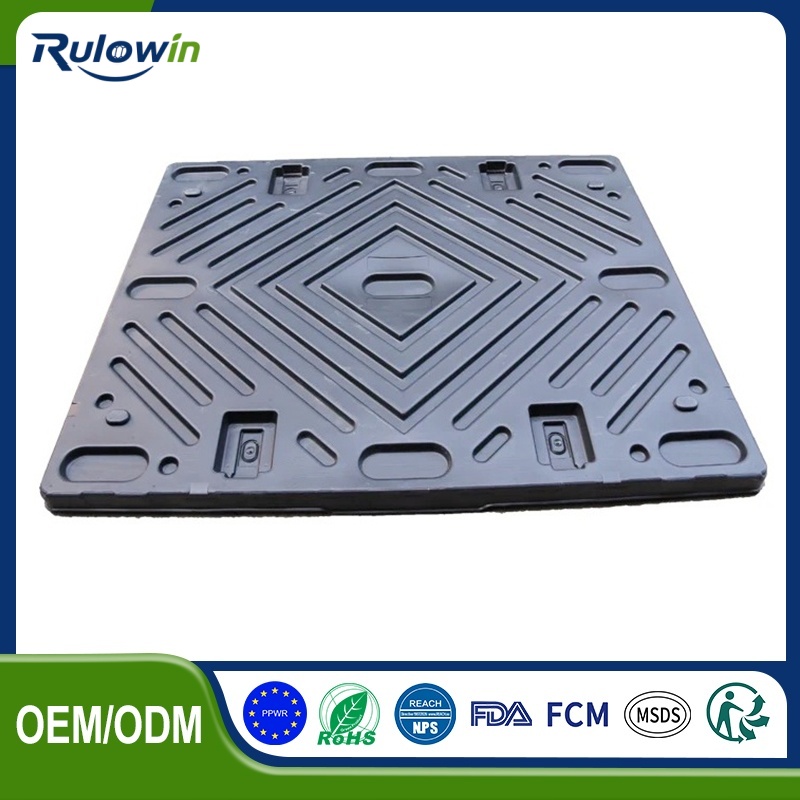
A stack of empty containers is light, which suggests it can go high. It is also springy, top-heavy and easily disturbed, which means it cannot. The limit on empty stack height is almost always stability rather than strength, and where a stack is stored against a walkway or a vehicle route, the consequence of getting it wrong is an unstable stack falling onto someone.
Why empties are less stable than fulls
A loaded stack has mass low down and the boxes are pressed together by weight, which is stabilising. An empty stack has almost no weight, so nothing holds it together except the stacking features, and those features work by geometry rather than by friction. Where the geometry has any play, the stack can walk – each box slightly out of alignment with the one below, accumulating until the top is visibly off-centre.
Nesting changes the calculation
Nested containers interlock, and a nested stack is far more stable than a stacked one because each box is inside the one below rather than on top of it. The height limit for nested empties is set by how far they nest before jamming, and by the weight of the column. Where containers nest, empty storage is both denser and safer, and the limit is usually the reach of whoever lifts them off the top.
Reach and the practical ceiling
Somebody has to take containers off the top of the stack, and that sets a ceiling regardless of stability – typically around shoulder height or a little above for a person working at floor level. Above that, the stack needs a step, and a step is a manual handling risk. Where empty stacks are higher than reach, the safe answer is a rack or a mezzanine rather than a taller stack on the floor.
Traffic and the disturbance risk
An empty stack near a vehicle route is disturbed by the vehicles – by contact, by vibration, or by the wash of a truck passing close. A stack that is stable in a quiet corner is not stable next to a route. Where empty storage has to be near traffic, either the height comes down or the stack gets a restraint – a rack, a barrier, or a wrap.
Warm storage and softening
PP softens as it warms, and a tall stack of empties in a warm building is a stack of slightly softer boxes. Creep over weeks produces a lean that would not appear in a cool building. Where empty stacks are stored for long periods, the height limit should be set for the warmest condition the building reaches, not for the temperature on the day the rule was written.
Writing the rule
A maximum height, stated in containers rather than in metres, posted where the stacking happens, and different for nested, stacked and folded containers. Where the rule is in metres, people convert it differently for different box heights. Where it is in containers, it is unambiguous. The rule should also say where empty stacks may not be placed – near routes, near doorways, and under anything that could fall.
What the container design can do
A stacking feature that locates positively rather than approximately stops the stack walking, and it is the single design change that raises the safe height. A base that nests deeply increases the density without increasing the height. Both are specification items, and where empty storage is a known constraint, both are worth raising at the enquiry rather than living with afterwards. See folding empties and storage density for the volume side.