
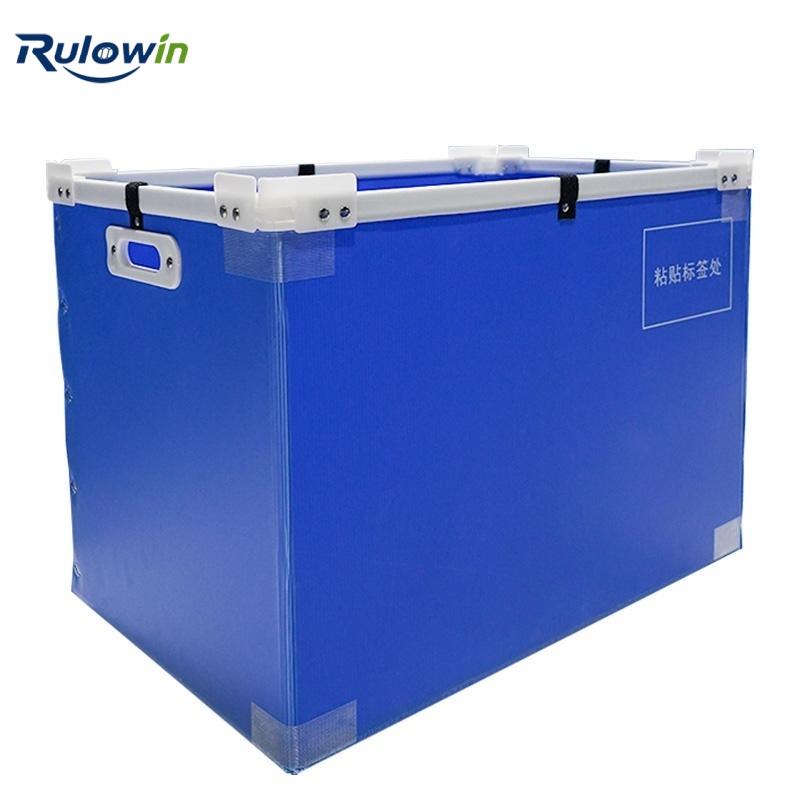
A collapsible container takes a fraction of its erected volume when empty, and for a reusable fleet that matters because a large share of the fleet is empty at any moment – in transit back, waiting at a dock, or stored between seasons. The gain is real and it is easy to overstate, because it applies only to the empty portion of the fleet and it comes with a folding operation at each end.
How much of the fleet is empty
On a closed loop, the empty fraction is roughly the return transit time divided by the total cycle time. On a short lane that is a small share; on a long one, or where containers wait for a full load before returning, it is large. Where the empty fraction is under a quarter, folding saves less than it costs in handling time. Where it is over a half, folding is clearly worth it. The fraction is measurable and it decides the question.
What folding does to storage
A folded container is a flat package, and a stack of them is a stack of boards. Compared to nested empties, folding roughly halves the height again; compared to erected empties, it is a factor of four or five. Applied to the empty store – which in a seasonal operation can be the largest single storage requirement in the building – the space released is often enough to remove a mezzanine or a satellite store entirely.
The folding operation itself
Somebody or something has to fold each container, and unfold it at the other end. By hand that is perhaps twenty seconds each way, twice per trip. Over a year, on a large fleet, that is real labour, and it has to be compared against the storage and transport saved. Where containers are folded at a defined station rather than wherever they happen to be emptied, the time is lower and the operation is controllable.
Transport, not just storage
The same density gain applies in a vehicle, and on a long return leg it is often worth more than the storage saving – because the return journey is a cost that folding reduces directly. Where empties are trucked back over a distance, folding reduces the number of vehicles, and that is usually the largest single line in the calculation. Where empties return as backhauls on a lane that runs anyway, the transport gain is smaller.
Durability of the folding mechanism
A folding container has hinges, latches or fold lines, and those are the parts that fail. A mechanism rated for a few hundred cycles will not survive a fleet that folds daily for years. Where collapsible containers are specified, the cycle rating of the mechanism matters more than the container’s other properties, and it should be stated in the enquiry along with the expected cycles per year.
Partially loaded containers cannot fold
A folding container has to be empty to fold, which means partially loaded returns take the full volume. Where a lane routinely returns partly full, the folding benefit is reduced in proportion. That is worth checking on the actual lanes rather than assuming – and it is the reason some operations fold only on the lanes that reliably return empty. The buffer sizing side is in how much box buffer a line needs.
Doing the calculation
Empty fraction, multiplied by the volume saving, valued at the cost of storage space and return transport; minus the labour of folding, multiplied by trips per year. That is the whole comparison, and it produces a clear answer either way. Where the answer is close, the deciding factor is usually whether the storage space is genuinely scarce, because that is the benefit that cannot be bought elsewhere.