
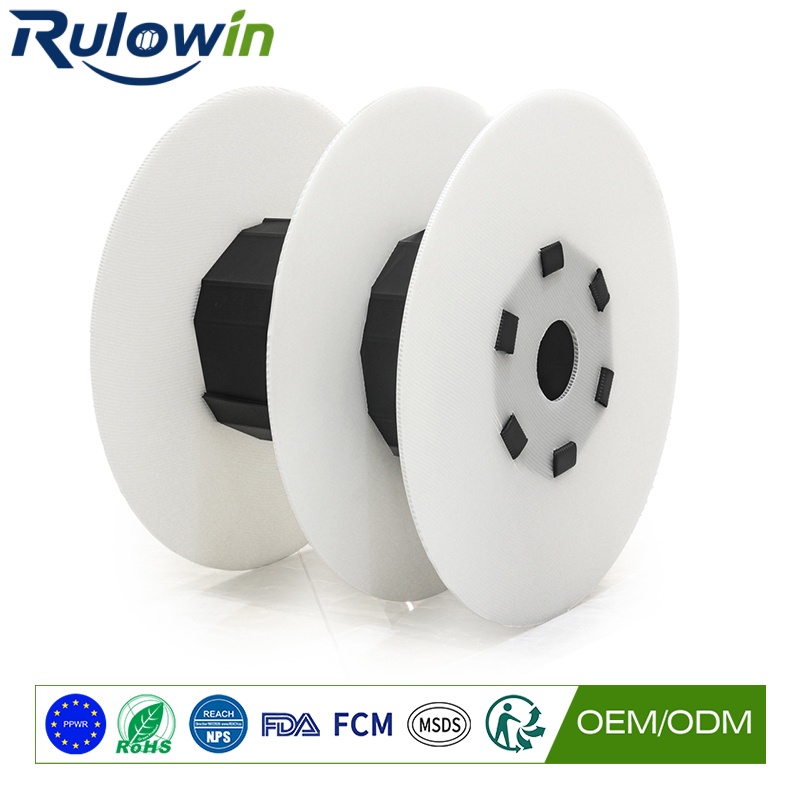
If you take one idea away about how a spool actually works, it should be this one. The product wound on a spool is not sitting there passively. It is pressing outward against the flange, continuously, for as long as it stays wound.
Where the push comes from
Think of a stretched elastic band wrapped around your fingers. It squeezes. A wound pack does the same thing in reverse — it was laid on under tension, and it wants to contract but cannot, because the flanges and the core are in the way. So it presses outward against whatever is containing it.
That outward pressure is what engineers call hoop load. For a spool it acts radially, all the way around, all the time.
Two things it presses against
The core gets squeezed inward. Every layer is trying to contract onto the one beneath, and the innermost layer is pressing directly on the core. This is why core crush is a real failure and why the core needs to be specified for it — as covered in our article on core construction.
The flanges get pushed outward. Less obvious, because the pressure is radial rather than sideways. But the flange is a disc fixed at the hub and free at the rim, and a radial pull at every point around it translates into the rim wanting to cone outward. That is the movement that opens a gap for outer turns to migrate into.
Why it matters more than the weight does
People size packaging by weight, and weight is the wrong measure here. A pack wound at high tension exerts far more outward pressure than the same weight wound slack. Twenty kilograms of product laid on tight will load a flange harder than forty kilograms laid on lightly.
This is why specifications that only quote a fill weight are incomplete. Fill weight tells you what it weighs; it does not tell you what it pushes with.
What changes the load
- Winding tension, which is the dominant factor and usually the least documented
- Number of layers. Pressure accumulates from every layer, so a deep pack loads the flange more than a shallow one at the same tension
- Product stiffness. Stiff product pushes harder; soft product relaxes and pushes less over time
- Time and temperature. Packs settle, and warm packs settle faster
That third one explains something that confuses people: a spool that coped fine on day one can start showing flange movement months later, without anything appearing to change. The product relaxed, redistributing load rather than adding to it.
What the flange does about it
Everything described across this series — ribbing, profile, thickness, rim reinforcement — is in service of resisting this one load. The flange is not decorative and it is not mainly about protecting the product during handling. Its structural job is holding its shape against continuous outward pull.
Once you see it that way, the design priorities fall into place. Stiffness near the hub matters more than at the rim, because that is where the bending is. Anything that interrupts radial load paths — badly placed holes, ribs cut through — is working against the primary job.
What this means practically
Three things worth doing:
- Quote tension when you specify, alongside fill weight. It is the number that governs the load.
- Test with actual product and actual settings rather than with weights on a bench — the method described in our deflection test article, and the loaded version of it in particular.
- Leave the flanges alone structurally. If you want cut-outs, lighting holes or drainage, place them where the load is not going.
Where we fit
We build our hollow board spools knowing this is the governing load, and it is why we ask about tension and layer count rather than just weight. If you tell us what you are winding and how hard, we can say whether the standard construction is comfortable or whether yours is one of the cases that needs more flange.