
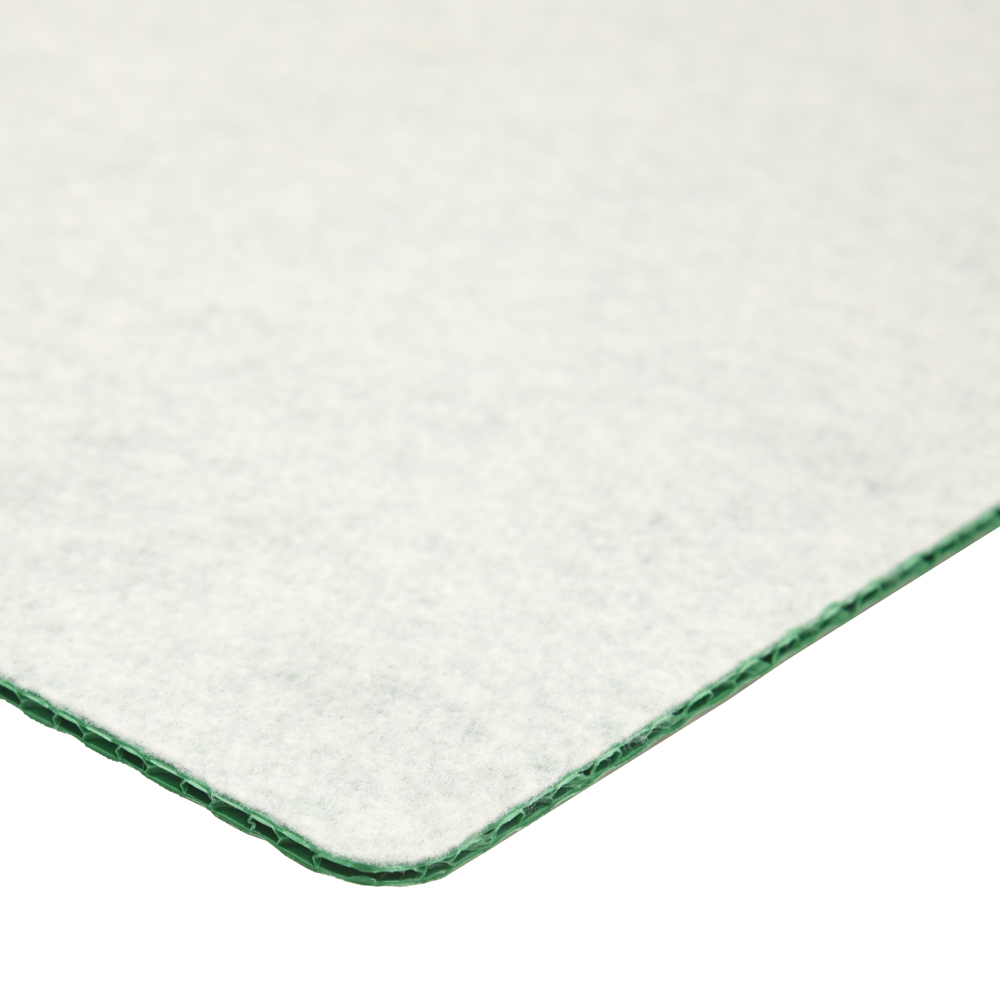
Exhibition stands need large flat panels that two people can carry, that do not bend, and that survive being built and struck repeatedly. Honeycomb panel does all three, and it is a common material in the industry for that reason. Two constraints come up every time.
Why it works
Stiffness for weight. A large honeycomb panel is dramatically lighter than MDF or plywood of the same rigidity, which matters for transport and for how quickly a stand goes up. Two people can handle a panel that would need three with board.
And it is reusable. A stand built from board is frequently a single-use build; a panel system goes back in a case and comes out again. Over several shows the economics are not close.
Constraint one: fire rating
Venues ask for a fire rating on any panel material, and standard PP honeycomb is combustible. A flame-retardant grade exists and it is what you need for anything going into a regulated venue.
Ask the venue what class they require before specifying, because it varies, and turn up with the certificate. Discovering the requirement at load-in is an expensive way to learn it.
Constraint two: surface finish
A bare honeycomb face shows the cell pattern slightly under some lighting, and it is not a printing surface without treatment. For a stand, panels are usually faced – laminated, printed with a vinyl wrap, or covered with fabric.
Vinyl applies well to a treated surface and less well to an untreated one. If the panel is going to be wrapped, say so when ordering.
Joining
Panels can be screwed, bolted or riveted through, and edge profiles are available that give a proper fixing line. Adhesive bonding is possible with the right product and unreliable without it – PP does not glue easily.
The practical answer for a demountable system is mechanical fixing into an edge profile, which comes apart cleanly and goes back together the same way.
What it is bad at
Point loads on the face – a heavy shelf bracket bolted through a thin panel will pull through. Use a backing plate or a thicker panel at any fixing that carries weight.
And it does not like being bent. A curved stand wall needs a different approach; honeycomb will not hold a tight radius.
Costs
More per sheet than board, and less per show because it is reused. The break-even is usually two or three builds, and after that it is cheaper every time. Transport saving is a bonus on top.
Between shows
Panels for a reusable stand need cases or a stillage, and the case is the difference between a system that survives and one that arrives with crushed corners. Purpose-made cases cost real money and pay for themselves in two or three shows.
Store panels flat in the case, with the printed faces protected. Printed faces rubbing against each other in transit is the most common damage to a stand system.
One more consideration
Check whether the venue requires a fire certificate to be present at load-in rather than just on file. Some do, and arriving without the document is a delay you cannot argue your way out of.
What we can do
We supply PP honeycomb panels including flame-retardant grades, and we will tell you honestly whether they suit your build. Tell us the panel size, the fixing method and what the venue requires – if board is the better answer for a one-off stand, we will say so.