
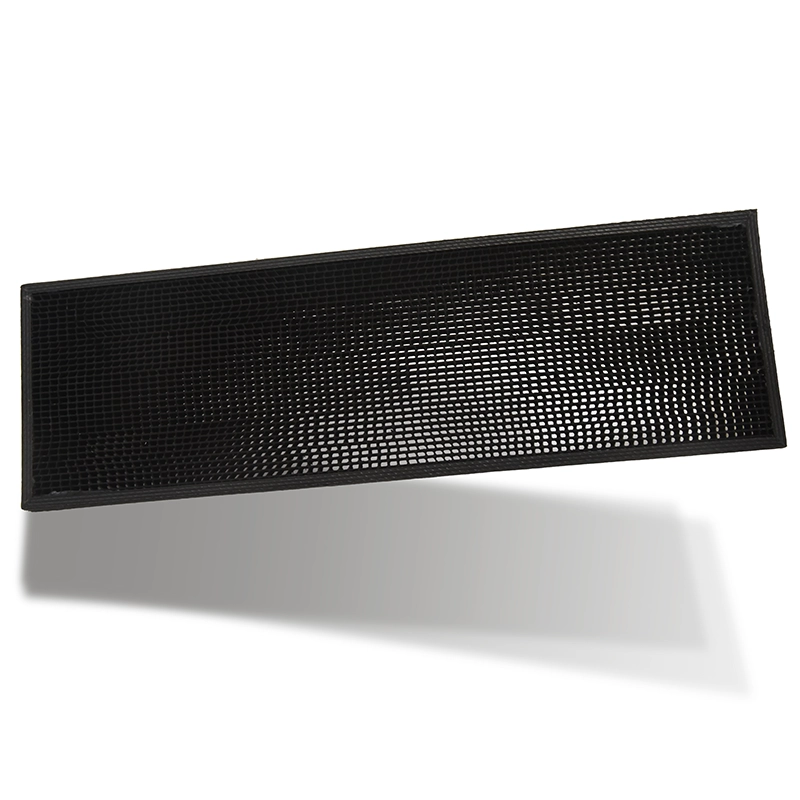
A canopy grease filter is doing a different job from a dust screen, and it is worth being clear about what that is. Its primary purpose is fire safety: it removes grease from the extract air so that ductwork does not accumulate a flammable deposit. Filtration performance is real but secondary to that.
Why grease behaves differently
Grease arrives as an aerosol of fine droplets and as vapour that condenses on cooler surfaces. It wets whatever it lands on and it holds onto dust that arrives with it, so a grease screen ends up carrying a sticky matrix rather than a dry layer.
That changes the capture mechanism. Grease droplets are caught by impingement – they deviate from the airflow and strike a surface, then run and drain. A structure that presents a lot of surface and allows drainage works; one that traps and holds does not.
It also changes the cleaning. Water alone will not remove grease. Detergent and hot water, or a dishwasher cycle, is required – and that is a labour commitment that has to be planned for.
Drainage matters
A screen that holds grease at the bottom of its structure becomes a reservoir and eventually drips. Geometry that lets the captured grease run down and out into a collection channel performs better and is more pleasant to handle. This is one of the few filtration cases where gravity is part of the design.
What to check
That the screen is cleaned often enough – a heavily loaded grease screen is a fire load, and this is the reason the interval should be set conservatively. That it has not been deformed by dishwasher heat, which is a common end for light-gauge plastic in a commercial kitchen. And that it still seats properly; a distorted screen lets grease-laden air past into the ductwork, which is where the risk actually is.
The cleaning side, in detail, is in washing a range hood grease screen.
What the screen is really for
The primary purpose of a canopy grease filter is to keep grease out of the ductwork, because grease deposited in a duct is a fire load that cannot be seen and is difficult to remove. Filtration efficiency for the sake of air quality is secondary and, in a kitchen, largely not the point.
This is why the interval matters more than the media. A moderately effective screen washed daily outperforms an excellent screen washed fortnightly, because what matters is how much grease reaches the duct over time, not how much the screen can hold.
Duct cleanliness
Even with good filters, ductwork accumulates some grease and needs periodic professional cleaning – how often depends on the cooking volume and type. The filter reduces the rate; it does not eliminate the requirement.
If a duct is accumulating faster than expected, suspect the filter before the duct: a distorted or undersized screen is the usual cause, and it is much cheaper to fix than the duct cleaning that follows.
Sizing and fit
A grease screen has to fill its aperture. Kitchen extract moves a lot of air through a relatively small face, and any gap at the edge passes grease-laden air straight into the duct – which is the outcome the screen exists to prevent. Where the hood has an odd aperture, a cut-to-size panel beats an ill-fitting standard one.
Check the fit after washing, not just after installation. A screen that has been through a dishwasher cycle repeatedly may no longer seat properly, and a screen that does not seat is barely better than no screen at all.
What we can do
We supply washable PP honeycomb grease filter screens for range hoods and canopies, cut to the hood aperture. Tell us the dimensions and how the screen will be cleaned – hand washing or machine – and we will tell you what gauge survives it.