
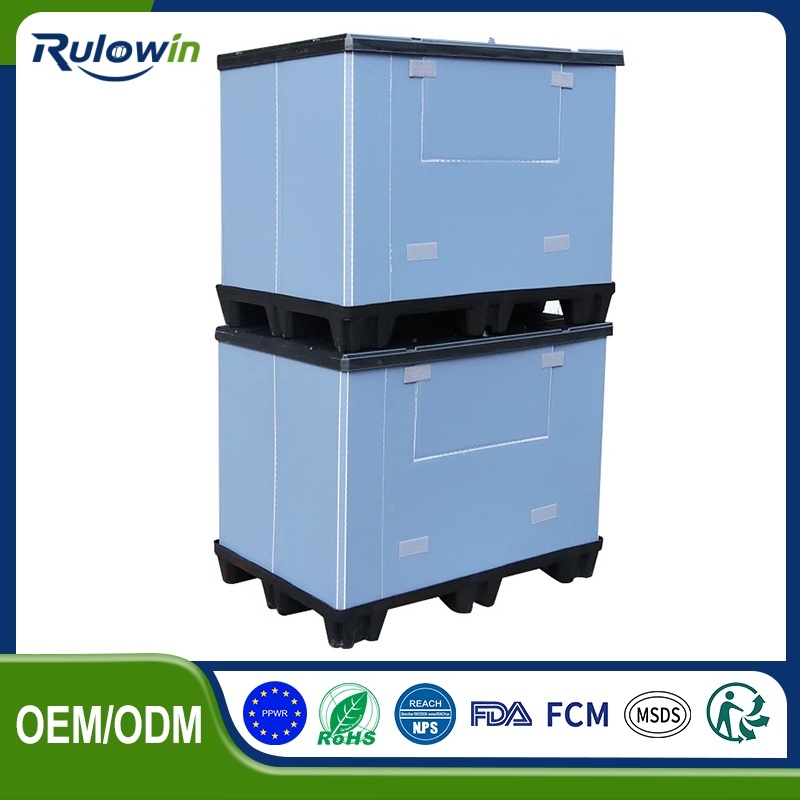
Ask a warehouse team how a box gets damaged and the answer is rarely dramatic. It is the lift, three hundred times, most of them fine, a few of them at an angle, and one of them with the forks set too wide. The tunnel and the base rails are what absorb that history, and they cost almost nothing at the design stage.
Four entry points or two
Two-way entry means the box can only be approached from one direction, which is fine for a dedicated cell and a problem everywhere else. Four-way entry, with two tunnels each way, is the default for anything that moves around a plant because it removes a driver decision. It adds a little base complexity and saves a lot of steering.
Clearance beats precision
A tunnel that fits the forks snugly looks tidy on a drawing. In service it means the driver has to be accurate every time, and the first miss takes a chip out of the tunnel edge that slowly becomes a hole. Fifty millimetres of extra height and a generous width make the box forgiving, and a forgiving box lasts. This is one of the few places where deliberately introducing slop improves the product.
Where the tunnels sit in the base
Tunnel position decides how the load travels into the deck. Tunnels set close to the ends put the load near the corners, which is where the structure is strongest. Tunnels set too far apart invite the deck to flex between them and too close together make the box unstable on the forks. The base and the tunnel layout should be drawn together; treating the tunnel as an add-on is how a base ends up carrying load in a way nobody intended.
The fork-tip problem
On a loaded box the tip of the fork goes in first and lands on the deck or on a runner, depending on how deep the tunnel is. Short tunnels mean the tips stop on a rail and the box can tip forward. Deep tunnels cost slightly more base material and remove the whole class of problem. If you have ever seen a loaded box slide off a lift truck, this is usually why.
Pallets, dollies and the interface
Many plants lift a box on a pallet or roll it on a dolly, and in those cases the box needs locating features rather than tunnels. A shallow recess that drops onto the pallet prevents the box from creeping, which is what causes strap and corner damage in a truck. Designing the box and the handling equipment together is worth the extra meeting; it is the same discipline as designing the base for the load path.
What to write into a specification
Four lines cover most of it: entry directions, tunnel clear height and width, deck load at the rated weight, and whether the box is lifted on forks, on a pallet or on a dolly. A supplier who cannot answer all four is going to default to whatever the last box used.
Retrofit is not an option
Everything in this section is decided before the panels are cut. Once a box exists, adding clearance means a new base, and reinforcing a tunnel means a new base. That is why the tunnel discussion belongs in the first design conversation and not in the first damage report.
What to look at on a damaged box
The tunnel edges tell you most of what you need to know about the fleet’s handling. Chipping at the front lower edge means the forks are entering low or off-centre. Crushed tunnel tops mean the box is being lifted on the tips rather than on the tunnels. Scored deck surfaces between the tunnels mean the forks are going in too far. Each of those points at a different fix, and all of them are visible without any measurement.
Collect the evidence from a handful of used boxes before specifying the next order. The pattern is usually consistent across a fleet, because it reflects the habits at one site rather than random damage, and habits are what the design has to accommodate.
What we can do
We build PP honeycomb board boxes with two-way or four-way entry, sized to the trucks you actually run, and with the tunnel layout drawn against the base. Tell us the handling equipment and the load, and we will design the entry around it.