
Foil, thin film and narrow web are worth covering separately because almost nothing from the wire and cable world transfers cleanly. They are flat, they are wide relative to their thickness, and they have edges that matter far more than their faces.
Edges first
With round product the whole surface can absorb minor contact. With thin web, edge damage is the whole complaint:
- Edge contact with a flange damages the web and generates scrap continuously
- Uneven winding at the edge creates a bulge that gets worse with every layer
- A single damaged edge can mean the entire width is unusable, depending on downstream requirements
Everything about flange condition, clearance and squareness that we discussed in our edge marks article applies here with higher stakes. A flange that is not running square will damage every metre that passes it.
Blocking
Layers sticking together. Foil and some films will block under pressure and time, sometimes adhering strongly enough that the material tears rather than separating.
It is driven by pressure, time and temperature, and it is one reason the storage discussion in our article on long-term wound storage is more relevant here than anywhere else in the series. Some coated films block within weeks.
Static
Film and thin web generate static readily and attract dust to themselves. It makes handling worse, causes cling at unwind, and can be a genuine hazard at higher speeds.
Whether antistatic construction is justified depends on the material and how much trouble you are having — discussed in our article on conductive and antistatic spools. For some web applications it is one of the few things that noticeably helps.
Tension consistency
Thin web tolerates almost no tension variation. Too much and it stretches or necks; too little and the pack telescopes sideways, which is the specific failure where layers slide sideways relative to each other and the roll becomes unusable from the edge.
Telescoping looks like a spool problem and is almost always a tension or traverse problem, but flange squareness contributes — if the flange is not perpendicular to the core, the web is being guided sideways every layer.
Core diameter and compression
Tension applied to thin web over a small core produces very high local pressure. Large cores reduce this and reduce set near the base of the roll. Standard advice in converting is generous core diameter, and nothing here argues against it.
Cleanliness, again
A particle between layers of thin web shows up as a mark that repeats through subsequent layers — a print-through defect that can affect several metres. Notably worse than with rigid product, where debris tends to sit without propagating.
Where we fit
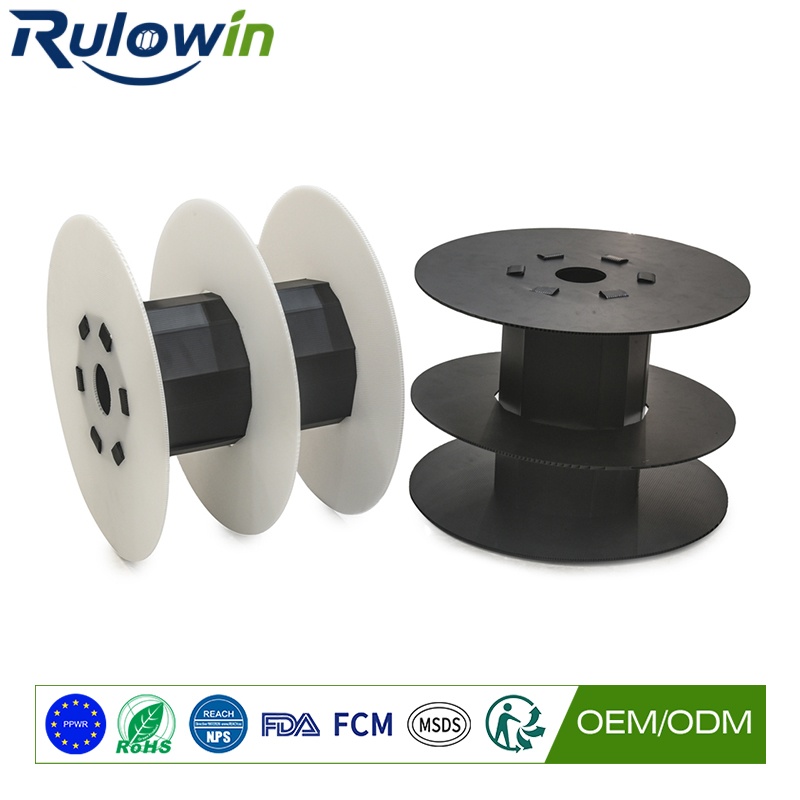
This is not our strongest application, and it is worth being direct about it. Hollow board flanges can be made smooth and square, and for narrow web at moderate width they work. But:
- Wide web needs a core longer than our typical constructions comfortably deliver
- The tolerance requirements tend towards moulded rather than fabricated — see the honest discussion in our construction comparison
- Many converting applications need cores of a specific standard size that the converting industry expects
If you are running narrow slit material, our hollow board spools may suit and we will tell you the squareness we can realistically hold. If you are running full-width converting rolls, that is a different product and we would point you somewhere else.