
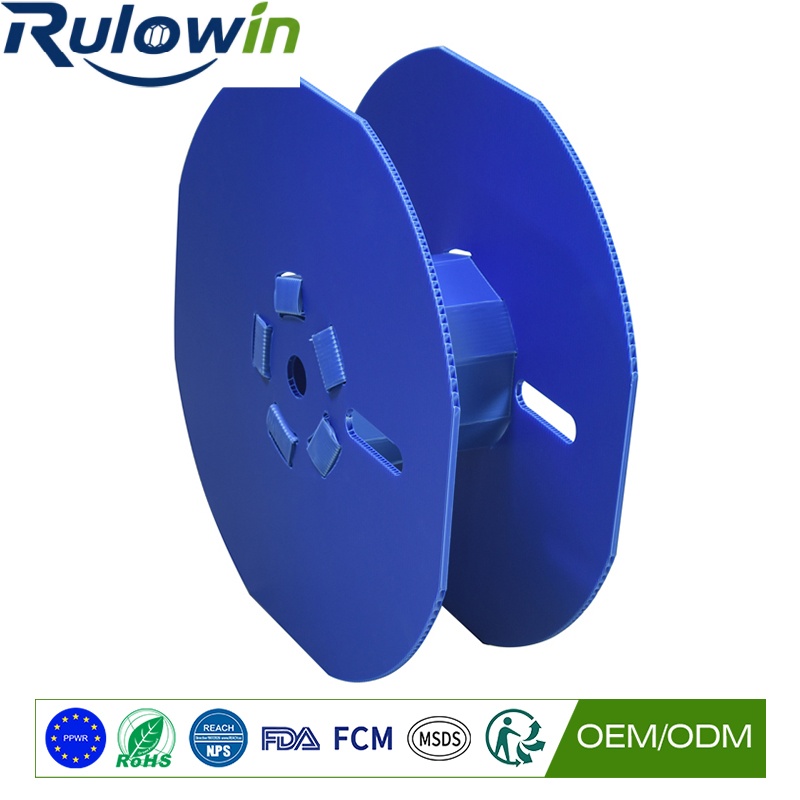
Ask somebody to picture a spool flange and they will draw a flat disc. It is the default, it is easy to make, and for a lot of applications it is genuinely fine. But the flange is the part carrying the hoop load from the wound product, and its shape across the radius is one of the few levers available for dealing with that load without adding material.
What the load does to a flat flange
A wound pack presses outward against the core and pulls the flange outward at the rim. A flat flange resists that entirely through the stiffness of the board itself — which is exactly the problem described in more detail in our piece on flange ribbing. Under enough load, a flat flange bows. The bow is small, usually, but it takes the rim away from the product, and once the rim has moved there is a gap for outer turns to migrate into.
So the question a different profile answers is: can geometry do some of this work instead of thickness?
Dished or shallow conical
A dished flange is formed with a slight cone — the rim sits a few millimetres out of the plane of the hub. It behaves like a very shallow dish spring: the same geometry that would resist pressure from outside now pre-loads in the opposite direction to the deflection the winding load creates.
The amounts involved are small. Two or three millimetres of dish over a 400 mm flange is typical. It does not transform the spool, and anybody who tells you it does is overselling. What it does is move the point at which measurable bow begins, and it costs nothing in material.
The trade-offs are real though:
- Stacking changes. Dished flanges nest into each other more deeply. Sometimes that is a benefit in return freight, sometimes it makes a stack unstable or taller than expected. Worth checking before you assume.
- Printing and labelling is harder. A flat face takes a print or a label cleanly; a curved one does not.
- The flange face touches the product differently. If your product is sensitive to edge marking, a curved face changes the contact line in ways you should test rather than predict.
Tapered thickness
The other approach is to vary the board thickness rather than the plane. Thicker towards the hub where the bending moment is highest, thinning towards the rim where the material is doing less. It is efficient — you put material where it works — but on hollow board construction it usually means a bonded second layer rather than a moulded taper, and that introduces a joint and a process step.
We tend to suggest it only where the spool is large and the duty is genuinely heavy, because elsewhere the added complexity is not worth it.
Tapered in the other direction
Thickening towards the rim is less common but has a use: it stiffens the rim against impact and against the localised load you get when a stack rests on the edge. If your spools get knocked about or stacked rim-to-ground, that is where the damage concentrates and where extra material actually helps.
When flat is right
Most of the time, honestly. If the flange is adequately specified in the first place, there is no load problem to solve with geometry, and flat is cheaper, easier to print, easier to stack predictably, and easier to repair. Profile changes are a fix for a spool that is marginal — and if a spool is marginal, adding thickness may be simpler and more predictable than redesigning the profile.
The case where we would push profile rather than thickness is a weight-constrained application where you cannot afford more material but stiffness is short. That combination does come up, particularly where return freight dominates the cost model.
How to tell whether yours is marginal
Measure it. With the spool empty, note the position of the rim relative to a straight edge across the hub. Wind it to full specified load, leave it a day, and measure again. You are looking for movement that does not recover when the load comes off.
If the flange recovers completely, it is coping. If there is residual set, the duty is beyond what the current construction handles and either profile or thickness needs to change. That is a half-hour test and it tells you far more than a specification comparison.
Our PP hollow board cable spools are built with profile as one of the variables we can set, and we will normally ask what is driving the requirement before recommending one. If nothing is, flat is the answer.