
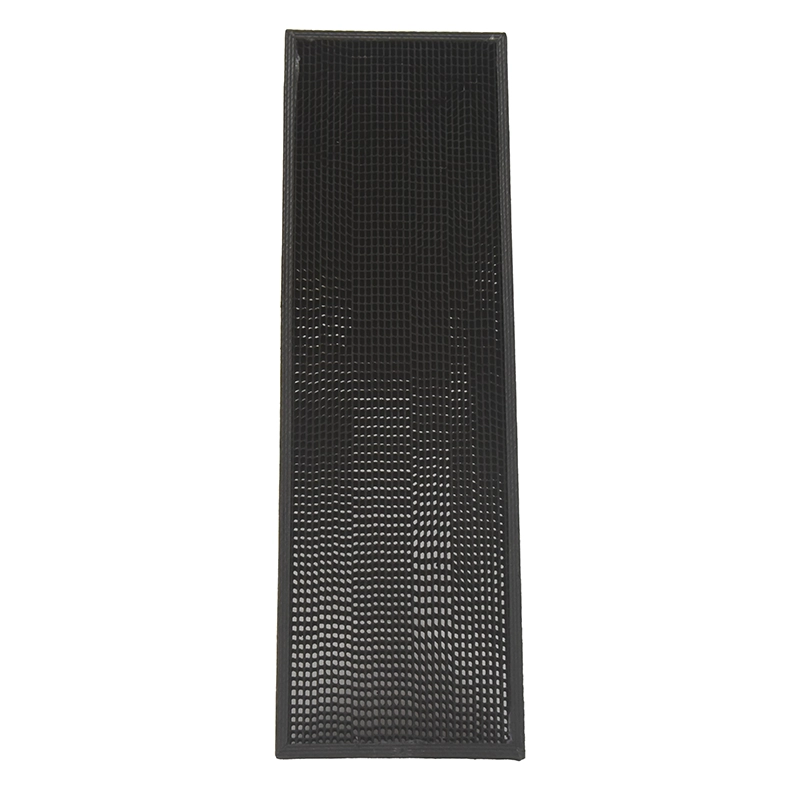
Two terms dominate filter specification and they are used loosely enough to cause real purchasing mistakes. They are related, but they are not the same thing, and one of them is what your equipment actually experiences.
Open area
The fraction of the filter face that is open to air, usually stated as a percentage. It is a geometric property of the screen – you can work it out from the cell size and wall thickness, and it does not change with airflow.
Higher open area means less resistance and, generally, slightly less capture of the finest fraction. For a pre-filter that trade is nearly always worth making, because the fine stage behind it is doing the fine work. We made that point in best pre-filter for a dusty workshop intake.
Pressure drop
The resistance the filter actually presents, measured as a pressure difference across it at a stated airflow. This is what your fan experiences, and it is the number that determines whether adding a filter costs you air changes.
Pressure drop depends on open area, on the filter’s depth, on the airflow, and on how loaded the filter is. So it is not a fixed property of the product – it is a condition, and any figure quoted without an airflow and a loading state is meaningless.
Ask for pressure drop at your airflow, clean, and ask what it rises to before the filter needs attention. The second number is the one that determines your maintenance interval.
Why the confusion costs money
Someone specifies by open area because it is on the data sheet, and buys a screen that is geometrically open but too shallow for their airflow. The face velocity is too high, the pressure drop is higher than expected, and the fan delivers less air than before the filter was fitted.
The fix is usually more face area, not a different screen – a pleated or angled arrangement that increases the area the air passes through. That is a mounting decision rather than a filter decision, and it is much cheaper to get right at design stage.
One more term worth knowing
Face velocity – the speed the air is moving as it arrives at the filter face. Too high and the filter loads unevenly and its pressure drop climbs fast; too low and you have bought more filter than you need. It is the number that ties airflow to face area, and it is worth asking your supplier what range they designed for.
Loading, and the number that sets your interval
A filter’s pressure drop is low when clean and rises as it loads. The interval between cleans is set by how much rise your system can tolerate, not by a fixed schedule – which is why calendar-based filter maintenance is wrong in both directions.
Ask what the pressure drop is clean and what it is at the point the supplier recommends cleaning. Those two numbers let you set a differential that triggers maintenance, and a differential is a much better signal than a date.
Most systems can be fitted with a simple differential gauge. It costs little and it ends the argument about whether the filter is due.
What we can do
We supply reusable PP honeycomb filter media specified by open area and by pressure drop at your airflow. Tell us the face size, the airflow and what the dust is, and we will give you both numbers – including telling you when you need more face area rather than a better screen.