
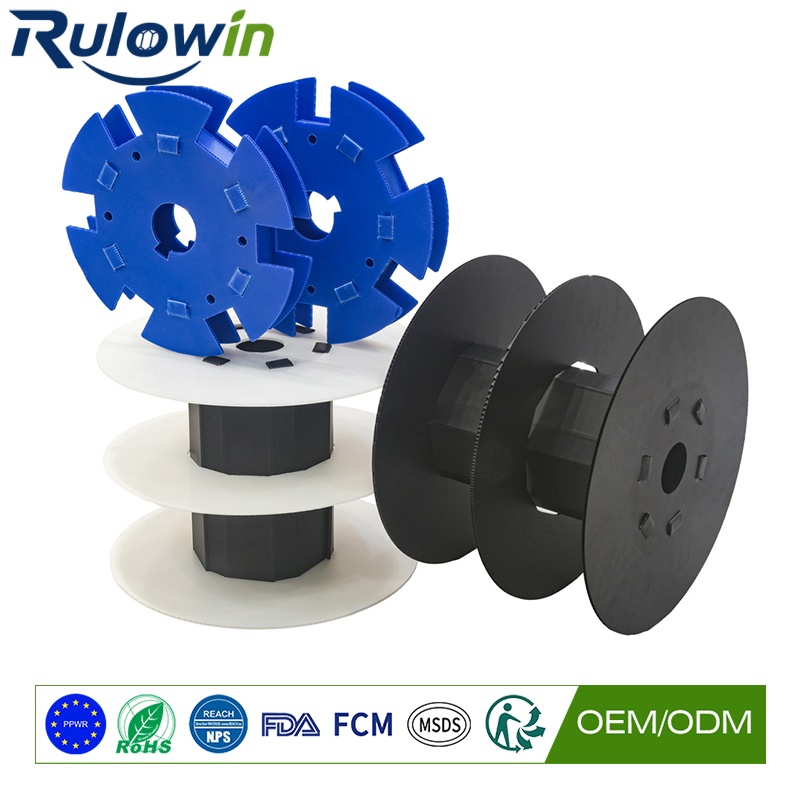
Cordage — twine, natural fibre rope, general-purpose synthetic cordage — sits at the low-value end of what gets spooled, and gets correspondingly little attention. It still has requirements, and they are not quite what people assume.
The economics are inverted
Compared with most of this series, cordage is worth little per kilogram. That pushes hard against expensive reusable packaging, and most of the time it wins: commodity cordage usually ships on disposable spools and that is the right answer.
Reusable only tends to make sense where:
- The loop is short and dense
- The cordage is higher-value — specialised marine or technical cordage
- There is a weight or bulk reason to recover rather than discard
- A customer is contractually running a returnable programme across all purchases
Our reverse loop article covers the arithmetic; for cordage it rarely comes out positive unless one of those applies.
Set is the main product problem
Fibre rope takes a bend set readily, and unlike anything discussed so far it is often sold on the basis of handling characteristics that set destroys. This is the same mechanism covered in our general piece on product curl, but here the complaint usually comes from whoever uses the rope rather than from the machinery.
Larger core, lower tension, shorter storage. In that order.
Contamination matters more than you would think
Cordage picks up whatever it touches, and once contaminated:
- It carries it into whatever it is used for
- It is difficult to clean
- On reusable spools it contaminates the next product too
The more particular version of this is discussed in our article on cleaning between runs. Natural fibre cordage in particular sheds dust that gets into everything, including the bore.
Identification is genuinely hard
Most cordage looks identical. Diameter, construction and material all give rope that looks the same from two metres away, and the consequences of a mix-up can be significant in applications where strength matters.
Colour coding is the practical answer and it earns its place here — see our article on colour coding. Written identification on reusable spools tends to be less reliable in this environment because cordage sheds dust that obscures whatever is written.
What damages it during storage
- Moisture promotes rot in natural fibre, which is worse than anything in this series elsewhere
- UV degrades most synthetic cordage
- Compression flattens it and makes it feel wrong even when it is structurally fine
- Heat accelerates all of the above
Spool requirements, briefly
- Smooth surfaces throughout — cordage frays against anything rough
- Large core relative to the minimum, for set reasons
- Nothing to snag on, since loose ends are common
- Drainage if stored outdoors — the same considerations as our drain holes article
- Durable colour coding rather than printed identification
Where we would point you
For commodity cordage on a short loop, our hollow board spools can work well and they survive outdoor yards better than most alternatives. For anything long-distance or anything where the return economics are marginal, we would not push a reusable programme — cordage rarely justifies it, and saying so is cheaper for everyone than discovering it after the order.
Winding behaviour worth knowing
Cordage is springy in a way wire is not. Released tension makes it relax, and if the wind does not account for that the pack slackens on the core — which then allows exactly the turn migration described generally in our piece on traverse behaviour. With cordage the effect is stronger, because there is more stored energy in each wrap than most people expect.
The practical consequence is that a pack that feels firm off the machine can be noticeably looser a day later. If it then gets moved before anyone notices, the loose turns shift and the reel arrives with a tangle that looks like a transit problem.
What to check on returned reels
- Core surface still smooth — cordage frays against anything rough, and this is the first thing to degrade
- No residual dust or debris from the previous product, particularly in the bore
- Colour coding still legible, since that is doing the identification work
- No trapped moisture if reels have been stored outdoors — see the drainage discussion in our article on drain holes
That list takes under a minute per reel and prevents most of the complaints we hear about cordage spooling.